

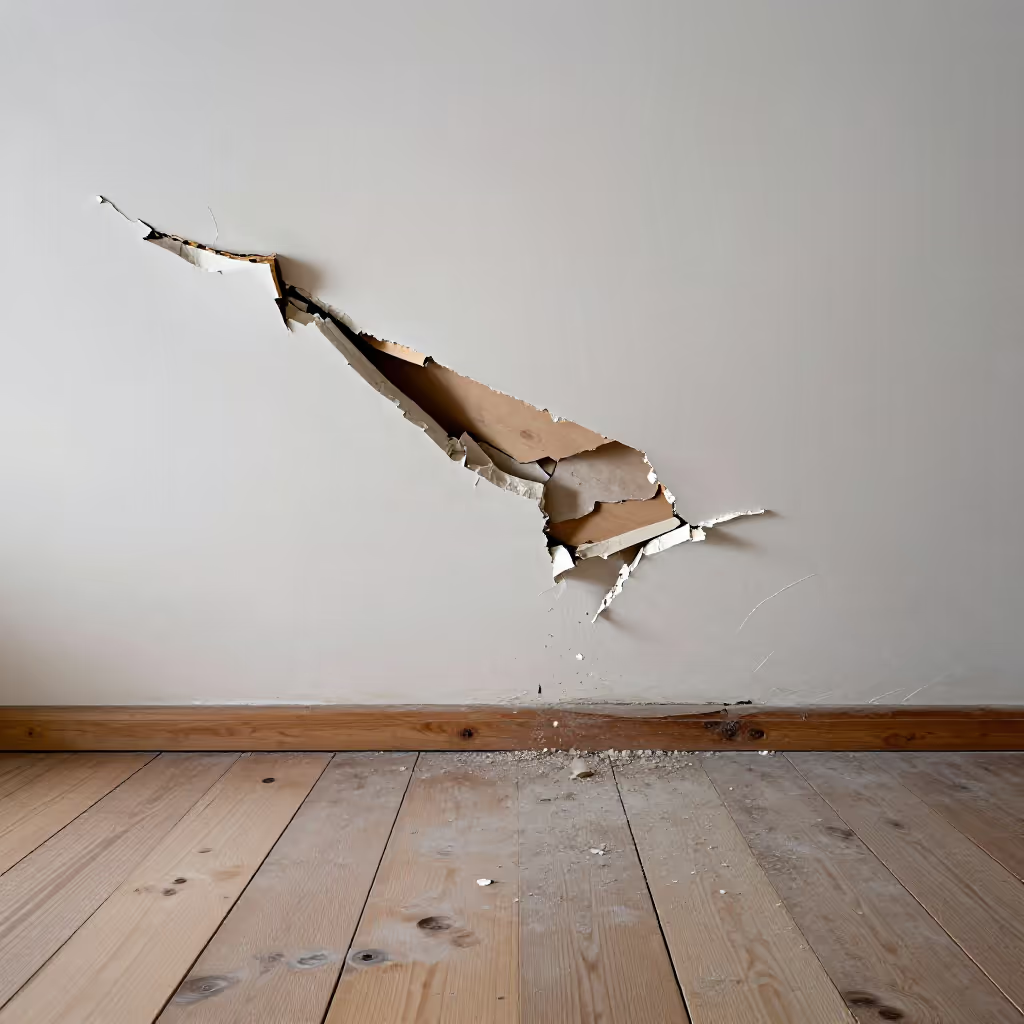
abfallen
to fall off
To detach from something and fall down, as with leaves, fruit, or plaster.
EXAMPLE
Nach dem Sturm sind viele Äpfel vom Baum abgefallen.
After the storm, many apples fell off the tree.
to fall off / decline
Loading your saved state.
to fall off
To detach from something and fall down, as with leaves, fruit, or plaster.
Nach dem Sturm sind viele Äpfel vom Baum abgefallen.
After the storm, many apples fell off the tree.

to slope down
To have a downward incline; to be sloping.
Das Gelände fällt hier sanft zum See hin ab.
The terrain slopes gently down toward the lake here.

to decline
To decrease or become worse in performance, quality, or intensity.
Nach einem starken Start ist seine Leistung in der zweiten Halbzeit deutlich abgefallen.
After a strong start, his performance declined noticeably in the second half.

to turn away from
To distance oneself from or turn away from a person, group, or belief.
Nach dem Skandal sind viele seiner früheren Unterstützer von ihm abgefallen.
After the scandal, many of his former supporters turned away from him.

to be left over
To remain as waste or a by-product during a process.
Beim Zuschneiden des Holzes fallen immer Späne ab.
When cutting the wood, shavings are always left over.
'Abfallen' is a separable verb. In a main clause, the prefix 'ab' stands at the end. In subordinate clauses and in the infinitive with 'zu', the verb stays together.
Im Herbst fallen die Blätter von den Bäumen ab.
In autumn, the leaves fall off the trees.
The verb consists of the prefix 'ab-' (away, down) and the verb 'fallen' (to fall). The literal meaning 'herunterfallen' (to fall down) is the basis for all the other, often figurative meanings.
Vorsicht, der Putz von der Decke fällt ab!
Careful, the plaster is falling off the ceiling!
Since 'abfallen' describes a movement or a change of state, the perfect tense is always formed with the auxiliary verb 'sein' (to be).
Die Temperatur ist über Nacht stark abgefallen.
The temperature fell sharply overnight.
In the meaning 'abschüssig sein' (to be sloping), a direction is often given, for example with 'zu' (to), 'nach' (toward), or 'hin' (toward/down).
Die Küste fällt hier steil zum Meer hin ab.
The coast slopes steeply down toward the sea here.
This figurative meaning is used for abstract things. While physical objects (leaves, fruit) 'abfallen' (fall off, meaning 1), abstract values (performance, quality, fever) 'abfallen' (decline).
Die Qualität der Produkte ist in den letzten Jahren abgefallen.
The quality of the products has declined in recent years.
In the meaning 'sich abwenden' (to turn away), 'abfallen' is always used with the preposition 'von' and the dative.
Er ist von seinem Glauben abgefallen.
He has turned away from his faith.
In this meaning, it is often used colloquially to ask whether a part of something is left over for someone, e.g., a piece of cake or a small profit.
Wenn du einen großen Auftrag bekommst, fällt für mich dann auch etwas ab?
If you get a big contract, will there be something left over for me too?
to lose weight / decrease / take off
Abnehmen describes a quantitative reduction in strength or intensity. Abfallen emphasizes that performance or quality declines from a higher level. For a mere decrease in a measured value, abnehmen is the better choice; for a noticeable deterioration, abfallen is more appropriate.

Nach mehreren Betriebsstunden fällt die Leistung der Maschine deutlich ab.
After several hours of operation, the machine’s performance declines significantly.
Die Leistung der Maschine nimmt bei geringer Stromzufuhr messbar ab.
The machine’s performance decreases measurably when the power supply is low.