

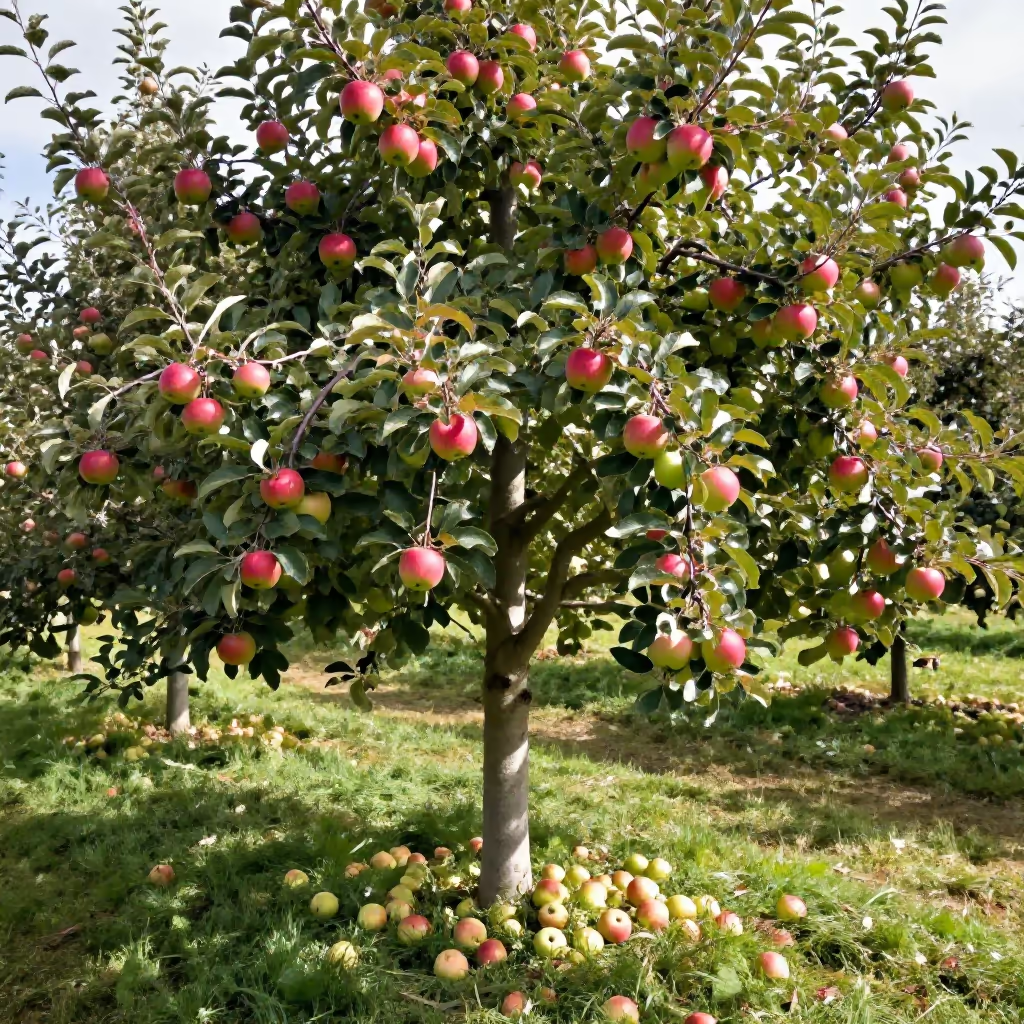
der Apfelbaum
apple tree
A fruit tree from the pome fruit family that bears apples as its fruit.
EXAMPLE
Im Herbst ernten wir die Äpfel von unserem Apfelbaum im Garten.
In autumn, we harvest the apples from our apple tree in the garden.
apple tree
der Apfelbaum, die Apfelbäume
Loading your saved state.
apple tree
A fruit tree from the pome fruit family that bears apples as its fruit.
Im Herbst ernten wir die Äpfel von unserem Apfelbaum im Garten.
In autumn, we harvest the apples from our apple tree in the garden.
| gender | masculine der |
|---|---|
| plural | die Apfelbäume |
| genitive | des Apfelbaums |
| singular | plural | |
|---|---|---|
| nominative | der Apfelbaum | die Apfelbäume |
| accusative | den Apfelbaum | die Apfelbäume |
| dative | dem Apfelbaum | den Apfelbäumen |
| genitive | des Apfelbaums des Apfelbaumes | der Apfelbäume |
The article changes with the case; it is shown in colour.
This word is a clear example of a German compound word: It consists of 'der Apfel' (apple) and 'der Baum' (tree). So the meaning is literally 'a tree for apples'.
Wir haben einen alten Apfelbaum im Garten.
We have an old apple tree in the garden.
The pattern '[fruit] + Baum' ([fruit] + tree) is very productive in German. The article of the compound word is always determined by the last part, so 'der Baum' (the tree).
Ein Kirschbaum, ein Birnbaum und ein Apfelbaum stehen nebeneinander auf der Wiese.
A cherry tree, a pear tree, and an apple tree stand next to each other in the meadow.
In connection with an apple tree, verbs are often used that describe its yearly cycle: In spring it 'blüht' (blooms), in summer it 'trägt' (bears) fruit, and in autumn one 'erntet' (harvests) from it.
Der Apfelbaum blüht dieses Jahr besonders schön.
The apple tree is blooming especially beautifully this year.
Dieser junge Baum trägt noch keine Äpfel.
This young tree does not bear any apples yet.