

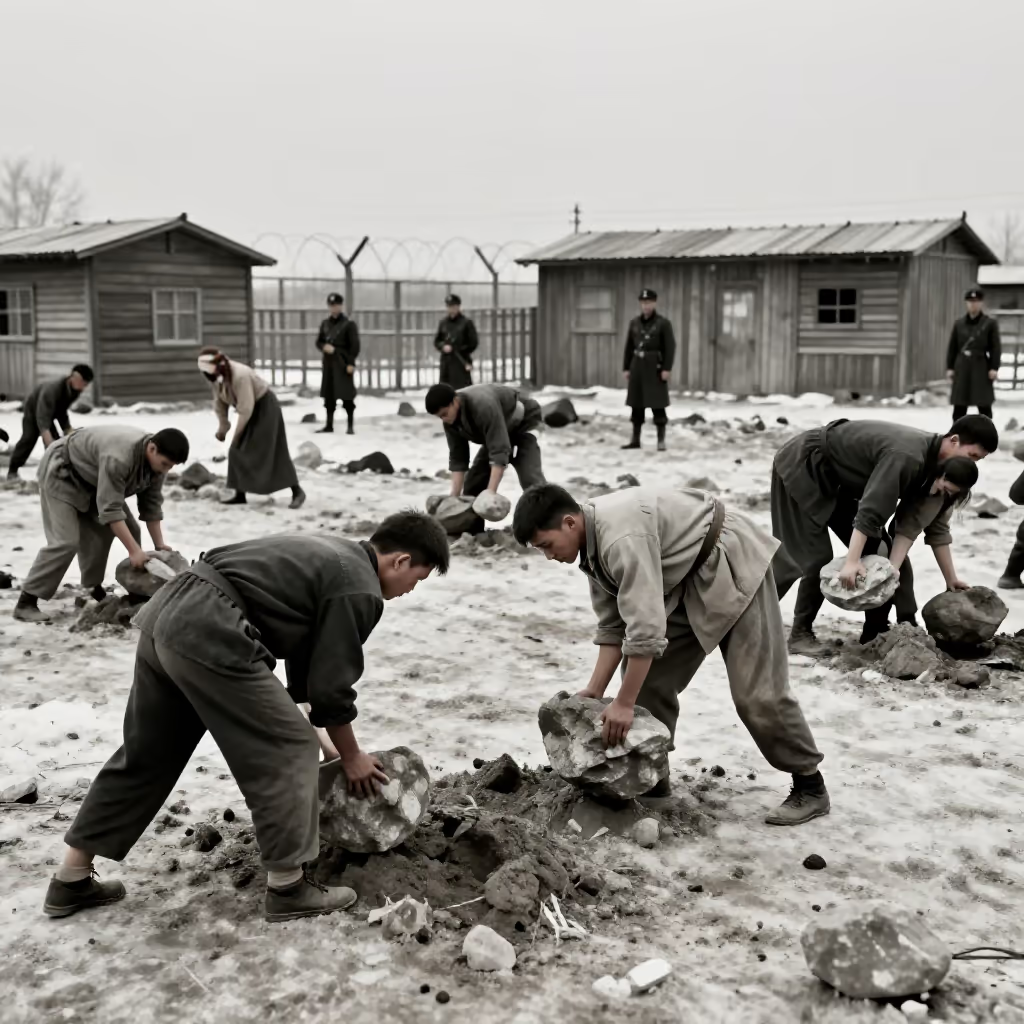
A camp in which prisoners (e.g., political prisoners or prisoners of war) are forced to do hard physical labor. The term is strongly associated with totalitarian regimes of the 20th century.
example
Der Schriftsteller Alexander Solschenizyn beschrieb das Leben in den sowjetischen Arbeitslagern.
The writer Alexander Solzhenitsyn described life in the Soviet labor camps.
Usage tips
Compound structure
The word is made up of 'Arbeit' (work) and 'Lager' (camp). So it literally describes a camp where work is done. However, its actual meaning is strongly negatively shaped by history.
EXAMPLE
Das Rote Kreuz versuchte, die Bedingungen in den Lagern zu verbessern.
The Red Cross tried to improve conditions in the camps.
Historical context
This word has a very strong, negative historical meaning. It is inseparably connected with the crimes of totalitarian regimes such as National Socialism or the Soviet Gulag system and is used almost exclusively in this context.
EXAMPLE
Viele politische Gegner des Regimes wurden in Arbeitslager verschleppt.
Many political opponents of the regime were deported to labor camps.
Preposition 'in'
The preposition 'in' is used with either the accusative or dative depending on the context. Movement into a camp is expressed with the accusative ('in ein Arbeitslager bringen' — to take someone to a labor camp), while being there is expressed with the dative ('in einem Arbeitslager sein' — to be in a labor camp).
EXAMPLE
Die Gefangenen wurden in ein Arbeitslager gebracht.
The prisoners were taken to a labor camp.
Compare with
near_synonym · confusable
Arbeitslager vs Lager
warehouse / camp
'das Lager' and 'das Arbeitslager' can both mean a place where people are held against their will. However, 'Arbeitslager' is more specific and stronger: there, prisoners are forced to do hard labor. 'Lager' by itself can have many meanings and is therefore not clear without context. Learners may confuse the words because an Arbeitslager is a special kind of Lager. If the topic is forced labor, 'Arbeitslager' is more precise; if the exact type is not important or not known, 'Lager' can fit.
Arbeitslager
Viele Gefangene mussten im Arbeitslager unter sehr harten Bedingungen arbeiten.
Many prisoners had to work in the labor camp under very harsh conditions.
Lager
Im Geschichtsunterricht sprechen wir über Menschen, die in einem Lager gefangen waren.
In history class, we talk about people who were imprisoned in a camp.