01
arm
poor
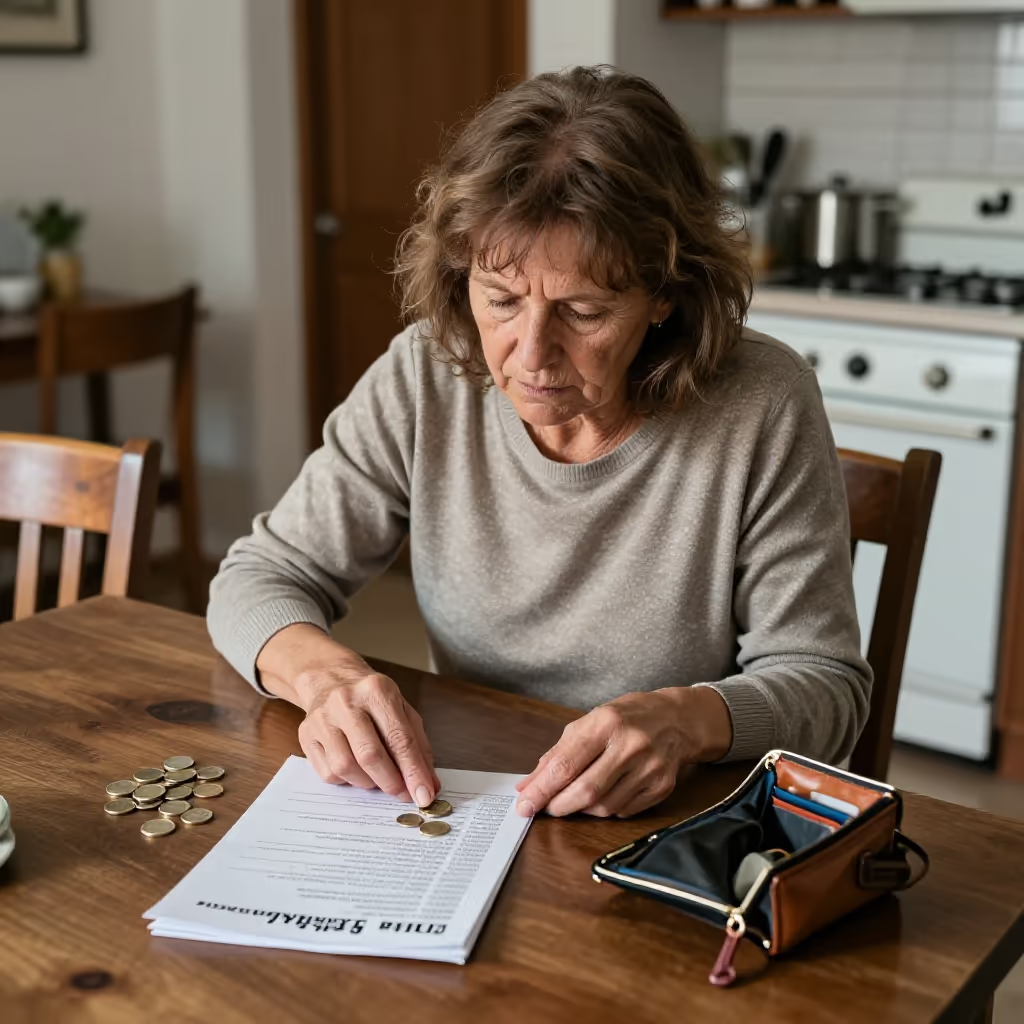
Having little or no money, property, or means; not rich.
example
Er wuchs in einer armen Familie mit vielen Geschwistern auf.
He grew up in a poor family with many siblings.
poor
Loading your saved state.
poor
Having little or no money, property, or means; not rich.
Er wuchs in einer armen Familie mit vielen Geschwistern auf.
He grew up in a poor family with many siblings.
To express that something contains little of a certain substance, you use the fixed structure 'arm an' (low in) followed by the dative. This construction is especially common when describing foods.
Die Wüste ist eine an Wasser arme Region.
The desert is a region poor in water.
When 'arm' (poor) expresses pity, it often stands directly before the noun with a definite article (der/die/das). It then means 'pitiful' and does not necessarily mean that someone has no money.
Der arme Kerl hat seinen Zug verpasst.
The poor guy missed his train.
The word 'arm' (poor/low in) is often used as the second part of compound adjectives to express 'having little of something.' Typical examples are 'fettarm' (low-fat), 'kalorienarm' (low-calorie), and 'risikoarm' (low-risk).
Ich kaufe immer fettarme Milch.
I always buy low-fat milk.
rich
'reich' and 'arm' are direct opposites when it comes to money, possessions, or means. A rich person has a lot; a poor person has little or almost nothing. Both words can also be used with 'an': then it is not about money, but about the amount of something. A country can be 'reich an Wasser' (rich in water) or 'arm an Rohstoffen' (low in raw materials), for example. The important point is: 'arm' can also express sympathy, but in this contrast it is mainly about having few possessions or little of something.

Viele Menschen in der Region sind arm und brauchen Unterstützung.
Many people in the region are poor and need support.
Die Familie ist reich und besitzt mehrere Häuser am See.
The family is rich and owns several houses by the lake.