

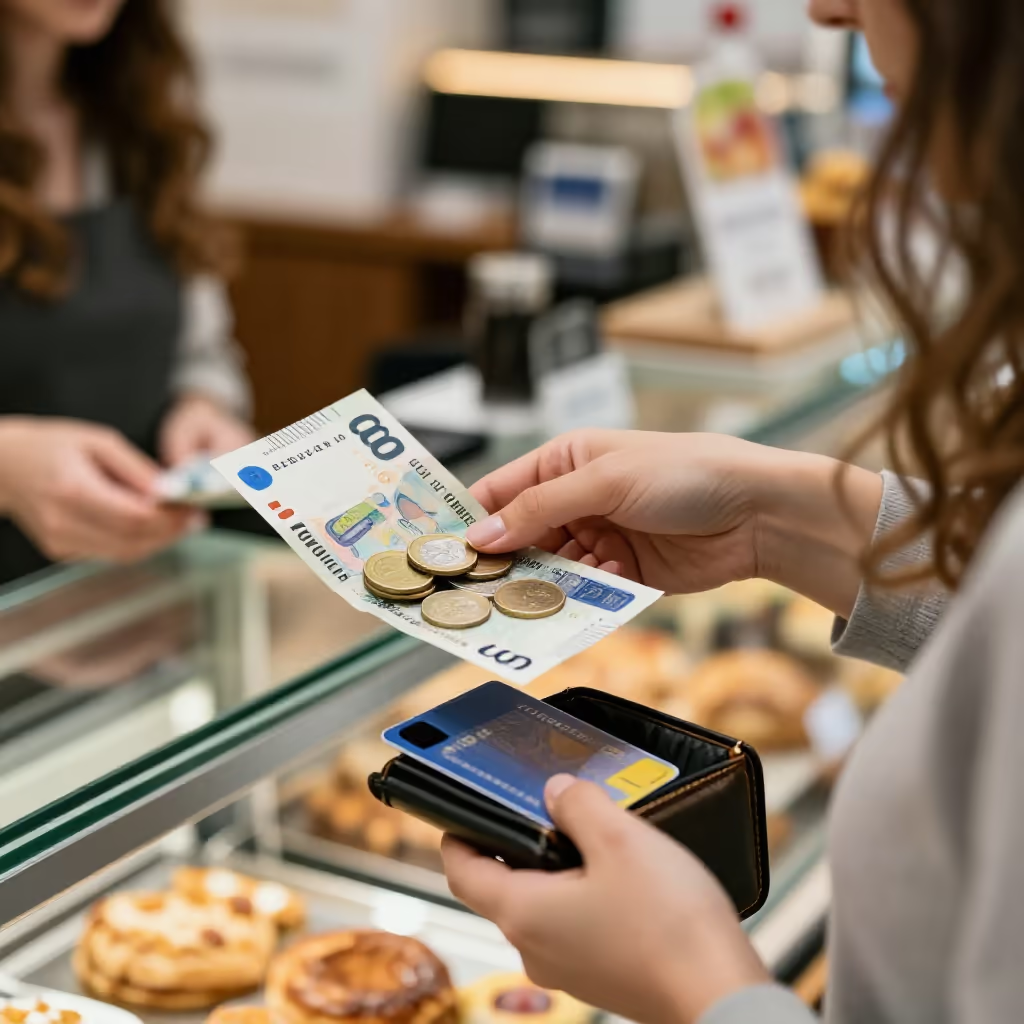
das Bargeld
cash
Money in physical form, meaning coins and banknotes, as opposed to electronic money such as when paying by card.
Ich habe nicht genug Bargeld dabei, kann ich mit Karte zahlen?
I don't have enough cash with me; can I pay by card?

cash
Loading your saved state.
cash
Money in physical form, meaning coins and banknotes, as opposed to electronic money such as when paying by card.
Ich habe nicht genug Bargeld dabei, kann ich mit Karte zahlen?
I don't have enough cash with me; can I pay by card?

'Bargeld' (cash) is a compound word made from 'bar' (cash/in cash) and 'Geld' (money). The adjective 'bar' in this context means 'in the form of coins and notes,' so not electronically.
Auf dem Flohmarkt kann man meistens nur bar bezahlen.
At the flea market, you can usually only pay in cash.
'Bargeld' (cash) is an uncountable noun. It is almost always used in the singular and often without an article, similar to 'Wasser' (water) or 'Luft' (air).
Haben Sie Bargeld oder zahlen Sie mit Karte?
Do you have cash, or are you paying by card?
Common verbs used with 'Bargeld' (cash) are 'abheben' (to withdraw, at an ATM), 'dabeihaben' (to have with you), 'wechseln' (to exchange, into another currency), and 'annehmen' (to accept, as a means of payment).
Ich muss noch schnell Bargeld am Automaten abheben.
I still need to quickly withdraw cash from the ATM.
money
'das Geld' and 'das Bargeld' both refer to a means of payment. 'Geld' is the general term and can also mean money in a bank account or a card payment. 'Bargeld' is more specific: it means only coins and bills that you actually have with you. The words can be confused because cash is a form of money. If it does not matter whether you pay in cash or by card, you say 'Geld'. If you specifically mean coins and bills, 'Bargeld' is correct.

Auf dem Wochenmarkt bezahlt Anna meistens mit Bargeld.
At the weekly market, Anna usually pays with cash.
Sie braucht Geld, weil sie noch ein Zugticket kaufen muss.
She needs money because she still has to buy a train ticket.