


bedingungslos
unconditional
Describes something that happens or is given without conditions, restrictions, or reservations.
EXAMPLE
Die Liebe einer Mutter zu ihrem Kind ist oft bedingungslos.
A mother's love for her child is often unconditional.
unconditional
Loading your saved state.
unconditional
Describes something that happens or is given without conditions, restrictions, or reservations.
Die Liebe einer Mutter zu ihrem Kind ist oft bedingungslos.
A mother's love for her child is often unconditional.
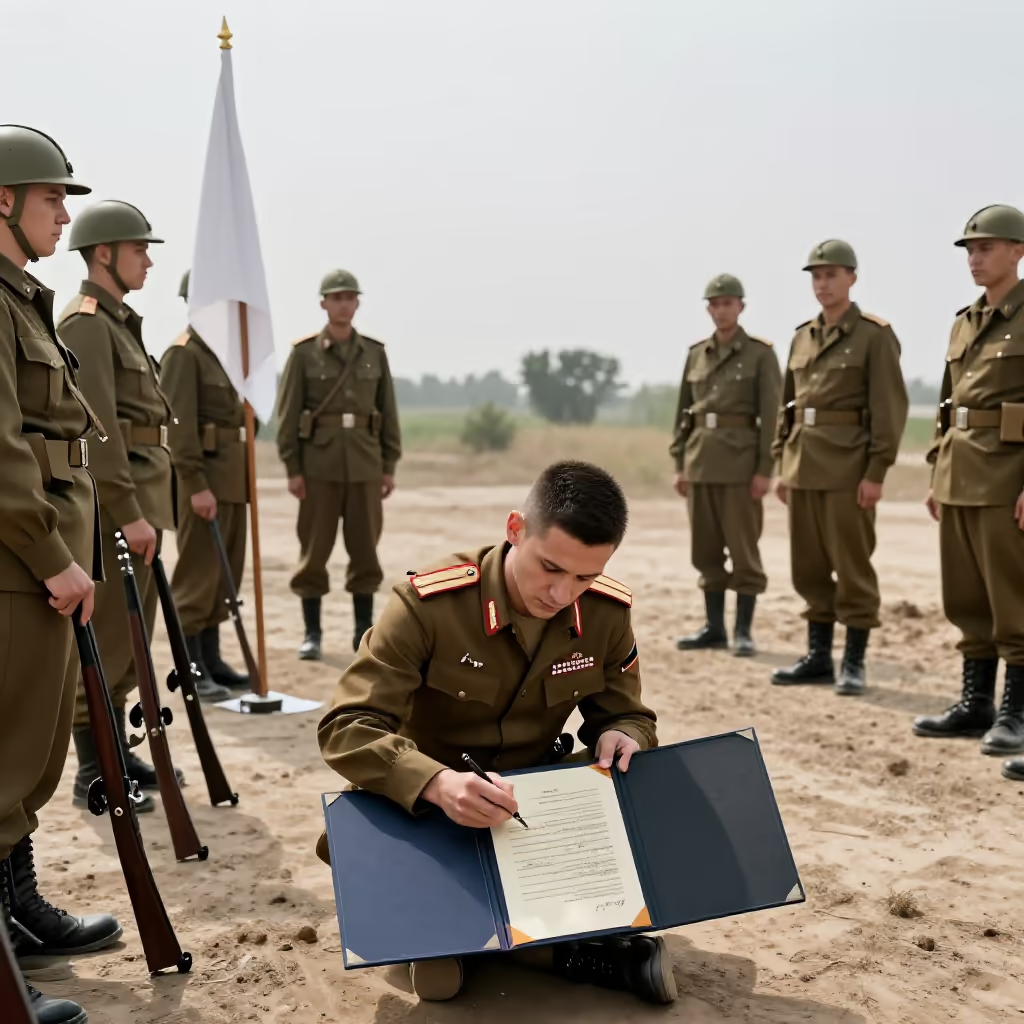
unconditional
Refers to a complete and unrestricted surrender or submission in which the defeated party cannot set any conditions.
Am Ende des Krieges forderten die Alliierten die bedingungslose Kapitulation Deutschlands.
At the end of the war, the Allies demanded Germany's unconditional surrender.
The word is logically built: it consists of 'die Bedingung' (condition), the linking -s, and the suffix '-los' (-less), which means 'without'. 'Bedingungslos' (unconditional) therefore literally means 'without conditions'.
Er bot ihr seine bedingungslose Hilfe an.
He offered her his unconditional help.
'Bedingungslos' (unconditional/unconditionally) can stand before a noun as an adjective or describe a verb as an adverb. As an adverb, it remains unchanged and describes the manner of an action.
Sie genoss seine bedingungslose Unterstützung.
She enjoyed his unconditional support.
In the general meaning, 'bedingungslos' (unconditional) is often connected with positive, emotional nouns. Typical examples are 'bedingungslose Liebe' (unconditional love), 'bedingungsloses Vertrauen' (unconditional trust), and 'bedingungslose Loyalität' (unconditional loyalty).
Ein Hund schenkt seinem Besitzer oft bedingungslose Zuneigung.
A dog often gives its owner unconditional affection.
The phrase 'bedingungslose Kapitulation' (unconditional surrender) is a fixed term that is usually used in historical, political, or military contexts and describes complete submission.
Die Armee musste die bedingungslose Kapitulation akzeptieren.
The army had to accept unconditional surrender.
definitely / unconditional
In an emphatic promise, unbedingt can mean that the support is definitely going to be provided. Bedingungslos more precisely says that the support is not tied to any conditions, restrictions, or reservations.

Ich werde dich bei deinem neuen Projekt bedingungslos unterstützen.
I will support you with your new project unconditionally.
Ich will dich bei deinem neuen Projekt unbedingt unterstützen.
I definitely want to support you with your new project.