

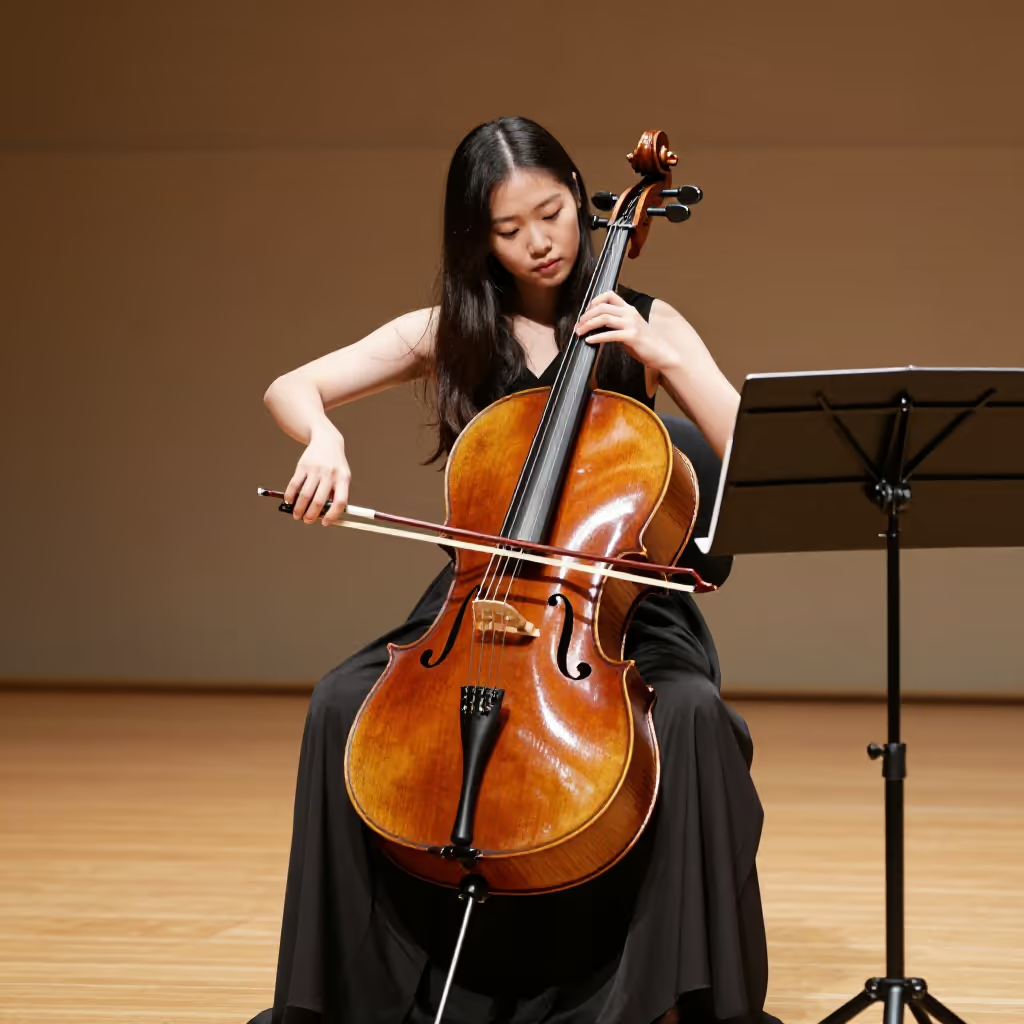
das Cello
cello
A large string instrument from the violin family that is held between the knees when played. The official term is violoncello.
Sie spielt seit ihrer Kindheit Cello im Orchester.
She has played cello in the orchestra since childhood.
cello
das Cello, die Celli
Loading your saved state.

cello
A large string instrument from the violin family that is held between the knees when played. The official term is violoncello.
Sie spielt seit ihrer Kindheit Cello im Orchester.
She has played cello in the orchestra since childhood.
| gender | neuter das |
|---|---|
| plural | die Celli |
| genitive | des Cellos |
| singular | plural | |
|---|---|---|
| nominative | das Cello | die Celli |
| accusative | das Cello | die Celli |
| dative | dem Cello | den Celli |
| genitive | des Cellos | der Celli |
The article changes with the case; it is shown in colour.
'Cello' is the common short form of the official Italian name 'Violoncello' (violoncello). In German, both terms are understood, but 'Cello' (cello) is much more common in everyday language.
Das Violoncello gehört zur Familie der Streichinstrumente.
The violoncello belongs to the family of string instruments.
When talking about making music, you use the fixed expression 'Cello spielen' (to play cello). As a rule, no article is placed before 'Cello' (cello).
Mein Bruder lernt seit zwei Jahren, Cello zu spielen.
My brother has been learning to play cello for two years.
To express which piece is being played on the instrument, you use the preposition 'auf' followed by the dative. The structure is: 'etwas auf dem Cello spielen' (to play something on the cello).
Er spielte eine Sonate von Bach auf dem Cello.
He played a sonata by Bach on the cello.