
Making something more difficult, more complicated, or worse. It describes a circumstance that negatively affects a situation.
example
Die schlechte Sicht war ein erschwerender Faktor bei der Bergung.
The poor visibility was a complicating factor during the rescue operation.
Usage tips
Word structure
'Erschwerend' (aggravating/complicating) is the present participle of the verb 'erschweren' (to make more difficult). This verb consists of the prefix 'er-' (which describes a process) and 'schwer' (difficult/heavy). So 'erschweren' means 'to make something more difficult.'
EXAMPLE
Der starke Wind erschwerte die Löscharbeiten der Feuerwehr.
The strong wind made the firefighters' extinguishing work more difficult.
Typical collocations
The adjective is often used in combination with certain nouns to describe negative influences. Typical collocations are 'ein erschwerender Umstand' (a complicating circumstance) or 'ein erschwerender Faktor' (a complicating factor).
EXAMPLE
Der Nebel war ein erschwerender Umstand für die Autofahrer.
The fog was a complicating circumstance for the drivers.
Sentence pattern
The fixed expression 'erschwerend hinzukommen' (to be an additional aggravating factor) is often used to introduce another negative point. A typical sentence pattern is: 'Erschwerend kam hinzu, dass ...' (An additional aggravating factor was that ...), followed by a subordinate clause.
EXAMPLE
Der Spieler war bereits verletzt. Erschwerend kam hinzu, dass er eine gelbe Karte erhielt.
The player was already injured. An additional aggravating factor was that he received a yellow card.
Register and context
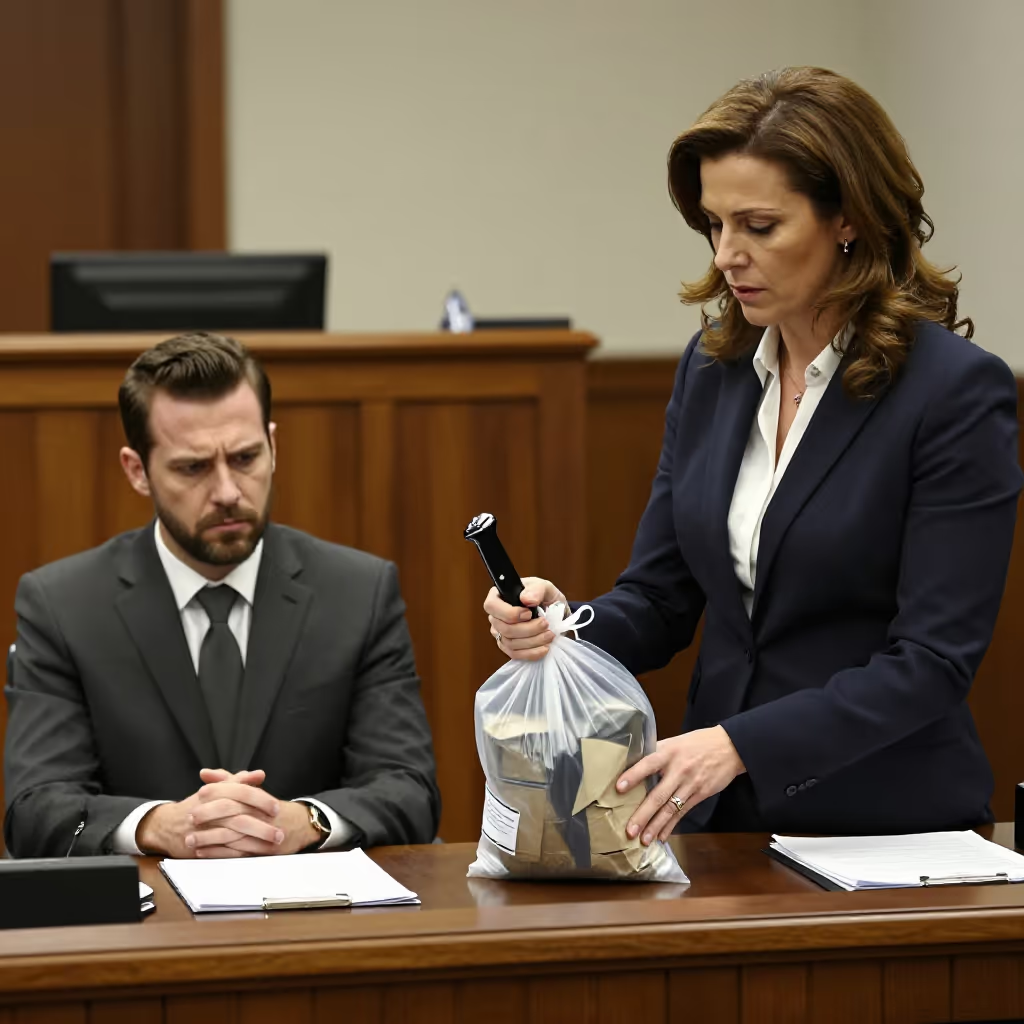
The expression 'erschwerend kommt hinzu' (an additional aggravating factor is) is used very frequently in formal, official, or legal contexts, for example in the news, reports, or in court.
EXAMPLE
Bei der Urteilsfindung kam erschwerend hinzu, dass der Angeklagte keine Reue zeigte.
In determining the sentence, an additional aggravating factor was that the defendant showed no remorse.
Compare with
near_synonym
erschwerend vs ungünstig
unfavorable / unflattering
'ungünstig' and 'erschwerend' both describe negative circumstances. 'ungünstig' is often used when something does not fit well, for example a time, the weather, or a situation. 'erschwerend' emphasizes that a particular factor makes a situation more difficult or worse. It sounds somewhat more factual and is often used with words like 'Umstand' (circumstance) or 'Faktor' (factor). In practical terms: 'ungünstig' describes the situation in general, while 'erschwerend' names the reason why something becomes more difficult.
erschwerend
Bei der Suche nach einer Wohnung kommt erschwerend hinzu, dass die Mieten stark gestiegen sind.
When looking for an apartment, a complicating factor is that rents have risen sharply.
ungünstig
Der frühe Termin beim Amt ist ungünstig, weil ich vorher arbeiten muss.
The early appointment at the government office is inconvenient because I have to work beforehand.