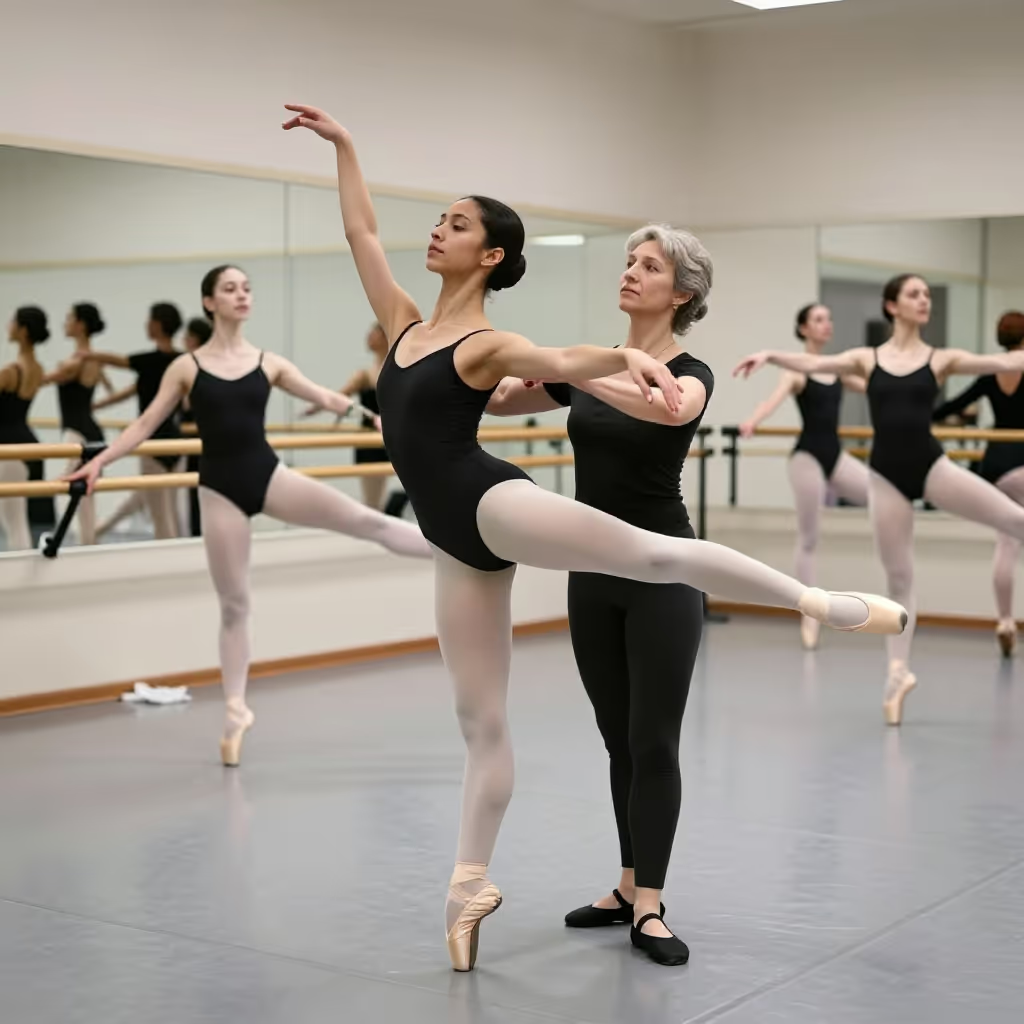
At a high or more developed level in terms of knowledge, skills, or development. It describes a state that goes beyond the basics or the beginning.
example
Dieser Sprachkurs richtet sich an fortgeschrittene Lerner auf dem Niveau C1.
This language course is aimed at advanced learners at level C1.

Usage tips
Word structure
'Fortgeschritten' (advanced) is the past participle of the verb 'fortschreiten' (to progress, to develop further). This idea of being 'further along' appears in all of its meanings.
EXAMPLE
Die Technologie ist in den letzten Jahren weit fortgeschritten.
Technology has advanced significantly in recent years.
Context clues
The context makes the meaning clear: if it is about skills or knowledge, 'hohes Niveau' (high level) is meant. If it is about time, it means 'late'. In a medical context, it describes a late stage of an illness.
EXAMPLE
Dieser Kurs ist für fortgeschrittene Programmierer gedacht.
This course is intended for advanced programmers.
Typical collocations
In the meaning 'hohes Niveau' (high level), 'fortgeschritten' (advanced) often appears with nouns that describe a skill or field of knowledge, e.g. 'fortgeschrittene Kenntnisse' (advanced knowledge), 'fortgeschrittene Technik' (advanced technology), or 'fortgeschrittener Kurs' (advanced course).
EXAMPLE
Für diesen Job benötigen Sie fortgeschrittene Englischkenntnisse.
For this job, you need advanced English skills.
Typical collocations
When it is about time, 'fortgeschritten' (late/advanced) is often combined with 'Stunde' (hour) or 'Alter' (age).
EXAMPLE
Auch in fortgeschrittenem Alter lernt er noch gerne neue Dinge.
Even at an advanced age, he still enjoys learning new things.
Fixed expression
In a medical context, the fixed expression 'in einem fortgeschrittenen Stadium' (at an advanced stage) is often used to describe the seriousness of an illness.
EXAMPLE
Der Krebs wurde in einem fortgeschrittenen Stadium diagnostiziert.
The cancer was diagnosed at an advanced stage.
Compare with
near_synonym
fortgeschritten vs spät
late
'spät' and 'fortgeschritten' can both express that a period of time is already far along. 'spät' is the normal everyday word for times, times of day, or stages of life. 'fortgeschritten' sounds somewhat more elevated and describes more of a state: the night, age, or time is already far progressed. People often say 'zu später Stunde' (at a late hour), but 'in fortgeschrittener Nacht' (late at night) or 'im fortgeschrittenen Alter' (at an advanced age). For simple everyday situations, 'spät' is usually more natural.
fortgeschritten
Nach dem Gespräch merkt meine Kollegin, dass die Zeit schon fortgeschritten ist.
After the conversation, my colleague realizes that it has already gotten late.