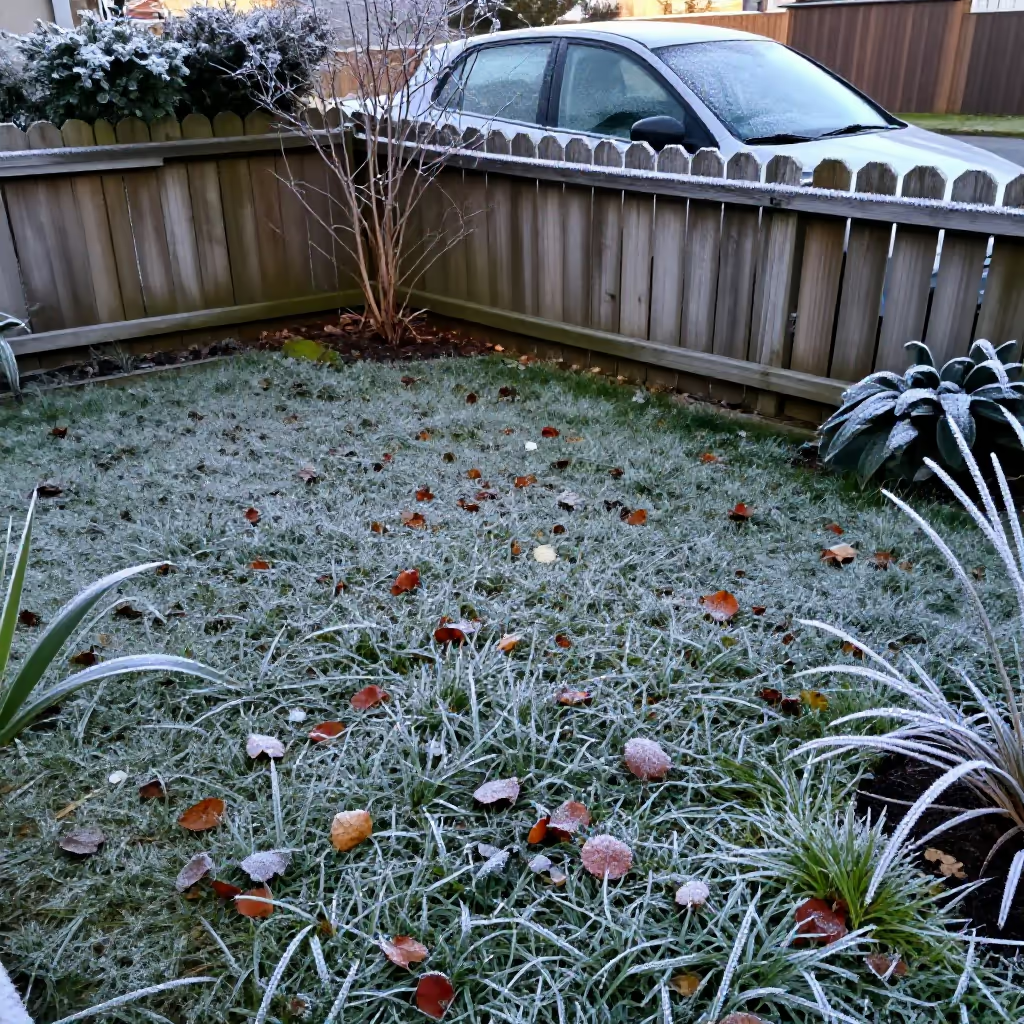
A weather condition in which the temperature drops below the freezing point of water (0 °C). It also refers to the thin layer of ice that forms on surfaces in these conditions.
example
In der Nacht gab es starken Frost und die Autoscheiben waren zugefroren.
There was heavy frost during the night, and the car windows were frozen over.

Usage tips
Word family
'Frost' belongs to the word family of 'frieren' (to freeze) and 'gefroren' (frozen). All of these words have to do with cold and ice.
EXAMPLE
Wegen des Frostes sind die Rohre gefroren.
Because of the frost, the pipes have frozen.
Uncountable noun
'Frost' is usually an uncountable noun (mass noun). You cannot say 'zwei Fröste' (two frosts). Instead, you describe its intensity or duration.
EXAMPLE
Die Meteorologen warnen vor starkem Frost in den kommenden Nächten.
The meteorologists are warning of severe frost in the coming nights.
Typical collocations
In connection with weather, 'Frost' (frost) is often combined with adjectives like 'leicht' (light) or 'streng' (severe). Typical phrases are also 'es gibt Frost' (there is frost) or 'es herrscht Frost' (frost prevails/there is frost).
EXAMPLE
Schützen Sie Ihre Pflanzen vor dem ersten Nachtfrost!
Protect your plants from the first night frost!
Metaphorical use
The figurative meaning for emotional coldness is often intensified by the adjective 'eisig' (icy). The context is always human relationships, not the weather.
EXAMPLE
Seit ihrem Streit herrscht eisiger Frost zwischen den Kollegen.
Since their argument, there has been an icy frost between the colleagues.
Compare with
confusable
Frost vs Eis
ice / ice cream
'Eis' and 'Frost' are both connected with cold and frozen water, but they refer to different things. 'Eis' is frozen water, meaning a solid layer or a piece of it. 'Frost' is mainly the weather condition when the temperature is below zero degrees. In these conditions, a thin layer of ice can also form on cars, plants, or paths. Learners may confuse the words because frost often causes ice to form. If you mean the material or the layer, you say 'Eis'. If you are talking about cold weather below zero degrees, 'Frost' is more precise.
Frost
Wegen des Frosts mussten Simon und seine Klasse morgens vorsichtig zur Schule gehen.
Because of the frost, Simon and his class had to walk carefully to school in the morning.
Eis
Auf dem See liegt seit gestern eine dünne Schicht Eis.
Since yesterday, there has been a thin layer of ice on the lake.