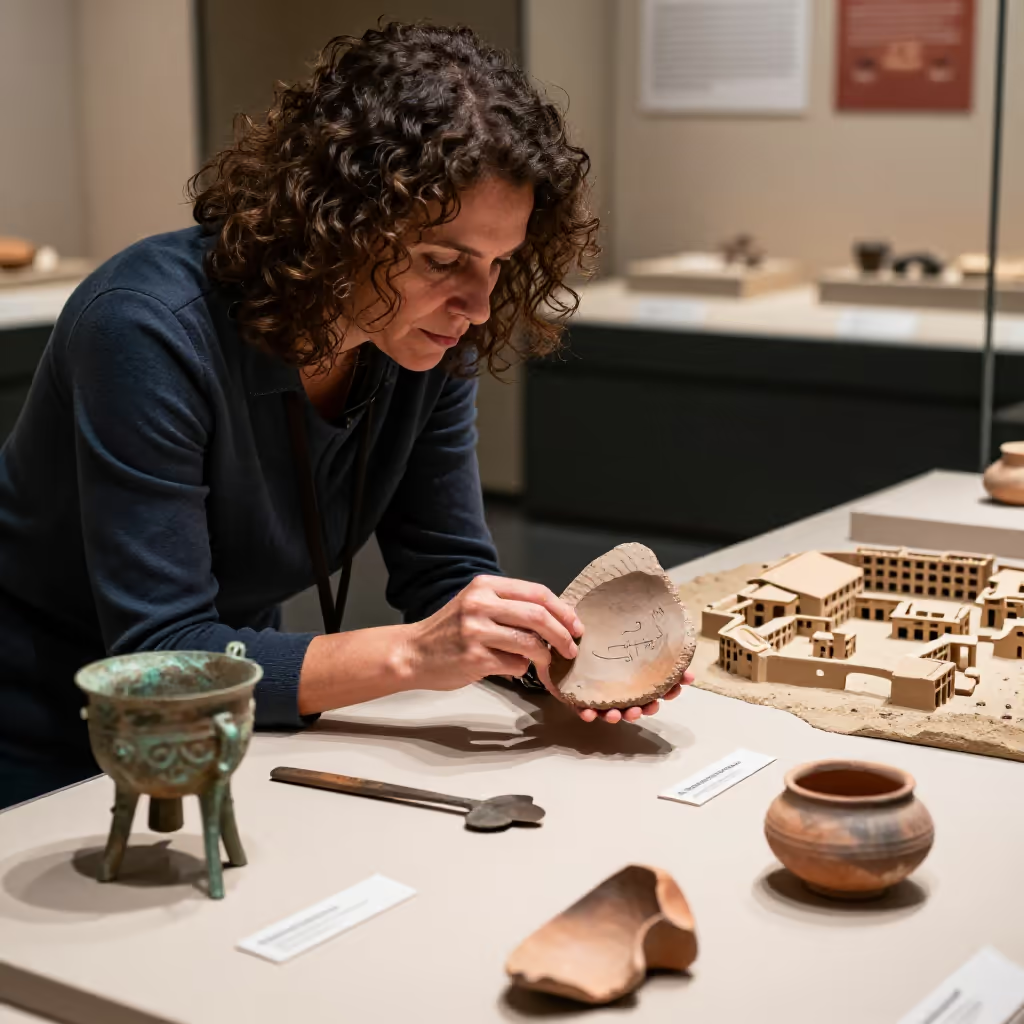
An era of the human past that lies between prehistory (without written sources) and history (with extensive written sources). In this period, there are early but only sparse written records.
example
Die Archäologen untersuchen Siedlungen aus der Frühgeschichte der Region.
The archaeologists are studying settlements from the early history of the region.

Usage tips
Word composition
The word is a compound of the adjective 'früh' (early) and the noun 'die Geschichte' (history/story). So it literally describes an 'early history'.
EXAMPLE
Das Museum hat eine große Abteilung zur Frühgeschichte der Menschheit.
The museum has a large section on the early history of humankind.
Context clue
You can recognize the meaning from context. If it is about archaeology, ancient cultures, or eras, the historical period is meant. If it is about the origin of a company, an invention, or an idea, the initial phase is meant.
EXAMPLE
Die Forscher fanden Werkzeuge aus der Frühgeschichte.
The researchers found tools from early history.
Historical context
As a historical era, 'Frühgeschichte' (early history) refers to the time between 'Urgeschichte' (prehistory; a period without written sources) and 'Geschichte' (history) in the narrower sense (a period with many written sources).
EXAMPLE
Die Kelten und Germanen sind wichtige Kulturen der Frühgeschichte in Mitteleuropa.
The Celts and Germanic peoples are important cultures of early history in Central Europe.
Figurative meaning
In the figurative meaning, 'Frühgeschichte' (early history) is often used with the genitive to describe the early period of something: the early history of the computer, of photography, or of a political movement.
EXAMPLE
Er gilt als einer der Pioniere in der Frühgeschichte der Luftfahrt.
He is considered one of the pioneers in the early history of aviation.
Compare with
confusable
Frühgeschichte vs Geschichte
story / history
'die Geschichte' and 'die Frühgeschichte' both belong to the area of the past. 'Geschichte' is the general term for past events or for the academic subject. 'Frühgeschichte' is much more specific: it means either a very early era of humanity with few written sources, or more generally the initial period of a development. The words can be confused because 'Frühgeschichte' is a part of, or an early phase of, history. If you are speaking generally about the past, use 'Geschichte'. If you mean the early beginning, 'Frühgeschichte' is more precise.
Frühgeschichte
Nach dem Unterricht sprechen wir über Werkzeuge aus der Frühgeschichte.
After class, we talk about tools from early history.
Geschichte
Der Kunde interessiert sich für die Geschichte des alten Hauses.
The customer is interested in the history of the old house.