

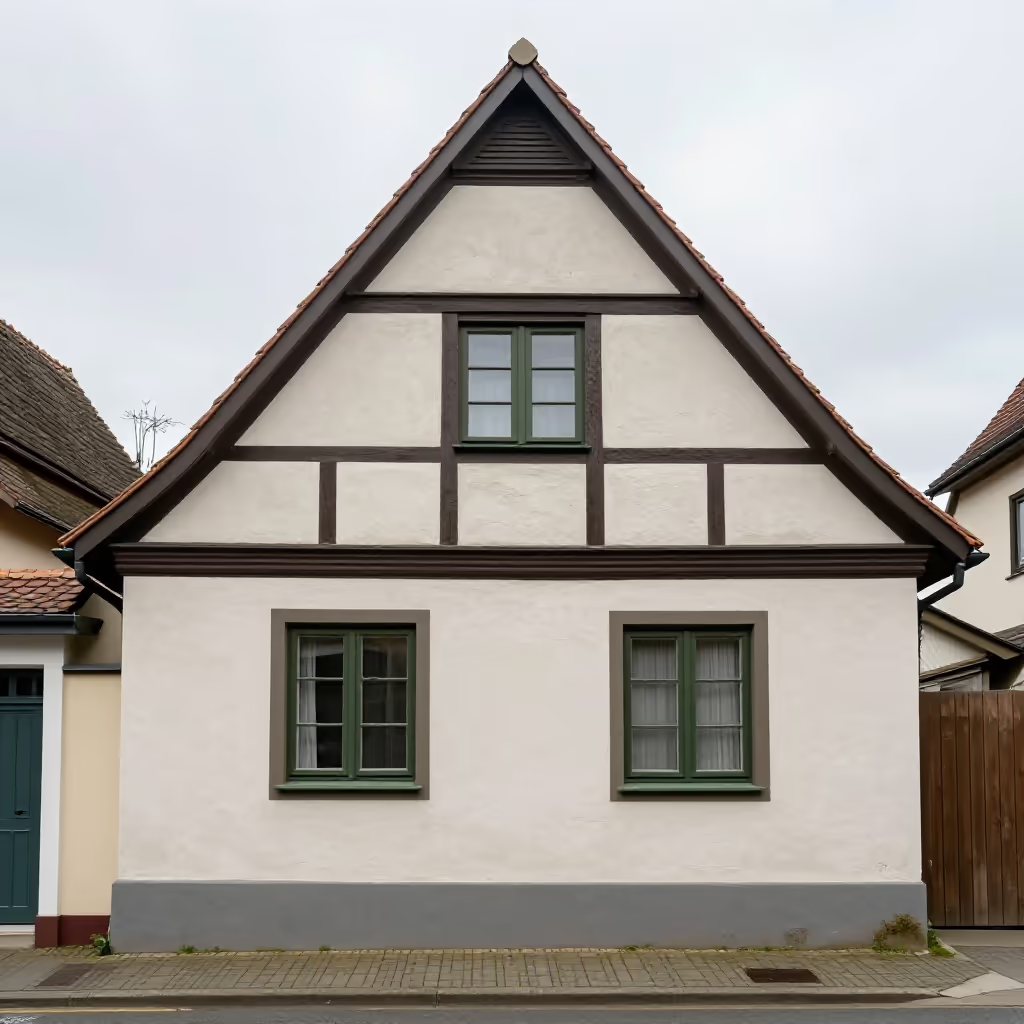
der Giebel
gable
The upper, usually triangular part of a house wall that lies directly under the roof.
EXAMPLE
Das alte Fachwerkhaus hatte einen wunderschön verzierten Giebel.
The old half-timbered house had a beautifully decorated gable.
gable
der Giebel, die Giebel
Loading your saved state.
gable
The upper, usually triangular part of a house wall that lies directly under the roof.
Das alte Fachwerkhaus hatte einen wunderschön verzierten Giebel.
The old half-timbered house had a beautifully decorated gable.
| gender | masculine der |
|---|---|
| plural | die Giebel |
| genitive | des Giebels |
| singular | plural | |
|---|---|---|
| nominative | der Giebel | die Giebel |
| accusative | den Giebel | die Giebel |
| dative | dem Giebel | den Giebeln |
| genitive | des Giebels | der Giebel |
The article changes with the case; it is shown in colour.
'Giebel' (gable) is a technical term from architecture. It is mainly used to describe the appearance of buildings, especially traditional or old houses.
Viele Häuser in der Altstadt haben spitze Giebel.
Many houses in the old town have pointed gables.
Adjectives such as 'steil' (steep), 'verziert' (decorated), 'hölzern' (wooden), or 'spitz' (pointed) are often used to describe a gable.
Das Haus hat einen reich verzierten Giebel aus Holz.
The house has a richly decorated wooden gable.
To assign the gable to a specific building, the genitive is often used. The structure is then 'der Giebel des [Gebäudes]' (the gable of the [building]).
Der Giebel des alten Rathauses wurde kürzlich restauriert.
The gable of the old town hall was recently restored.