

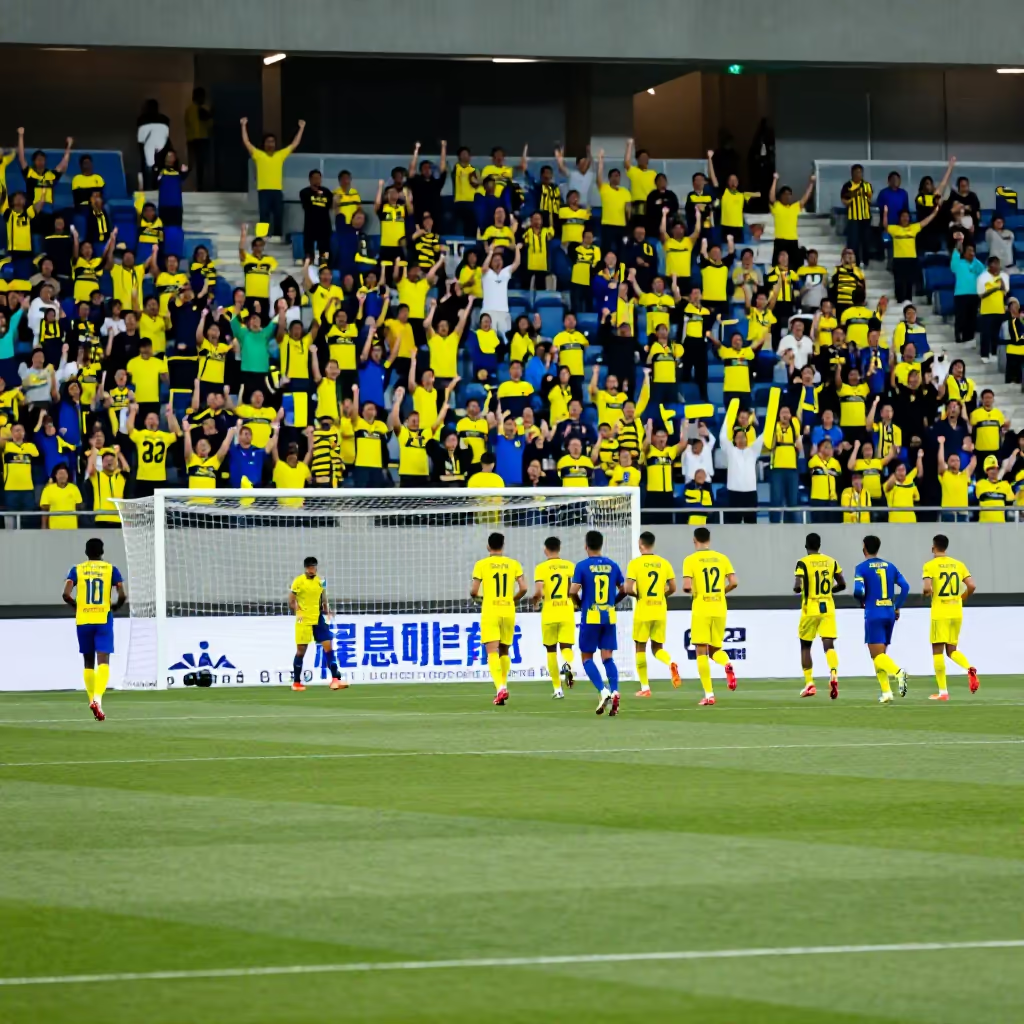
das Heimspiel
home game
A sporting competition that a team plays on its own sports field or in its own arena.
EXAMPLE
Der FC Bayern hat am Samstag ein Heimspiel gegen Dortmund.
FC Bayern has a home game against Dortmund on Saturday.
home game
Loading your saved state.
home game
A sporting competition that a team plays on its own sports field or in its own arena.
Der FC Bayern hat am Samstag ein Heimspiel gegen Dortmund.
FC Bayern has a home game against Dortmund on Saturday.

home advantage
A situation in which someone has a clear advantage because of a familiar environment or known circumstances.
Die Präsentation vor seinen eigenen Mitarbeitern war für den Chef ein Heimspiel.
The presentation in front of his own employees was a home advantage for the boss.
'Heimspiel' (home game) is a compound word made from 'Heim' (home) and 'Spiel' (game). So it literally means a 'game at home.'
Für die Fans ist jedes Heimspiel ein besonderes Ereignis.
For the fans, every home game is a special event.
In a sports context, 'Heimspiel' (home game) is often combined with verbs such as 'haben' (to have), 'gewinnen' (to win), 'verlieren' (to lose), or 'bestreiten' (to play/contest).
Die Mannschaft hat in dieser Saison noch kein Heimspiel verloren.
The team has not lost a home game yet this season.
The opponent in a home game is introduced with the preposition 'gegen' (against). The pattern is: 'ein Heimspiel gegen [Mannschaft]' (a home game against [team]).
Nächste Woche hat der Verein ein wichtiges Heimspiel gegen den Tabellenführer.
Next week, the club has an important home game against the league leader.
A 'Heimspiel' (home game) is often associated with 'Heimrecht' (home advantage/home-field advantage). This is the advantage of playing in one's own stadium and in front of one's own fans.
Dank des Heimrechts konnte die Mannschaft das Spiel noch drehen.
Thanks to home-field advantage, the team was able to turn the game around.
You can recognize the figurative meaning by the fact that it is not about sports. When someone has an advantage in a familiar situation (e.g., at work, in their own company), people speak of a 'Heimspiel' (home advantage).
Für den erfahrenen Redner war der Vortrag vor Studenten ein Heimspiel.
For the experienced speaker, the lecture in front of students was a home advantage.
In the figurative meaning, the structure 'Das ist ein Heimspiel für [Person]' (That is a home advantage for [person]) is often used. The person who has the advantage is named with 'für' (for).
Die Diskussion über ihr Lieblingsthema war ein Heimspiel für sie.
The discussion about her favorite topic was a home advantage for her.