


hinunter
down
Expresses movement from a higher point to a lower point, away from the speaker. The opposite is 'herunter' (down toward the speaker).
EXAMPLE
Er ging die Treppe hinunter in den Keller.
He went down the stairs into the basement.
down / downward
Loading your saved state.
down
Expresses movement from a higher point to a lower point, away from the speaker. The opposite is 'herunter' (down toward the speaker).
Er ging die Treppe hinunter in den Keller.
He went down the stairs into the basement.

down
Used in connection with swallowing to describe movement through the esophagus.
Er spülte die Tablette mit einem großen Schluck Wasser hinunter.
He washed the tablet down with a big gulp of water.
The adverb consists of 'hin' and 'unter'. The prefix 'hin-' always describes movement away from the speaker. 'Hinunter' (down) therefore means downward movement that moves away from the speaker.
Schau mal, die Katze klettert den Baum hinunter.
Look, the cat is climbing down the tree.
The counterpart to 'hinunter' (down away from me) is 'herunter' (down toward me). The choice depends on the speaker's perspective.
Bleib oben, ich komme gleich zu dir hinunter.
Stay upstairs; I'll come down to you in a moment.
'Hinunter-' can also be used as a separable prefix for verbs of movement, e.g. 'hinuntergehen' (to go down) or 'hinunterfallen' (to fall down). In a main clause, the prefix stands at the end.
Wir gehen jetzt die Treppe zum Ausgang hinunter.
We are now going down the stairs to the exit.
In the meaning of swallowing, 'hinunter' (down) is almost always combined with verbs such as 'schlucken' (to swallow), 'würgen' (to choke/gag), or 'spülen' (to wash down). It emphasizes the movement through the throat.
Das Kind wollte die bittere Medizin nicht hinunterschlucken.
The child did not want to swallow the bitter medicine down.
down
Runter and hinunter can both express movement downward. Runter is the colloquial short form and often leaves the exact direction unspecified, while hinunter more precisely marks movement downward and away from the speaker. Use runter in everyday speech and hinunter when this direction is important.
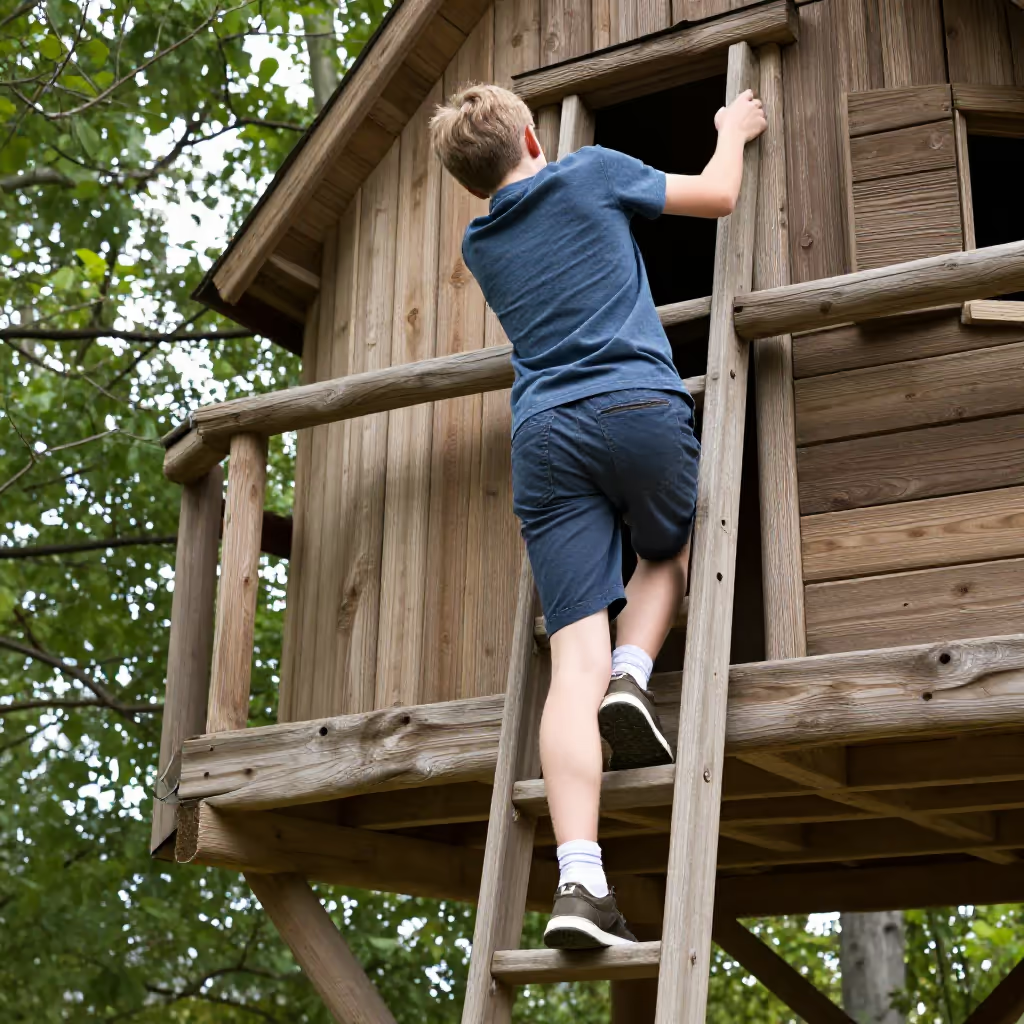
Geh bitte hinunter in den Hof, dort wartet der Bus auf dich.
Please go down to the courtyard; the bus is waiting for you there.
Komm bitte runter in den Hof, dort wartet der Bus auf uns.
Please come down to the courtyard; the bus is waiting for us there.