

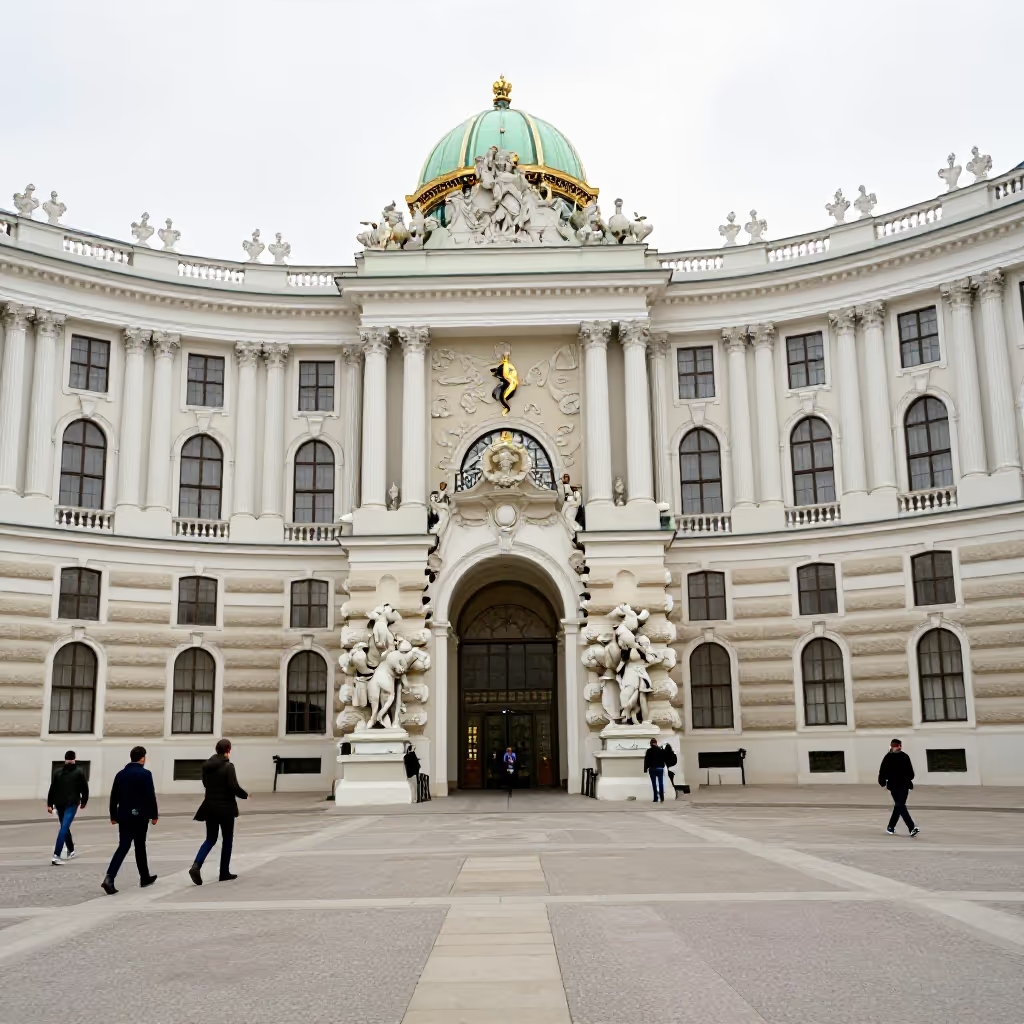
The former imperial residence of the Habsburgs in Vienna, which today houses, among other things, the official residence of the Austrian Federal President as well as various museums.
example
Bei unserem Wien-Besuch haben wir natürlich auch die Hofburg besichtigt.
During our visit to Vienna, of course we also toured the Hofburg.
Usage tips
Compound word
The name 'Hofburg' is made up of 'Hof' (in the sense of an imperial or royal court) and 'Burg' (castle, fortress). So it literally means 'the castle of the court'.
EXAMPLE
Der Kaiser hielt am liebsten in seiner Burg Hof.
The emperor preferred to hold court in his castle.
Use as a proper name
As the name of a specific, unique building, 'Hofburg' is always used with the definite article 'die'. It is a fixed proper name.
EXAMPLE
Die Hofburg ist eine der größten Touristenattraktionen in Wien.
The Hofburg is one of the biggest tourist attractions in Vienna.
Cultural context
The Hofburg is not a generic name, but refers to a specific, very famous building in Vienna. It is a central symbol of Austrian history and politics.
EXAMPLE
Der österreichische Bundespräsident hat seinen Amtssitz in der Hofburg.
The Austrian Federal President has his official residence in the Hofburg.
Compare with
near_synonym · confusable
Hofburg vs Schloss
castle / lock
'Schloss' and 'Hofburg' can both refer to a large historical ruler's building. 'Schloss' is the general word for such buildings. 'Hofburg' is a proper name here: the former imperial residence of the Habsburgs in Vienna. Learners may confuse the words because the Hofburg functions like a castle or palace. But you say 'die Hofburg' when you mean this exact building in Vienna. For other buildings, you do not simply use 'Hofburg', but rather 'Schloss' or the specific name.
Hofburg
Die Gruppe besucht die Hofburg, weil sie mehr über Wien lernen möchte.
The group visits the Hofburg because they want to learn more about Vienna.
Schloss
Im Urlaub haben wir ein Schloss auf einem Hügel besichtigt.