

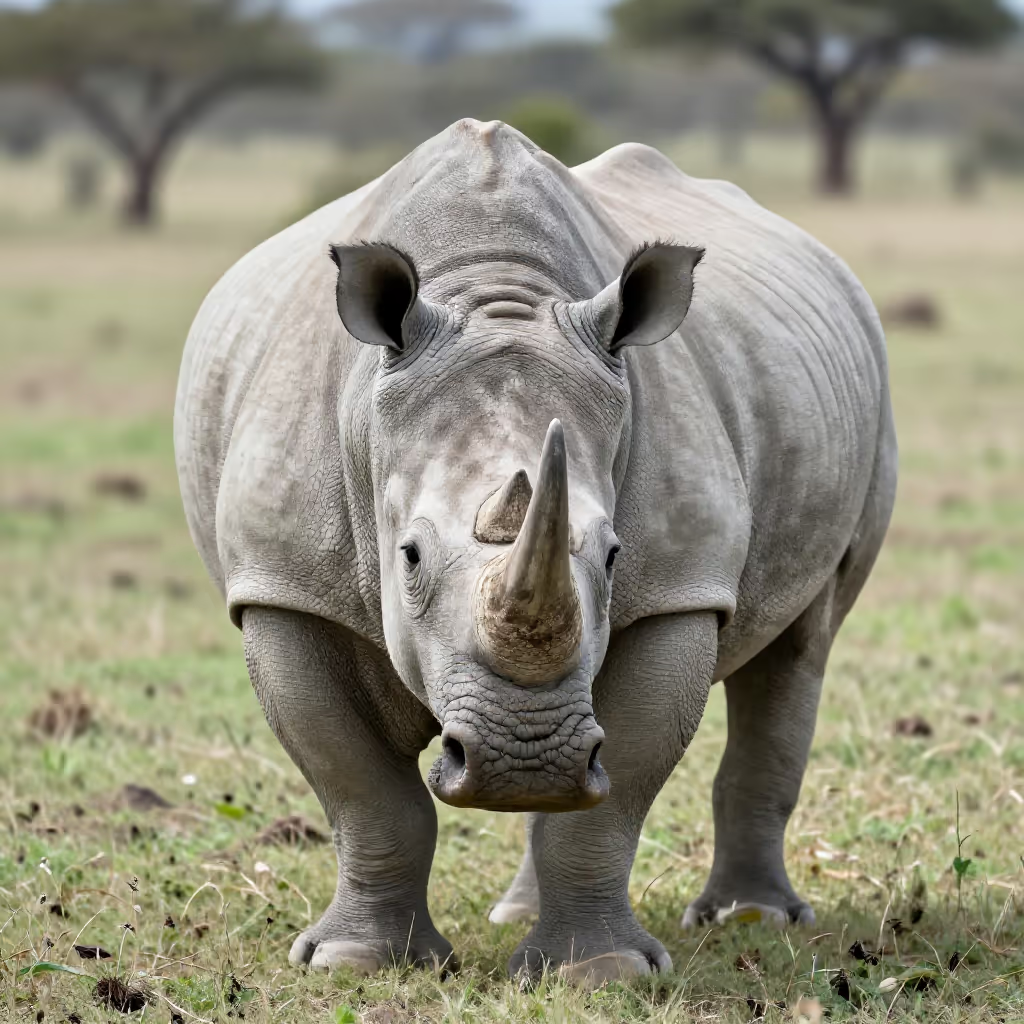
das Horn
horn
A hard, pointed growth on the head of certain animals such as cattle, goats, or rhinoceroses, used for defense or fighting.
EXAMPLE
Der Stier senkte seine Hörner zum Angriff.
The bull lowered its horns to attack.
horn
Loading your saved state.
horn
A hard, pointed growth on the head of certain animals such as cattle, goats, or rhinoceroses, used for defense or fighting.
Der Stier senkte seine Hörner zum Angriff.
The bull lowered its horns to attack.

horn
A brass instrument with a funnel-shaped mouthpiece and a long, coiled tube, often used in an orchestra.
Sie spielt seit ihrer Kindheit Horn im örtlichen Musikverein.
She has played the horn in the local music club since childhood.

horn
Colloquial term for a vehicle's horn, which produces a loud warning signal.
Der wütende Fahrer drückte auf das Horn, als ihm die Vorfahrt genommen wurde.
The angry driver pressed the horn when someone cut him off.

pastry horn
A pastry, often shaped like a little horn, that may be filled with nuts, poppy seeds, or jam, for example.
Zum Kaffee gab es frische Nusshörner vom Bäcker.
With coffee, there were fresh nut horns from the bakery.

to say the same thing
To express the same opinion as someone else or support the same cause, often in order to reinforce that opinion.
Alle Kritiker stießen ins gleiche Horn und lobten den Film in den höchsten Tönen.
All the critics said the same thing and praised the film to the skies.

to sow one's wild oats
To go through a phase of youthful immaturity and wild behavior in order to become more reasonable and settled afterward.
Lass ihn ruhig feiern gehen, er muss sich erst mal die Hörner abstoßen.
Let him go out partying; he first needs to sow his wild oats.
The meaning of 'Horn' (horn) is almost always clear from the context. Pay attention to the topic: animals (bull, rhinoceros), music (orchestra, instrument), traffic (car, honk), or food (bakery, pastry).
Das Orchesterstück beginnt mit einem Solo für das Horn.
The orchestral piece begins with a solo for the horn.
When referring to the growth on animals' heads, the plural form 'Hörner' (horns) is often used, since many of these animals have two of them. The singular 'Horn' (horn) is typical for animals such as the rhinoceros.
Die Hörner eines Widders können sehr imposant sein.
The horns of a ram can be very impressive.
The term 'Horn' (horn) for a car horn is colloquial. You hear it in spoken German, but it is used less often in more formal contexts.
Als der Radfahrer die Straße überquerte, drückte ein Autofahrer aufs Horn.
When the cyclist crossed the street, a driver pressed the horn.
As a pastry, 'Horn' (horn) is usually part of a compound noun that describes the filling. Typical examples are 'Nusshorn' (nut horn), 'Mohnhorn' (poppy-seed horn), or 'Marzipanhorn' (marzipan horn).
Zum Frühstück esse ich am liebsten ein warmes Schokohorn.
For breakfast, my favorite thing to eat is a warm chocolate horn.
The idiom `ins gleiche Horn stoßen` (to say the same thing / to blow the same horn) is a fixed unit. It means that someone expresses the same opinion as another person and thereby supports it.
Viele Experten stießen ins gleiche Horn und warnten vor den wirtschaftlichen Folgen.
Many experts said the same thing and warned of the economic consequences.
The idiom `sich die Hörner abstoßen` (to sow one's wild oats) is reflexive. The person going through this phase of maturing is in the dative: `sich (dative) die Hörner abstoßen`.
In seiner Jugend hat er sich ordentlich die Hörner abgestoßen.
In his youth, he really sowed his wild oats.
horn
Hupe is the usual neutral term for a vehicle’s acoustic warning device. Horn can refer to the same device, but in this sense it is colloquial. Hupe is therefore more suitable in a factual description, while Horn is also possible in casual everyday speech.

Der Fahrer rief seinem Beifahrer zu: „Drück doch aufs Horn!“
The driver called out to his passenger, “Go on, press the horn!”
In der Werkstatt prüft die Mechanikerin die Hupe des Autos.
At the garage, the mechanic checks the car’s horn.