

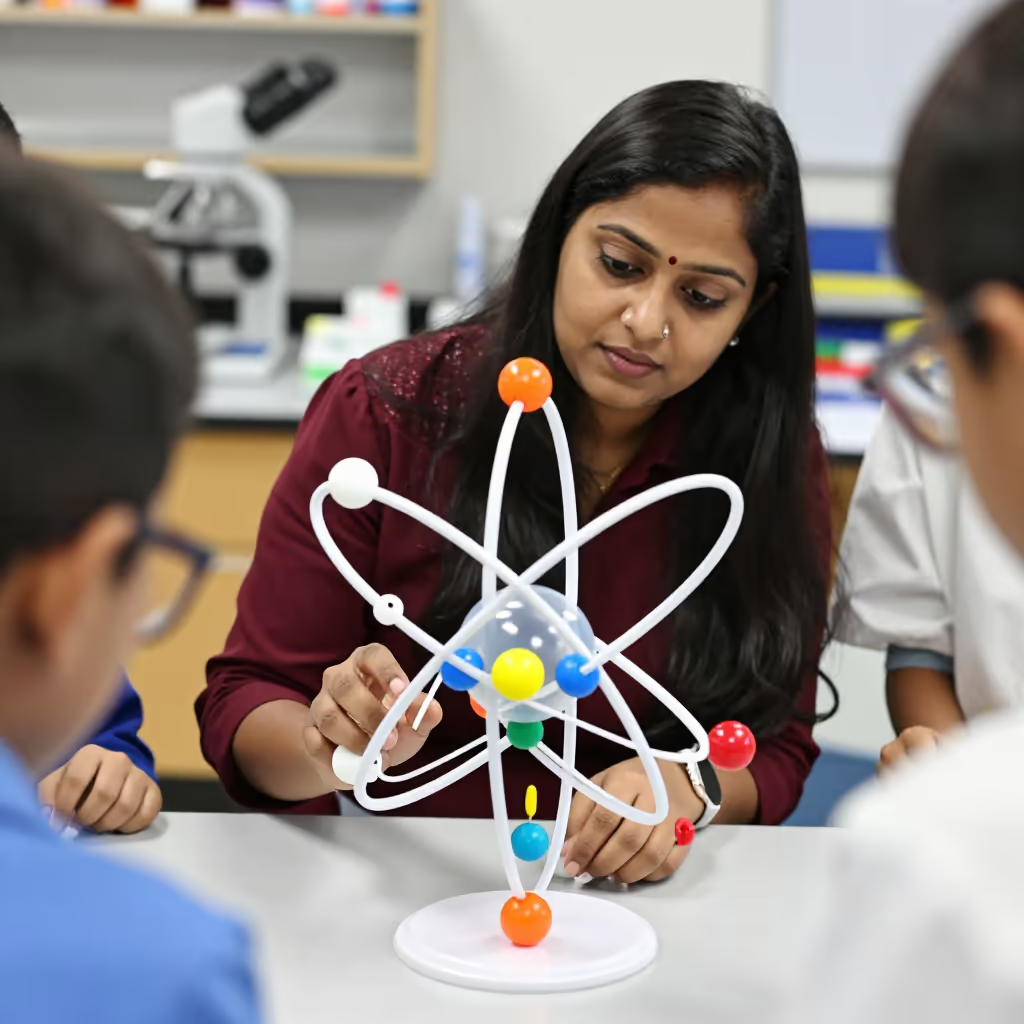
An electrically charged atom or molecule. It forms when a neutral atom or molecule gives up or takes in one or more electrons.
example
Kochsalz zerfällt in Wasser in positive Natrium-Ionen und negative Chlorid-Ionen.
Table salt breaks down in water into positive sodium ions and negative chloride ions.
Usage tips
Register: technical language
'Ion' is a technical term from the natural sciences, especially chemistry and physics. In normal everyday life, this word is rarely used.
EXAMPLE
Im Chemieunterricht lernen wir, was Ionen sind.
In chemistry class, we learn what ions are.
Typical collocations
'Ion' is almost always combined with an adjective that describes its electrical charge. The most common combinations are 'positives Ion' (positive ion) and 'negatives Ion' (negative ion).
EXAMPLE
Ein Atom, das ein Elektron verliert, wird zu einem positiven Ion.
An atom that loses an electron becomes a positive ion.
Word family
The verb 'ionisieren' (to ionize, to turn into an ion) and the noun 'die Ionisation' (ionization, the process of ion formation) are derived from the noun 'das Ion' (ion). These words belong to the same word family.
EXAMPLE
Starke Strahlung kann die Luft ionisieren.
Strong radiation can ionize the air.
Compare with
confusable
Ion vs Atom
atom
'Atom' and 'Ion' both belong to chemistry and can seem very similar, because an ion can form from an atom. The important difference is the electrical charge. In this context, an 'Atom' is neutral. An 'Ion' is charged because it has given up or taken in electrons. It is easy to confuse the words if you are only thinking of the small chemical building block. So pay attention to the charge: without a special charge, you say 'Atom'; with a positive or negative charge, you say 'Ion'.
Ion
Ein Ion ist elektrisch geladen, weil es ein Elektron verloren oder aufgenommen hat.
An ion is electrically charged because it has lost or gained an electron.
Atom
Im Chemieunterricht zeichnet Tom ein Atom mit Kern und Elektronen.
In chemistry class, Tom draws an atom with a nucleus and electrons.