

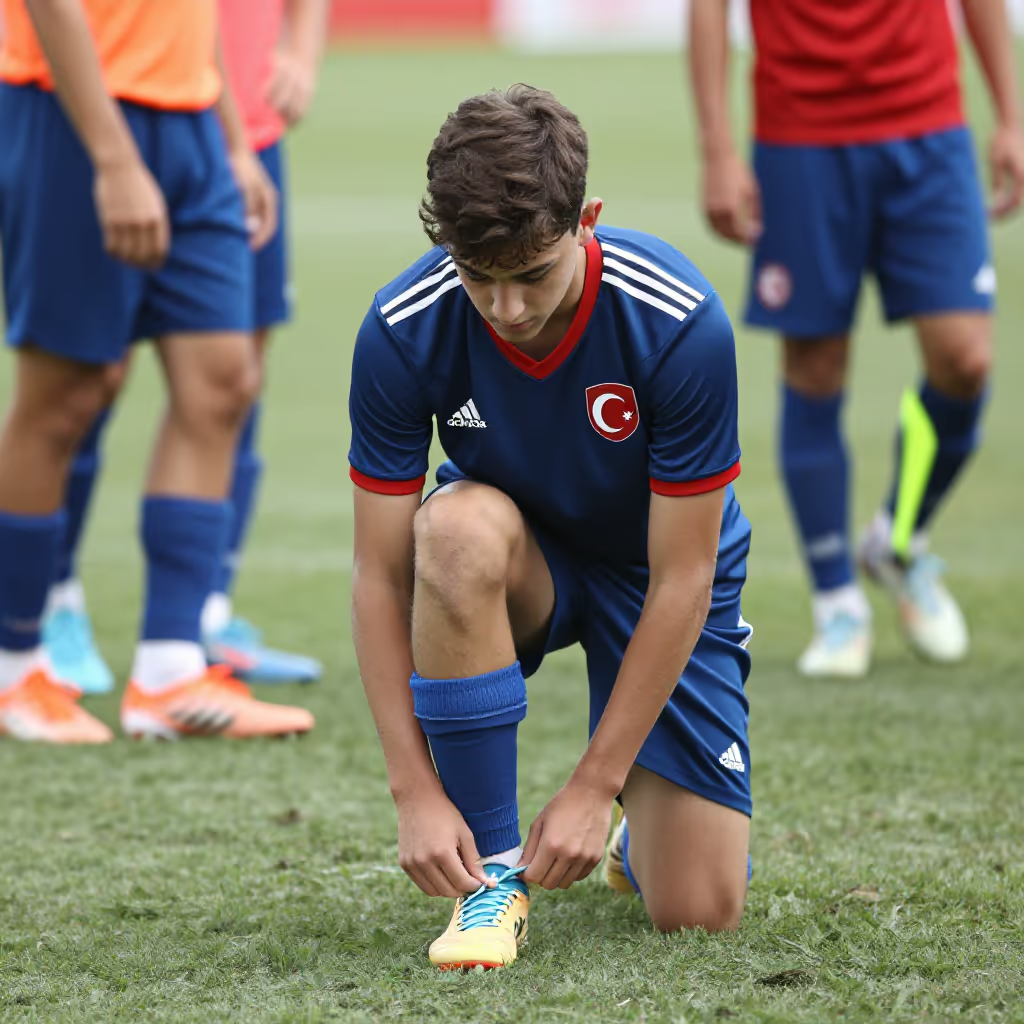
knien
to kneel
To lower oneself onto one or both knees so that the body rests on the knees.
EXAMPLE
Er kniete vor ihr nieder, um ihr den Heiratsantrag zu machen.
He knelt down in front of her to propose to her.
to kneel
Loading your saved state.
to kneel
To lower oneself onto one or both knees so that the body rests on the knees.
Er kniete vor ihr nieder, um ihr den Heiratsantrag zu machen.
He knelt down in front of her to propose to her.

to throw oneself into
To deal with a task or topic very intensively and with great commitment.
Für die Prüfung musste er sich richtig in die Bücher knien.
For the exam, he really had to throw himself into his books.
The verb 'knien' (to kneel) is derived directly from the noun 'das Knie' (the knee). It describes the action one performs with the knees.
Das Kind kniete auf dem Boden, um mit seinen Spielzeugautos zu spielen.
The child knelt on the floor to play with his toy cars.
The perfect tense of 'knien' (to kneel) is formed in standard German with the auxiliary verb 'haben' (to have), because it describes a position.
Er hat eine Stunde lang vor dem Altar gekniet.
He knelt in front of the altar for an hour.
In its literal meaning, 'knien' (to kneel) is often used with the prepositions 'vor' (+ dative) or 'auf' (+ dative).
Der Gärtner kniet auf der Erde, um Unkraut zu jäten.
The gardener is kneeling on the ground to weed.
The expression 'sich in etwas knien' (to throw oneself into something) is reflexive and requires the preposition 'in' with the accusative. It means to devote oneself to something with full energy.
Ich muss mich jetzt richtig in dieses Projekt knien, um die Frist einzuhalten.
I really have to throw myself into this project now in order to meet the deadline.
The figurative meaning 'sich in etwas knien' (to throw oneself into something) belongs to colloquial language and sounds very committed and energetic.
Wenn du die Prüfung bestehen willst, musst du dich in den Lernstoff knien.
If you want to pass the exam, you have to throw yourself into the study material.
to specialize
Sich spezialisieren means concentrating on a particular field over the long term and acquiring special knowledge there. Sich in etwas knien (to throw oneself into something), by contrast, emphasizes a strong commitment to a specific task or topic. Intensive work alone is therefore not yet specialization.

Die Restauratorin kniet sich in die schwierige Reparatur dieses alten Holzmöbels.
The restorer is throwing herself into the difficult repair of this antique wooden piece of furniture.
Die Restauratorin spezialisiert sich auf die Reparatur alter Holzmöbel.
The restorer is specializing in repairing antique wooden furniture.