

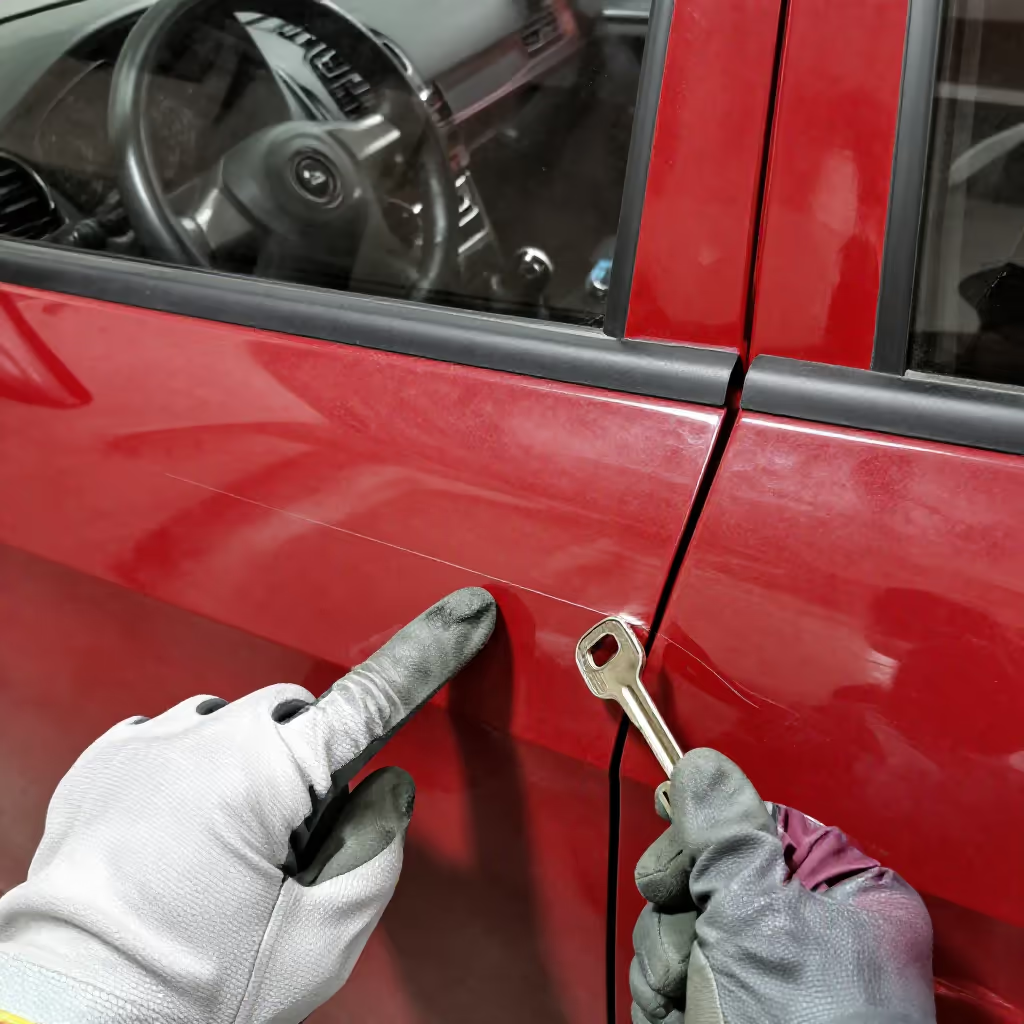
der Kratzer
scratch
A superficial, usually line-shaped mark or damage on a surface, caused by a sharp or rough object.
EXAMPLE
Ich habe einen tiefen Kratzer im neuen Parkettboden entdeckt.
I discovered a deep scratch in the new parquet floor.
scratch
Loading your saved state.
scratch
A superficial, usually line-shaped mark or damage on a surface, caused by a sharp or rough object.
Ich habe einen tiefen Kratzer im neuen Parkettboden entdeckt.
I discovered a deep scratch in the new parquet floor.

scratch
A minor, superficial skin injury, often caused by an animal's claws or a pointed object.
Meine Katze hat mir beim Spielen einen Kratzer am Arm verpasst.
My cat gave me a scratch on my arm while we were playing.
'Der Kratzer' (scratch) is the noun related to the verb 'kratzen' (to scratch). The noun describes the result of the action: when a cat scratches, it leaves a scratch.
Pass auf, dass du mit dem Schlüssel keinen Kratzer in die Tür machst.
Be careful not to make a scratch in the door with the key.
To describe the location of a scratch, German usually uses the prepositions 'in' or 'auf' with the dative. 'In' is used when the damage is in the material, and 'auf' when it is on the surface.
Nach dem Parken war ein neuer Kratzer in der Autotür.
After parking, there was a new scratch in the car door.
Scratches are often described more precisely with adjectives such as 'tief' (deep), 'leicht' (minor), or 'oberflächlich' (superficial). Common verbs are 'einen Kratzer haben' (to have a scratch) or 'einen Kratzer machen' (to make a scratch).
Es ist nur ein oberflächlicher Kratzer, den kann man leicht wegpolieren.
It's only a superficial scratch; it can easily be polished out.