

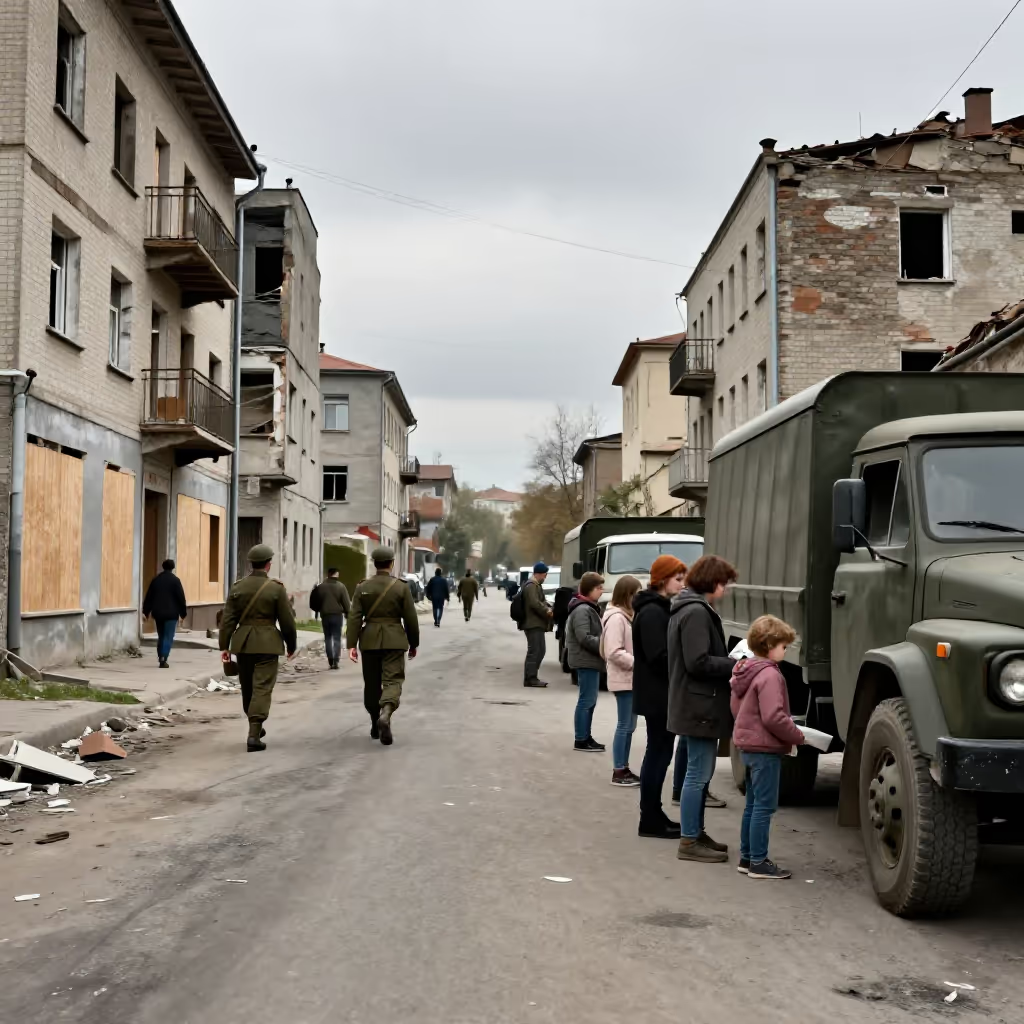
The period during which a war is taking place. This era is often marked by hardship, destruction, and special social conditions.
example
Meine Großmutter erzählt oft davon, wie schwer das Leben in Kriegszeiten war.
My grandmother often talks about how hard life was in wartime.
Usage tips
Word composition
The word consists of 'Krieg' (war), the linking element '-s-', and 'Zeiten' (times, the plural of 'Zeit'). So it literally describes the 'times of war'.
EXAMPLE
In Kriegszeiten war die Versorgung mit Lebensmitteln oft schwierig.
In wartime, the supply of food was often difficult.
Use in the plural
This word is almost always used in the plural to describe the entire era of a war with all its circumstances. The singular 'die Kriegszeit' (wartime/the war period) is less common.
EXAMPLE
Die Ausstellung zeigt das Alltagsleben in Kriegszeiten.
The exhibition shows everyday life in wartime.
Typical prepositions
To express that something happens during a war, the prepositions 'in' or 'zu' are used. Both phrases, 'in Kriegszeiten' (in wartime) and 'zu Kriegszeiten' (in wartime), are correct and common.
EXAMPLE
Zu Kriegszeiten mussten die Menschen sehr erfinderisch sein.
In wartime, people had to be very inventive.
Compare with
confusable
Kriegszeiten vs Krieg
war
'Der Krieg' and 'die Kriegszeiten' are closely related, but they do not mean the same thing. 'Der Krieg' is the armed conflict itself. 'Die Kriegszeiten' refers to the time during which a war takes place, and often also to the difficult living conditions during that time. The words can be confused because both talk about the same historical situation. If the fighting or conflict is meant, you say 'Krieg'. If you are talking about life during that period, 'Kriegszeiten' is more precise.
Kriegszeiten
In Kriegszeiten mussten die Menschen oft mit sehr wenig Essen auskommen.
In wartime, people often had to get by with very little food.
Krieg
Der Krieg begann im Frühjahr und dauerte mehrere Jahre.