

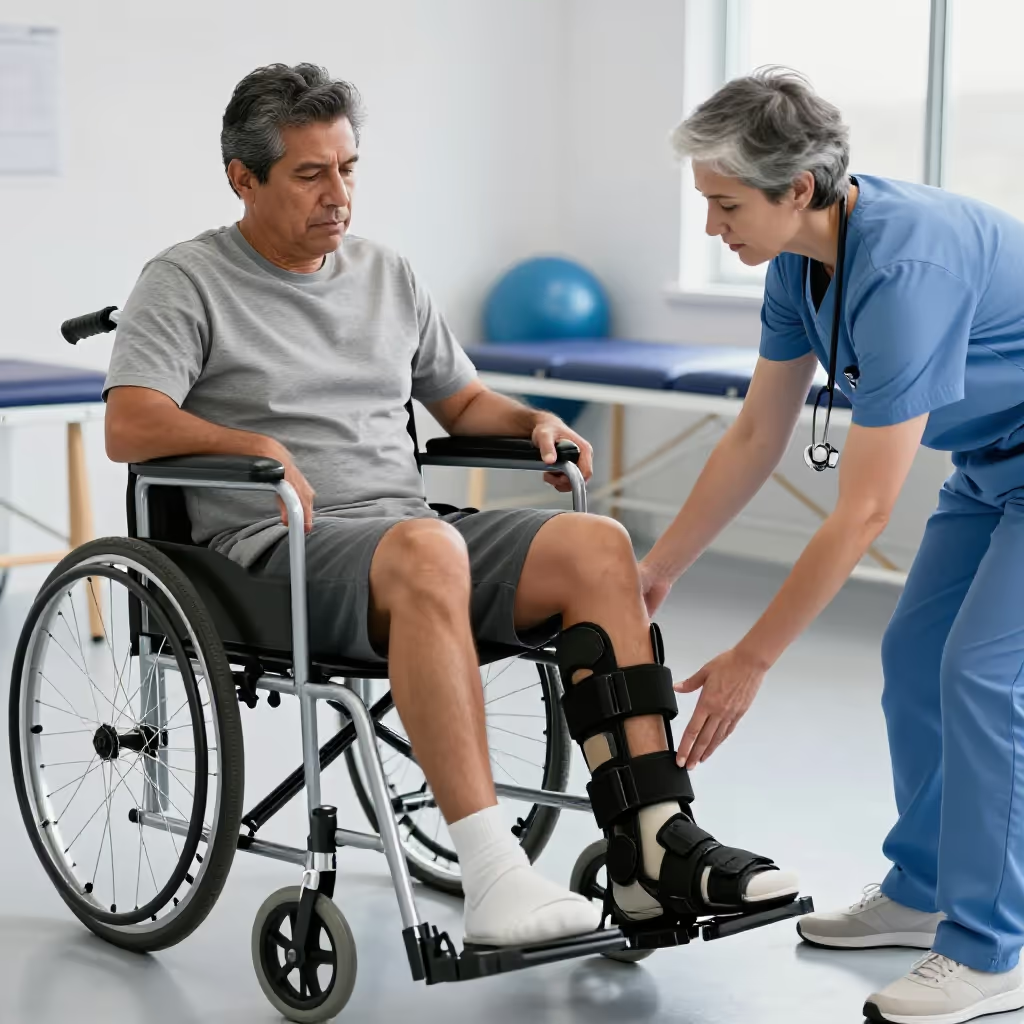
die Lähmung
paralysis
The medical condition in which the ability to move one or more body parts is completely or partially lost.
Der Unfall führte zu einer vollständigen Lähmung seiner Beine.
The accident led to complete paralysis of his legs.

paralysis
Loading your saved state.

paralysis
The medical condition in which the ability to move one or more body parts is completely or partially lost.
Der Unfall führte zu einer vollständigen Lähmung seiner Beine.
The accident led to complete paralysis of his legs.

paralysis
In a figurative sense, a state of standstill, inability to act, or inactivity in a system, organization, or society.
Die ständigen Streiks führten zu einer Lähmung des öffentlichen Nahverkehrs.
The constant strikes led to a paralysis of public transportation.
The word 'Lähmung' (paralysis) comes from the verb 'lähmen' (to paralyze, to make something immobile). The related adjective is 'lahm' (lame). If you know these words, the meaning is easier to understand.
Der Giftstoff kann die Muskeln lähmen.
The toxin can paralyze the muscles.
In a medical context, 'Lähmung' (paralysis) is often described more precisely. Typical combinations are 'vollständige' (complete), 'teilweise' (partial), or 'einseitige Lähmung' (one-sided paralysis), as well as 'an einer Lähmung leiden' (to suffer from paralysis).
Seit dem Schlaganfall leidet er an einer einseitigen Lähmung.
Since the stroke, he has suffered from one-sided paralysis.
In a figurative sense, 'Lähmung' (paralysis) describes a standstill. The word is then combined with abstract nouns such as 'Wirtschaft' (economy), 'Verkehr' (traffic/transport), or 'Politik' (politics).
Der Generalstreik führte zu einer vollständigen Lähmung der Wirtschaft.
The general strike led to a complete paralysis of the economy.