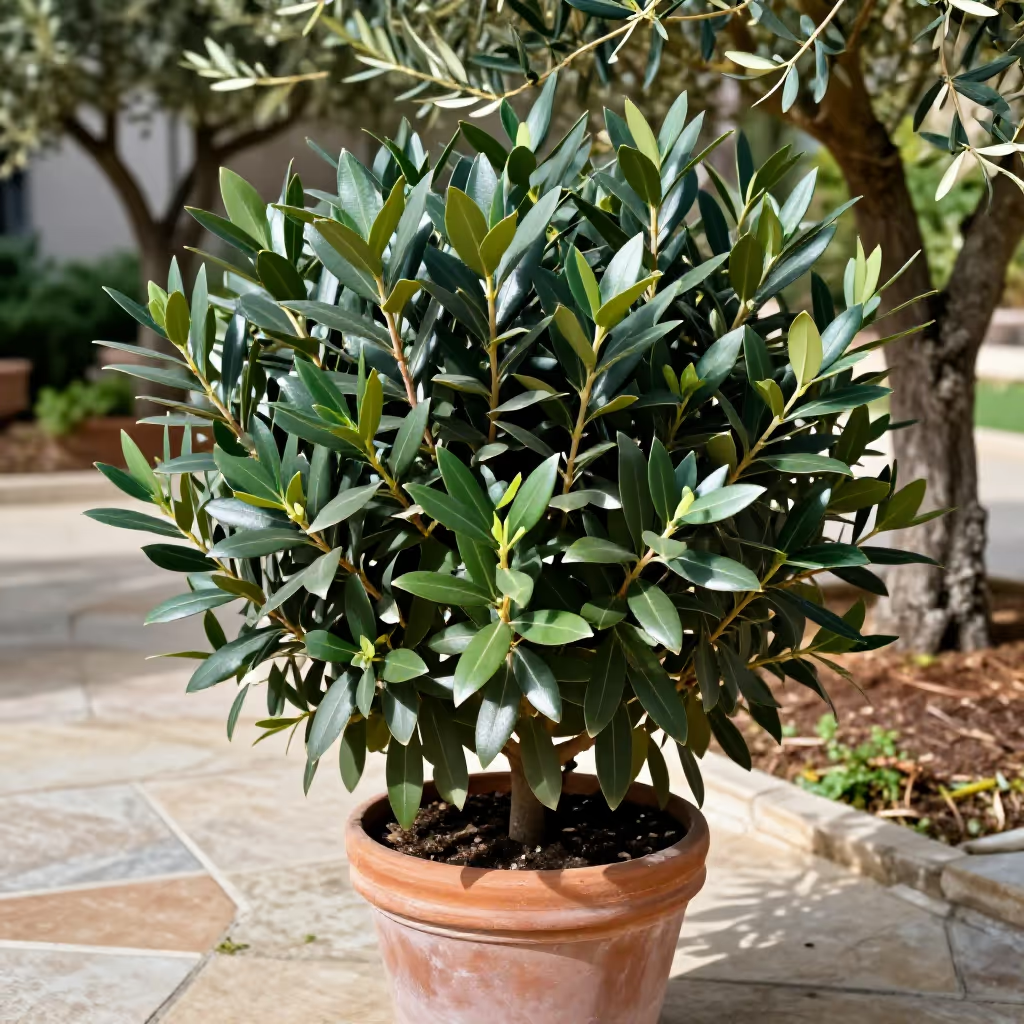
der Lorbeer
laurel
An evergreen plant (tree or shrub) with aromatic, leathery leaves, native mainly to the Mediterranean region.
Im Garten des alten Klosters wächst ein riesiger Lorbeer.
A huge laurel grows in the garden of the old monastery.


laurel
Loading your saved state.
laurel
An evergreen plant (tree or shrub) with aromatic, leathery leaves, native mainly to the Mediterranean region.
Im Garten des alten Klosters wächst ein riesiger Lorbeer.
A huge laurel grows in the garden of the old monastery.

The laurel wreath was a symbol of victory and honor in ancient Greece and Rome. The figurative meaning of 'Lorbeer' (laurel) as glory and recognition comes from this tradition.
Der siegreiche Feldherr wurde mit einem Lorbeerkranz geehrt.
The victorious general was honored with a laurel wreath.
The plural form 'die Lorbeeren' (the laurels) is used almost exclusively in the figurative meaning of 'Ruhm' (glory) or 'Ehre' (honor). The literal meanings (plant, spice) are usually in the singular.
Für ihre harte Arbeit hat sie endlich die verdienten Lorbeeren erhalten.
For her hard work, she finally received the honors she deserved.
When 'Lorbeer' (laurel/bay leaf) is meant as a spice, people often use the more precise term 'Lorbeerblatt' (bay leaf). In recipes, however, the short form 'Lorbeer' is also common and then means one or more leaves.
Gib ein Lorbeerblatt in die Soße, das gibt einen guten Geschmack.
Add a bay leaf to the sauce; it gives it a good flavor.
In the figurative meaning, 'Lorbeeren' (laurels) is often combined with verbs such as 'ernten' (to reap), 'einheimsen' (to rake in), or 'sammeln' (to collect) to express that someone receives recognition.
Der Autor erntete für seinen neuen Roman viele Lorbeeren.
The author reaped many honors for his new novel.
The idiom 'sich auf seinen Lorbeeren ausruhen' (to rest on one's laurels) uses a dative reflexive pronoun ('sich') and a possessive pronoun that agrees with the subject.
Du hast die Prüfung bestanden, aber jetzt ruh dich nicht auf deinen Lorbeeren aus!
You passed the exam, but don't rest on your laurels now!
honor
'die Ehre' and 'der Lorbeer' can both have to do with recognition. 'Ehre' is the more general word: it can mean a person's good reputation or a special distinction. 'Lorbeer' is usually used figuratively in this meaning and often in the plural: 'Lorbeeren' are the glory or recognition after a special achievement. 'Ehre' fits in many serious and ceremonial situations. 'Lorbeeren' sounds more strongly connected to success, a prize, or achievement and often appears in fixed expressions.

Nach dem Sieg bekam das Team viel Lob, aber es ruhte sich nicht auf seinen Lorbeeren aus.
After the victory, the team received a lot of praise, but it did not rest on its laurels.
Es ist eine große Ehre für Nina, bei der Feier sprechen zu dürfen.
It is a great honor for Nina to be allowed to speak at the celebration.