

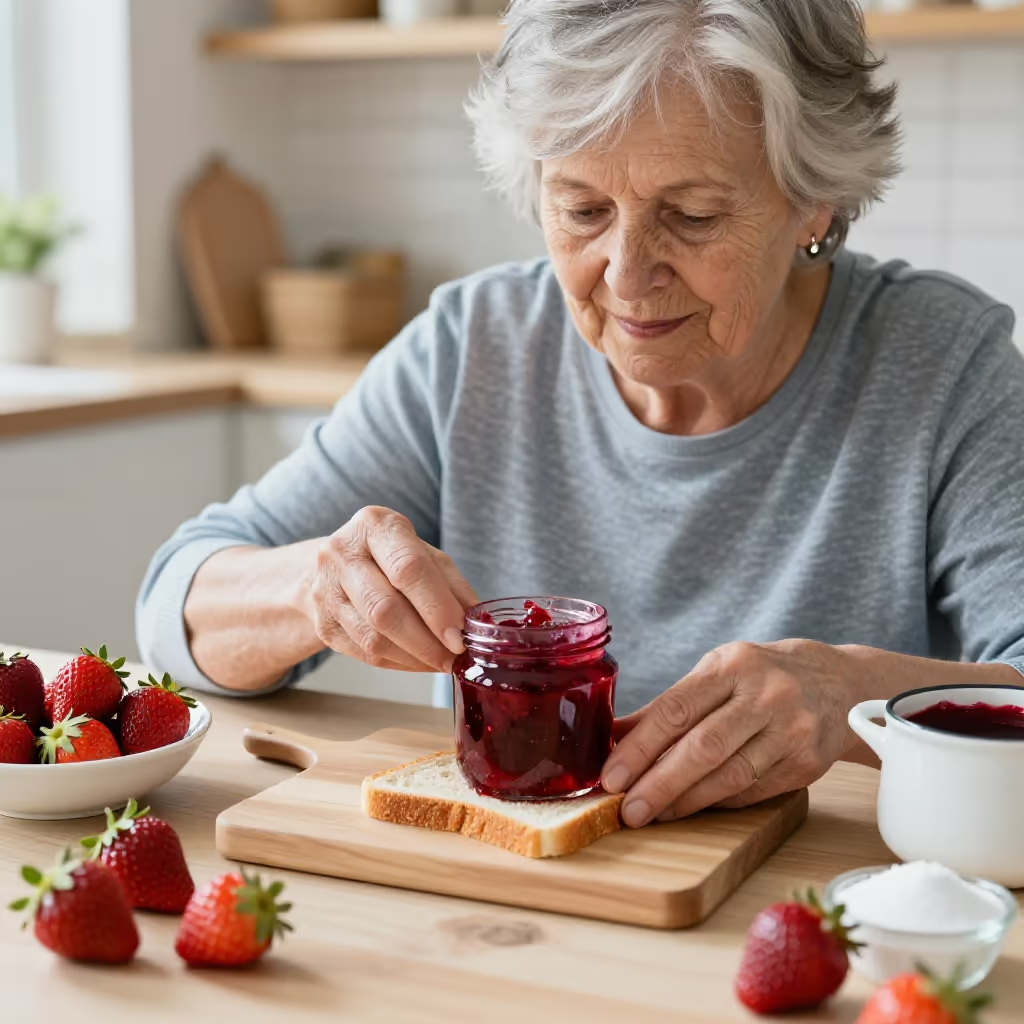
A sweet spread made by cooking fruit with sugar. Colloquially, the term is used for all kinds of fruit spreads.
example
Zum Frühstück esse ich am liebsten ein Brötchen mit selbstgemachter Erdbeermarmelade.
For breakfast, I most like eating a roll with homemade strawberry jam.
Usage tips
False friend
Careful: the English word 'marmalade' almost always refers only to a spread made from citrus fruits like oranges. In German, 'Marmelade' is the colloquial umbrella term for almost all fruit spreads, including those made from strawberries, cherries, or apricots.
EXAMPLE
Ich liebe die selbstgemachte Himbeer-Marmelade von meiner Oma.
I love my grandma's homemade raspberry jam.
Word composition
'Marmelade' is a very productive word. You can simply put the type of fruit in front to name a new variety, for example 'Erdbeermarmelade' (strawberry jam), 'Kirschmarmelade' (cherry jam), or 'Aprikosenmarmelade' (apricot jam).
EXAMPLE
Möchtest du lieber Erdbeer- oder Kirschmarmelade zum Frühstück?
Would you rather have strawberry or cherry jam for breakfast?
Typical verbs
Common verbs used in connection with 'Marmelade' (jam) are 'kochen' (to cook) or 'einkochen' (to preserve/cook down) for making it, and '(aufs Brot) streichen' (to spread on bread) for eating it.
EXAMPLE
Im Sommer kochen wir immer viel Marmelade für den Winter ein.
In the summer, we always make a lot of jam for the winter.
Colloquial use
In everyday life, 'Marmelade' is used for almost any fruit spread. Although officially and in stores there are more precise terms depending on the type of fruit and preparation, 'Marmelade' is by far the most common word.
EXAMPLE
Kannst du bitte die Marmelade aus dem Kühlschrank holen?
Can you please get the jam out of the fridge?
Compare with
confusable
Marmelade vs Mus
purée / mush
'die Marmelade' and 'das Mus' can both be made from cooked fruit and be sweet. The difference mainly lies in how they are used and in their consistency. 'Marmelade' is a spread for bread and usually contains sugar. 'Mus' is a thick, soft mass made from puréed fruit or vegetables, for example 'Apfelmus' (applesauce). It is often eaten as a side dish or dessert, not necessarily on bread. Learners may confuse the words because both can be fruity and soft. If it goes on bread, 'Marmelade' is usually more natural; if it is mushy and eaten with a spoon, 'Mus' fits better.
Marmelade
Zum Frühstück streicht Lena Erdbeermarmelade auf ihr Brötchen.
For breakfast, Lena spreads strawberry jam on her roll.
Mus
Nach dem Mittagessen gibt es Apfelmus mit etwas Zimt.
After lunch, there is applesauce with a little cinnamon.