


mehr
more
Expresses a larger quantity or a higher degree of something; comparative of 'viel' (much/a lot).
EXAMPLE
Ich hätte gerne mehr Kaffee, bitte.
I’d like more coffee, please.
more
Loading your saved state.
more
Expresses a larger quantity or a higher degree of something; comparative of 'viel' (much/a lot).
Ich hätte gerne mehr Kaffee, bitte.
I’d like more coffee, please.

no longer
Used with a negation to express that a state or action has ended; no longer.
Er wohnt nicht mehr hier.
He no longer lives here.
more
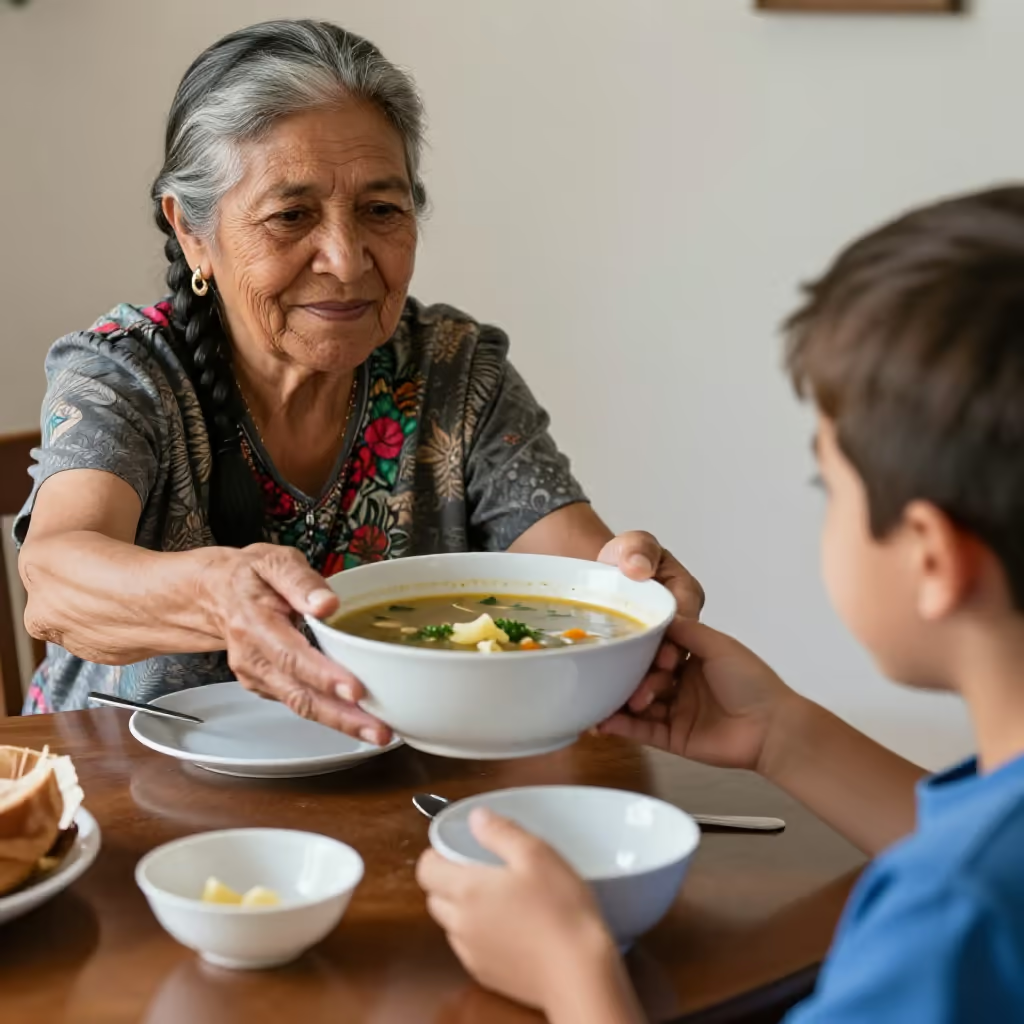
Used as a pronoun to refer to an unspecified larger amount.
Willst du noch etwas? Nein danke, ich brauche nicht mehr.
Do you want anything else? No thanks, I don’t need more.
'Mehr' is invariable. It does not take endings, regardless of whether it comes before a masculine, feminine, or neuter noun or which case follows. It always remains 'mehr'.
Ich brauche mehr Zeit.
I need more time.
'Mehr' is the comparative form of 'viel' (much/a lot). It is used to compare quantities.
Sie verdient mehr Geld als ich.
She earns more money than I do.
The combination 'nicht mehr' is a fixed unit and means 'no longer' or 'over'. It expresses that a state or action has ended.
Seit seinem Umzug sehe ich ihn nicht mehr.
Since he moved away, I don’t see him anymore.
'Mehr' is part of many fixed expressions. 'Immer mehr' means a continuous increase, and 'mehr oder weniger' means 'approximately' or 'more or less'.
Immer mehr Menschen ziehen in die Stadt.
More and more people are moving to the city.
additional
Mehr and zusätzlich can refer to an amount beyond what is already present. Mehr emphasizes that the total amount should become larger, while zusätzlich marks the new amount as an addition to the existing basis. Ask for mehr when referring to an amount and for zusätzliche Dinge (additional things) when referring to an addition.
Für die Suppe brauchen wir mehr Wasser.
We need more water for the soup.
Für die Suppe brauchen wir zusätzlich frische Kräuter.
We also need fresh herbs for the soup.