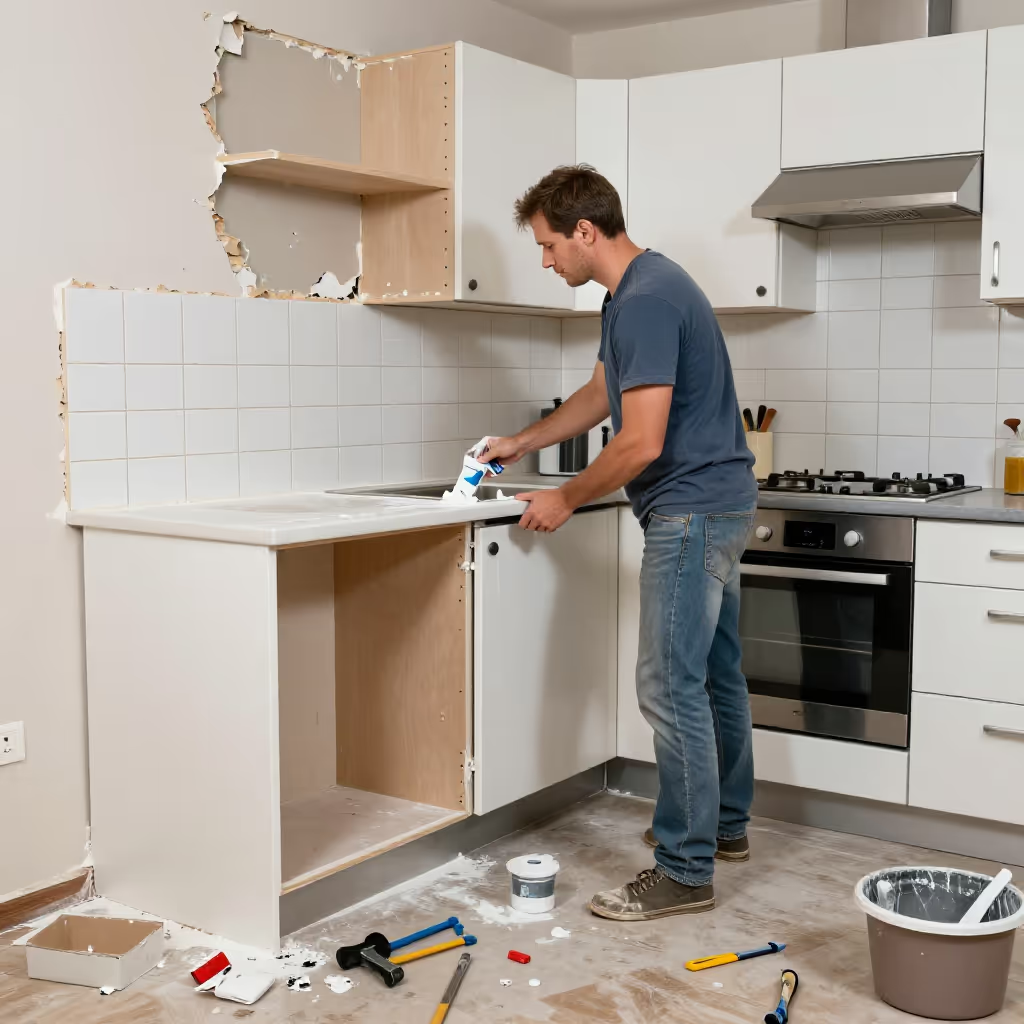
Indicates the exact midpoint or center of a place, time, group, or action. The word is almost always followed by a preposition such as 'in', 'auf', 'unter', or 'durch'.
example
Das Haus steht mitten im Wald.
The house is right in the middle of the forest.

Usage tips
Always with a preposition
The word 'mitten' almost never stands alone. It always needs a preposition directly after it, for example 'in', 'auf', 'unter', or 'durch', which describes the exact location.
EXAMPLE
Das Kind stand mitten auf der Straße.
The child was standing right in the middle of the street.
Word family
'Mitten' comes directly from the noun 'die Mitte' (the middle). It emphasizes that something is exactly in the center or innermost part of something.
EXAMPLE
Der Punkt muss genau in die Mitte des Kreises.
The point has to go exactly in the middle of the circle.
Typical combinations
Common combinations describe a place or time: 'mitten in der Stadt' (right in the middle of the city), 'mitten in der Nacht' (in the middle of the night), 'mitten im Satz' (in the middle of a sentence), or 'mitten unter Leuten' (right among people).
EXAMPLE
Er hat mich mitten im Satz unterbrochen.
He interrupted me in the middle of a sentence.
Use with 'durch'
When 'mitten' describes a sudden separation, it is often combined with 'durch' (through) or 'entzwei' (in two). It emphasizes that something has broken exactly in the middle.
EXAMPLE
Der Stock ist beim Drauftreten mitten durchgebrochen.
The stick broke right through the middle when someone stepped on it.
Compare with
confusable
mitten vs während
during / while
'während' and 'mitten' can both show that something happens within a period of time or during an action. 'während' neutrally describes that two things happen at the same time or that something happens during a period of time. 'mitten' puts stronger emphasis on the exact middle or on a situation that is already in progress. It often sounds more surprising or urgent, especially in phrases like 'mitten im Gespräch' (in the middle of a conversation) or 'mitten in der Nacht' (in the middle of the night). Learners may confuse the words because both can mean 'at this time'. Use 'während' for normal simultaneity. Use 'mitten' when you want to emphasize: right in this ongoing situation, often suddenly or unexpectedly.
mitten
Mitten in der Besprechung steht Frau Lange auf und verlässt den Raum.
In the middle of the meeting, Ms. Lange stands up and leaves the room.