

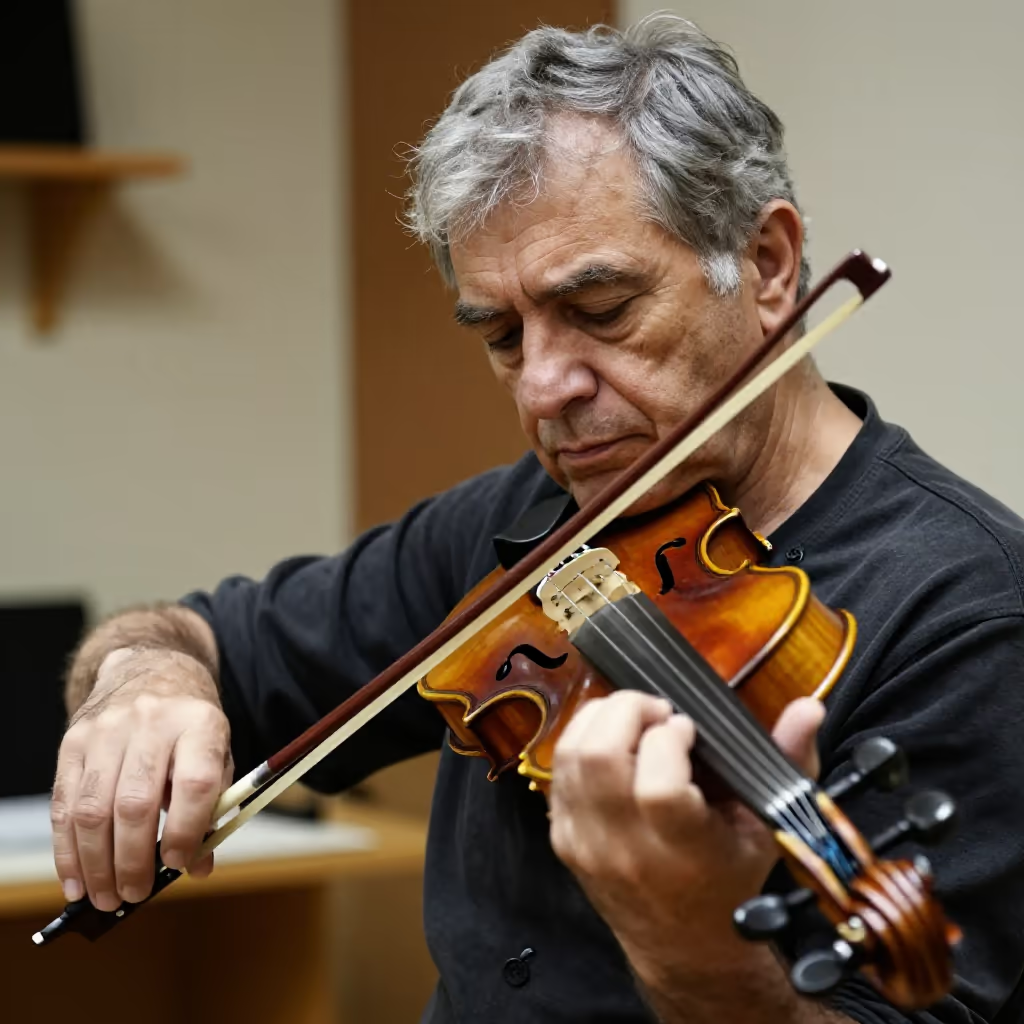
An object that was designed to produce tones and sounds and thereby make music.
example
Als Kind wollte ich unbedingt lernen, ein Musikinstrument zu spielen.
As a child, I really wanted to learn to play a musical instrument.
Usage tips
Word composition
The word is clearly made up of 'Musik' (music) and 'Instrument' (instrument). It is the general term for all instruments used to make music.
EXAMPLE
Die Gitarre ist ein sehr beliebtes Musikinstrument.
The guitar is a very popular musical instrument.
The right verb
In German, you 'spielt' (play) a musical instrument. The verb 'machen' (to make) is not connected directly with the instrument, but with the music itself.
EXAMPLE
Welches Musikinstrument spielst du?
Which musical instrument do you play?
Typical verbs
Besides 'spielen' (to play), the verbs 'lernen' (to learn) and 'üben' (to practice) are also very common in connection with a musical instrument.
EXAMPLE
Ich übe jeden Tag eine Stunde Klavier.
I practice piano for an hour every day.
Compare with
synonym · confusable
Musikinstrument vs Instrument
instrument
'das Instrument' and 'das Musikinstrument' can both mean an object used to make music. In this sense, they are very similar. 'Musikinstrument' is more specific and immediately makes it clear that the topic is music. 'Instrument' is shorter and completely natural in a musical context. Learners may confuse the words because 'Instrument' can also have other meanings, for example a tool in medicine or technology. If the context is not clear, 'Musikinstrument' is more unambiguous.
Musikinstrument
Hannah lernt ein neues Musikinstrument, weil sie in der Schulband spielen möchte.
Hannah is learning a new musical instrument because she wants to play in the school band.
Instrument
Im Musikraum steht ein altes Instrument neben dem Klavier.
In the music room, there is an old instrument next to the piano.