

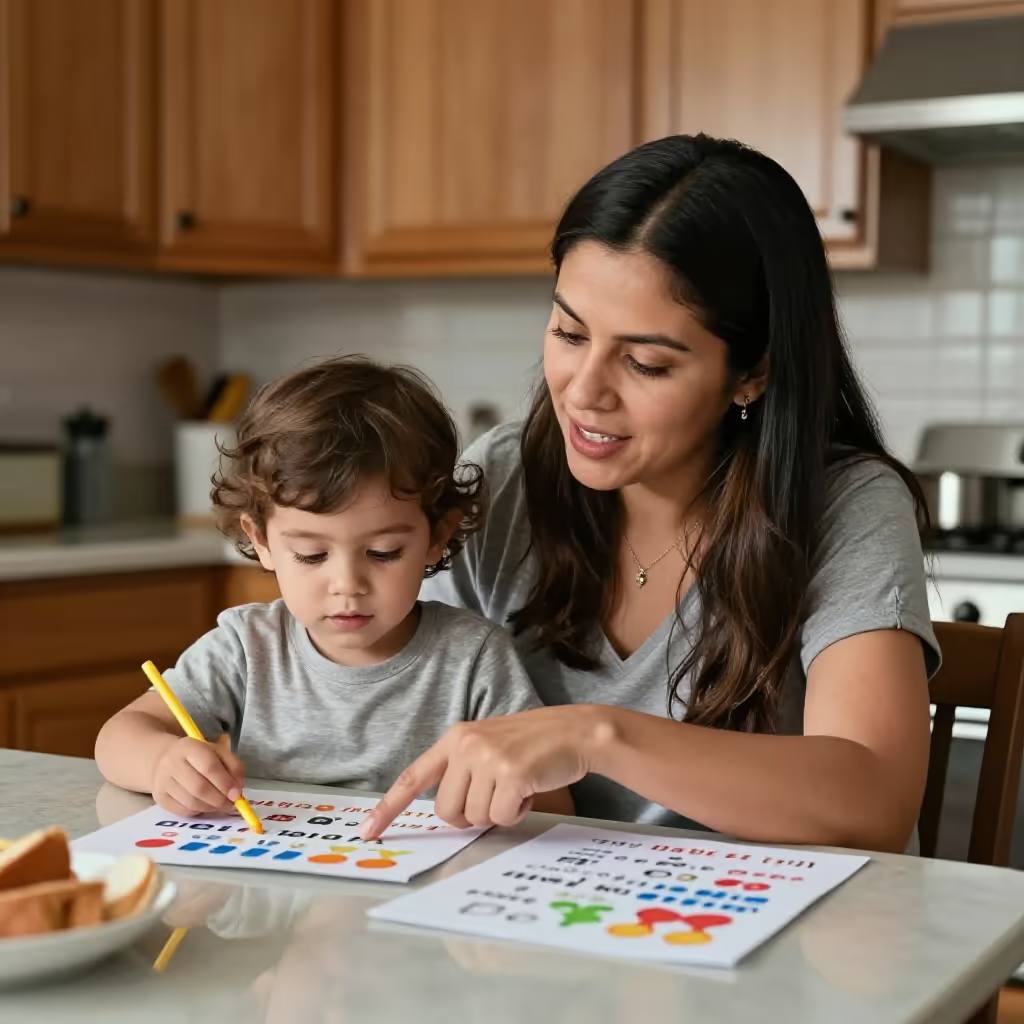
The first language a person learns as a child and grows up with. It is typically acquired in the family environment.
example
Seine Muttersprache ist Portugiesisch, aber er spricht auch fließend Deutsch und Englisch.
His native language is Portuguese, but he also speaks German and English fluently.
Usage tips
Compound word
The word is made up of 'Mutter' (mother) and 'Sprache' (language), connected with an 's'. So it literally describes the 'language of the mother', the one you learn first.
EXAMPLE
Obwohl er in Deutschland lebt, ist seine Muttersprache Türkisch.
Although he lives in Germany, his native language is Turkish.
Word family
The word 'der Muttersprachler' (native speaker) or 'die Muttersprachlerin' (female native speaker) is derived from 'Muttersprache' (native language). It refers to a person who learned this language as their first language.
EXAMPLE
Wir suchen einen Muttersprachler, der den Text korrigieren kann.
We are looking for a native speaker who can correct the text.
Typical usage
The word is very often used with a possessive pronoun (mein, dein, sein, etc.) and the verb 'sein' (to be) to name one's language of origin.
EXAMPLE
Meine Muttersprache ist Spanisch.
My native language is Spanish.
Compare with
antonym · confusable
Muttersprache vs Fremdsprache
foreign language
'Muttersprache' and 'Fremdsprache' both describe a person's relationship to a language. A 'Muttersprache' is the first language someone grows up with as a child. A 'Fremdsprache' is learned later and is not one's own native language. Learners may confuse the words because both often come up in language learning. The important thing is the perspective: for one person, German can be their native language; for another, it can be a foreign language.
Muttersprache
Der Gast hat erzählt, dass Arabisch seine Muttersprache ist.
The guest said that Arabic is his native language.
Fremdsprache
Für die Bewerbung lernt du eine Fremdsprache besonders gründlich.
For the application, you study a foreign language especially thoroughly.