

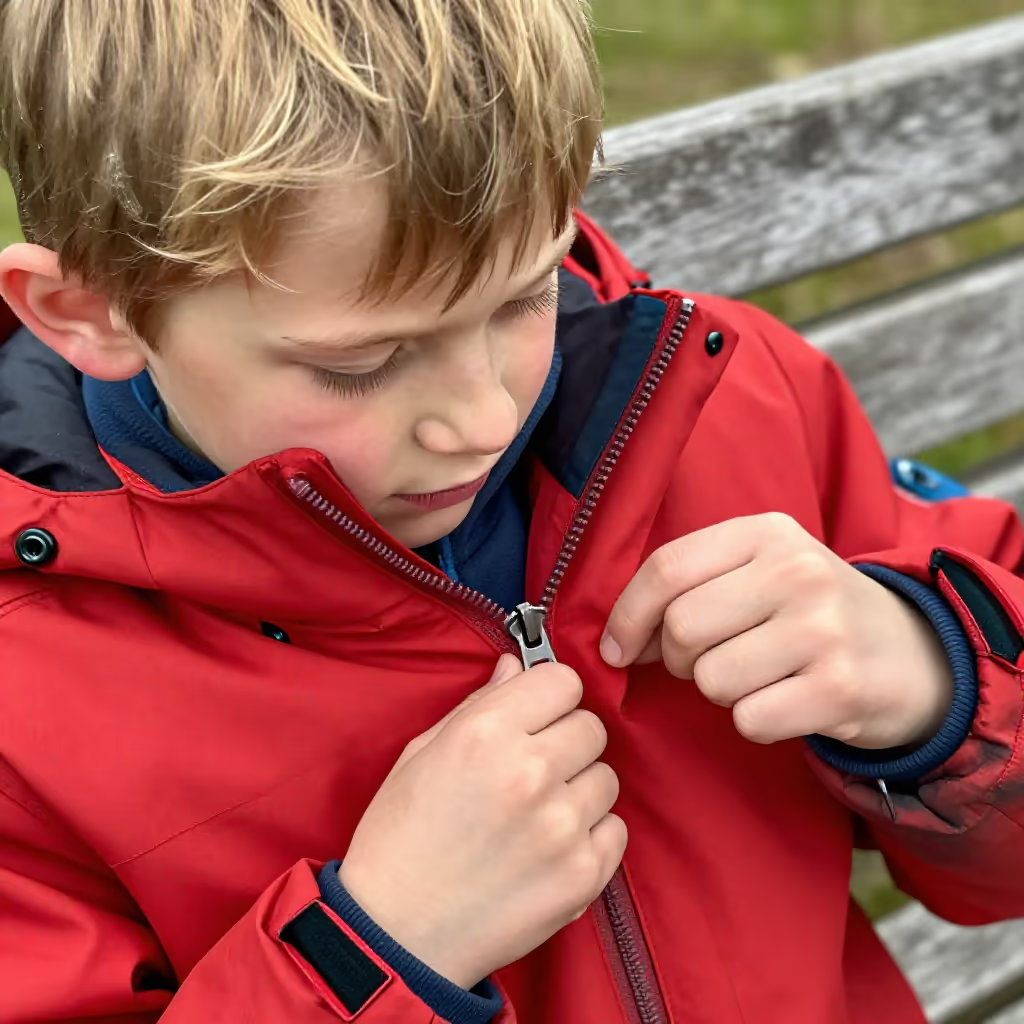
A fastening mechanism consisting of two flexible strips with small teeth that are hooked together or separated by a slider. It is commonly used on clothing, bags, and tents.
example
Der Reißverschluss an meiner Jacke ist kaputt.
The zipper on my jacket is broken.
Usage tips
Word composition
The word is made up of the verb 'reißen' (to tear/pull) and the noun 'Verschluss' (fastener/closure). Although you do not tear it apart, the name describes the quick pulling motion when closing it.
EXAMPLE
Der Reißverschluss meiner Tasche ist sehr robust.
The zipper on my bag is very sturdy.
Typical verbs
The most common verbs are 'öffnen' (to open) and 'schließen' (to close). In colloquial language, the separable verbs 'aufmachen' (to open) and 'zumachen' (to close) are also used frequently.
EXAMPLE
Kannst du mir helfen, den Reißverschluss an meinem Kleid zuzumachen?
Can you help me zip up the zipper on my dress?
Typical problems
When a zipper does not work, people often use the verb 'klemmen' (to be stuck/jam) or say that it 'ist kaputt' (is broken).
EXAMPLE
Mein Reißverschluss klemmt schon wieder, ich bekomme die Jacke nicht auf.
My zipper is stuck again; I can't get the jacket open.
Compare with
confusable
Reißverschluss vs Knopf
button
'der Knopf' and 'der Reißverschluss' can both be on clothing and close something. Even so, they are different things. A 'Knopf' is a small part that you push through a buttonhole. A 'Reißverschluss' consists of two rows of teeth and a slider that you pull up or down. Learners may confuse the words because both appear on jackets, trousers, or bags. If you press something or push it through a hole, it is a Knopf. If you pull a slider, it is a Reißverschluss.
Reißverschluss
Der Reißverschluss meiner Jacke klemmt schon wieder.