


der Sand
sand
A fine, grainy material made up of rock particles, found on beaches, in deserts, or used as a building material.
EXAMPLE
Die Kinder spielen am Strand im Sand.
The children are playing in the sand at the beach.
sand
Loading your saved state.
sand
A fine, grainy material made up of rock particles, found on beaches, in deserts, or used as a building material.
Die Kinder spielen am Strand im Sand.
The children are playing in the sand at the beach.

a hitch
In the idiom 'Sand im Getriebe sein/haben' (to be/have sand in the gears), it means that there is a problem or disruption preventing things from running smoothly.
Seit dem neuen Update ist bei unserer Software irgendwie Sand im Getriebe.
Since the new update, there has somehow been a hitch in our software.

to bury one's head
In the idiom 'den Kopf in den Sand stecken' (to bury one's head in the sand), it means consciously ignoring an unpleasant reality or problem instead of dealing with it.
Du kannst nicht ewig den Kopf in den Sand stecken, du musst dich dem Problem stellen.
You can't bury your head in the sand forever; you have to face the problem.
The word 'Sand-' is a very productive first part of compound nouns. If you see 'Sand-' at the beginning of a word, it usually refers to the material, as in 'Sandburg' (sandcastle), 'Sandkasten' (sandbox), or 'Sandstrand' (sandy beach).
Im Sommer gehen wir oft zum Sandstrand an der Küste.
In summer, we often go to the sandy beach on the coast.
In its main meaning, 'Sand' (sand) is an uncountable noun (mass noun). When talking about the material in general, it is often used without an article. The plural 'die Sande' is very rare and is only used in technical language for different types of sand.
Pass auf, du hast Sand in den Schuhen.
Watch out, you have sand in your shoes.
The idiom 'Sand im Getriebe haben/sein' (to have/be sand in the gears) figuratively describes that a process or collaboration is not running smoothly. You can say 'Es ist Sand im Getriebe' (there is sand in the gears) or 'Wir haben Sand im Getriebe' (we have sand in the gears).
In der Kommunikation zwischen den Abteilungen ist momentan Sand im Getriebe.
At the moment, there is a hitch in the communication between the departments.
The idiom 'den Kopf in den Sand stecken' (to bury one's head in the sand) is an active action. The subject of the sentence is the person who consciously ignores a problem or danger instead of dealing with it.
Wir können nicht länger den Kopf in den Sand stecken und müssen über unsere Finanzen reden.
We can no longer bury our heads in the sand and have to talk about our finances.
gravel / dough
Sand and Kies are both granular materials, but they differ mainly in grain size. Sand consists of very fine grains, while Kies consists of larger, usually rounded stones. Use Sand for fine material and Kies for paths or concrete containing larger stones.
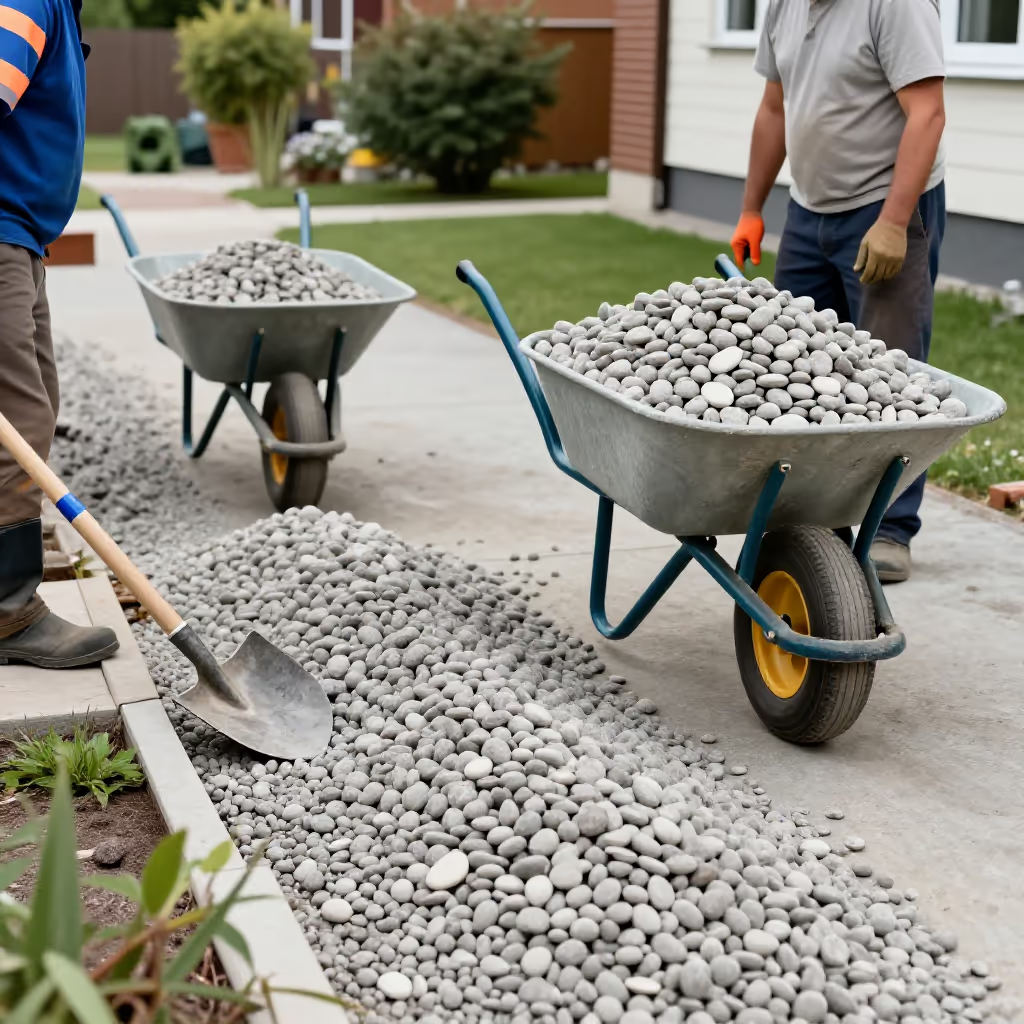
Für den Spielplatz bestellten wir feinen Sand.
We ordered fine sand for the playground.
Für den Gartenweg bestellten wir runden Kies.
We ordered rounded gravel for the garden path.