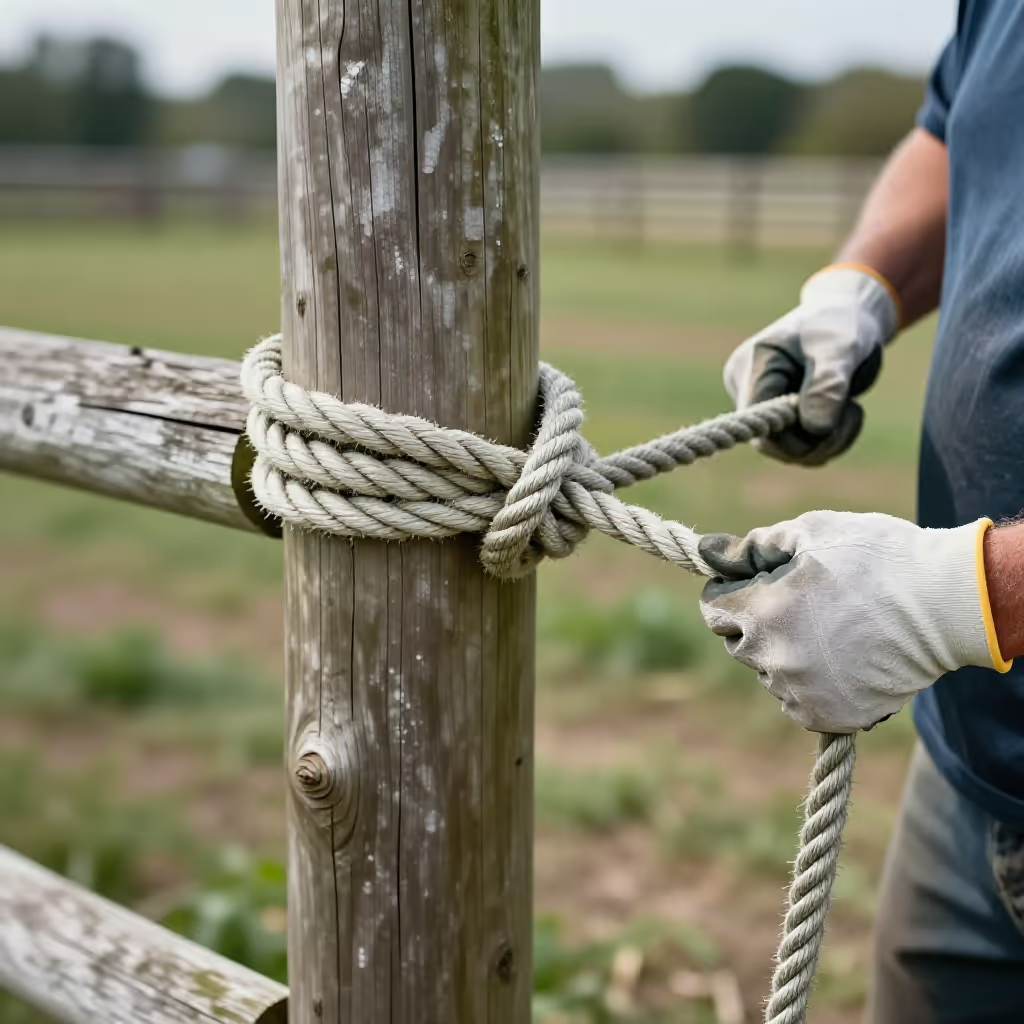
A loop made of rope, wire, or similar material that tightens when you pull on it. It is used for catching, fastening, or hanging.
example
Der Wilderer stellte eine Schlinge, um ein Kaninchen zu fangen.
The poacher set a noose to catch a rabbit.

Usage tips
Word family
The noun 'die Schlinge' (noose/sling) is closely related to the verb 'schlingen' (to wrap something around something / to wind), which means 'etwas um etwas wickeln' or 'winden'. A Schlinge is therefore the result of this action.
EXAMPLE
Er schlang das Seil um den Baumstamm.
He wrapped the rope around the tree trunk.
Context clue
To distinguish the meanings, pay attention to the context. If it is about ropes, traps, or hunting, a tightening loop is meant. In a medical context involving an arm injury, an arm sling is meant.
EXAMPLE
Der Jäger fand eine alte Schlinge im Wald.
The hunter found an old noose in the forest.
Fixed expression
The idiom 'den Kopf aus der Schlinge ziehen' (to save one's neck) is meant figuratively and means to save oneself from danger. The possessive pronoun is adapted to the person (mein, dein, sein Kopf).
EXAMPLE
Durch eine schnelle Entschuldigung konnte ich meinen Kopf gerade noch aus der Schlinge ziehen.
By apologizing quickly, I managed to save my neck at the last moment.
Typical verbs
For the meaning of a catching noose, the verbs 'eine Schlinge legen' (to lay a noose) or 'eine Schlinge stellen' (to set a noose) are typical. They express that a trap is being set up.
EXAMPLE
Es ist verboten, im Naturschutzgebiet Schlingen zu legen.
It is forbidden to set nooses in the nature reserve.
Typical use
In a medical context, 'Schlinge' (sling) is usually combined with the verb 'tragen' (to wear). You can also say that someone 'den Arm in einer Schlinge hat' (has their arm in a sling).
EXAMPLE
Nach ihrer Schulter-OP musste sie sechs Wochen lang eine Schlinge tragen.
After her shoulder surgery, she had to wear a sling for six weeks.
Compare with
near_synonym · confusable
Schlinge vs Falle
trap
'die Falle' and 'die Schlinge' can both have to do with catching something or with a dangerous situation. 'Falle' is the more general word for a device or situation in which an animal or a person is caught. 'Schlinge' is more specific: it is a loop made of rope, wire, or similar material that can tighten. Figuratively, there is also the expression 'den Kopf aus der Schlinge ziehen' (to save one's neck), meaning to get oneself out of a difficult situation. Learners may confuse the words because a 'Schlinge' can be a type of 'Falle', but not every 'Falle' is a 'Schlinge'.
Schlinge
Der Förster fand im Wald eine Schlinge aus dünnem Draht.
The forester found a noose made of thin wire in the woods.
Falle
Im Keller stellte Herr Müller eine Falle für die Maus auf.
Mr. Müller set up a trap for the mouse in the basement.