


schreien
to scream
To produce a loud, inarticulate sound, often in response to strong emotions such as pain, fear, anger, or great joy.
EXAMPLE
Das Kind schrie vor Schmerz, als es hinfiel.
The child screamed in pain when it fell down.
to scream
Loading your saved state.
to scream
To produce a loud, inarticulate sound, often in response to strong emotions such as pain, fear, anger, or great joy.
Das Kind schrie vor Schmerz, als es hinfiel.
The child screamed in pain when it fell down.
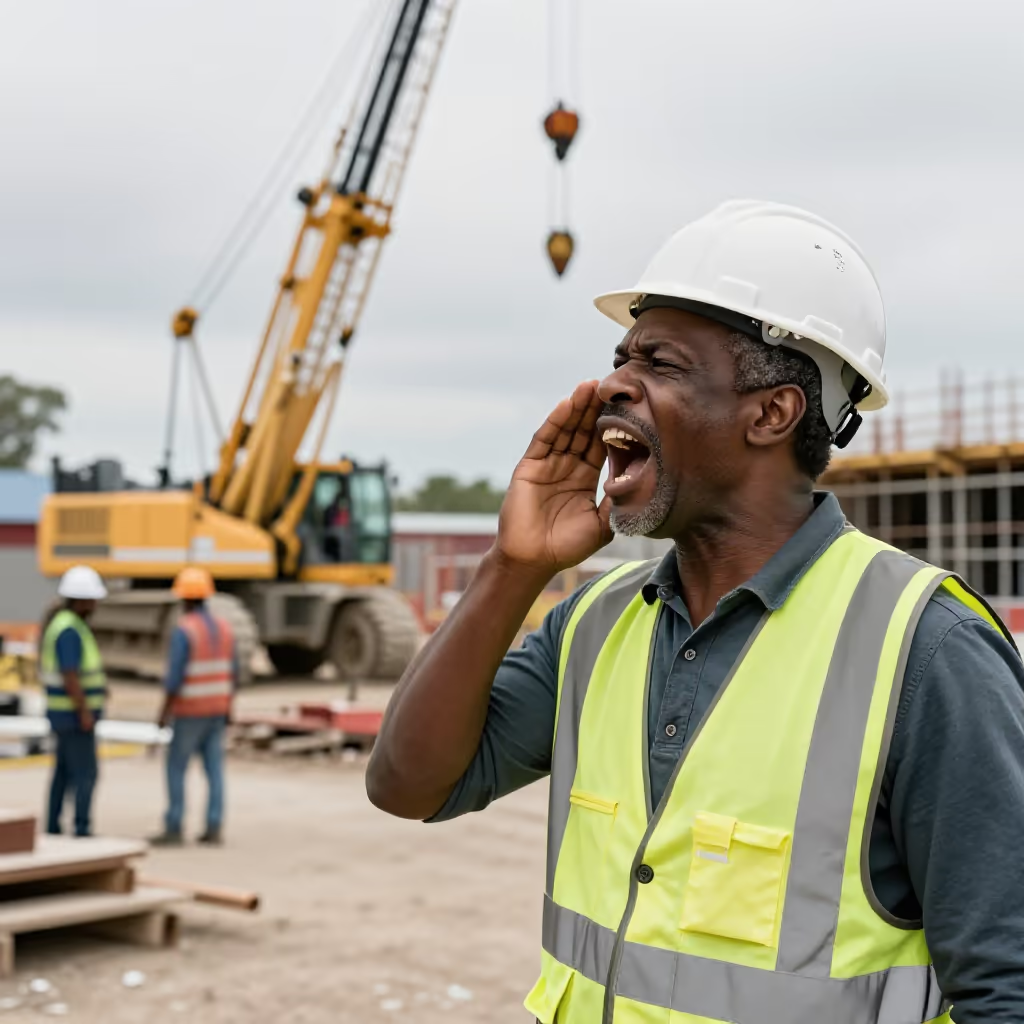
to shout
To call out or speak very loudly in order to be understood over a long distance or amid noise.
Du musst nicht so schreien, ich stehe direkt neben dir.
You don't have to shout like that; I'm standing right next to you.

to cry out for
Figuratively, for a situation to urgently require a specific measure or solution.
Dieses alte System schreit geradezu nach einer Modernisierung.
This old system is practically crying out for modernization.

to scream
Figuratively, for something to be extremely noticeable, especially with regard to colors or patterns.
Sein neongelbes Hemd schrie förmlich nach Aufmerksamkeit.
His neon yellow shirt practically screamed for attention.
To state the reason for screaming, the preposition 'vor' with the dative is often used, especially with emotions. The phrase 'aus vollem Hals' (at the top of one's lungs) is also common.
Die Fans schrien vor Freude, als ihr Team das Tor schoss.
The fans screamed with joy when their team scored the goal.
In the meaning 'to produce a loud sound,' 'schreien' (to scream) can often stand alone, without an object or a preposition. This is especially common with babies or in sudden moments of fright.
Als sie die Spinne sah, musste sie laut schreien.
When she saw the spider, she had to scream loudly.
The expression 'schreien nach' (to cry out for) is used figuratively and means that a situation urgently requires a solution. The thing that needs the solution is the subject of the sentence.
Die unübersichtliche Kreuzung schreit nach einer Ampel.
The confusing intersection is crying out for a traffic light.
When colors or patterns are described as 'schreiend' (screaming), it means they are extremely noticeable and garish. This is often intensified with adverbs such as 'förmlich' (practically/literally) or 'geradezu' (downright).
Ihre Jacke war in einem schreienden Orange gehalten.
Her jacket was in a screaming orange.
to call
When making a loud utterance over a distance, both „rufen“ and „schreien“ can be possible. „Rufen“ emphasizes a message directed at a specific person, while „schreien“ focuses mainly on the extreme volume, for example because of noise or a great distance. Choose the word according to this emphasis.

Wegen des Baulärms schreit er, damit seine Schwester ihn hört.
Because of the construction noise, he shouts so that his sister can hear him.
Ich rufe meiner Schwester vom Balkon aus zu, damit sie nach oben kommt.
I call out to my sister from the balcony so that she comes upstairs.