

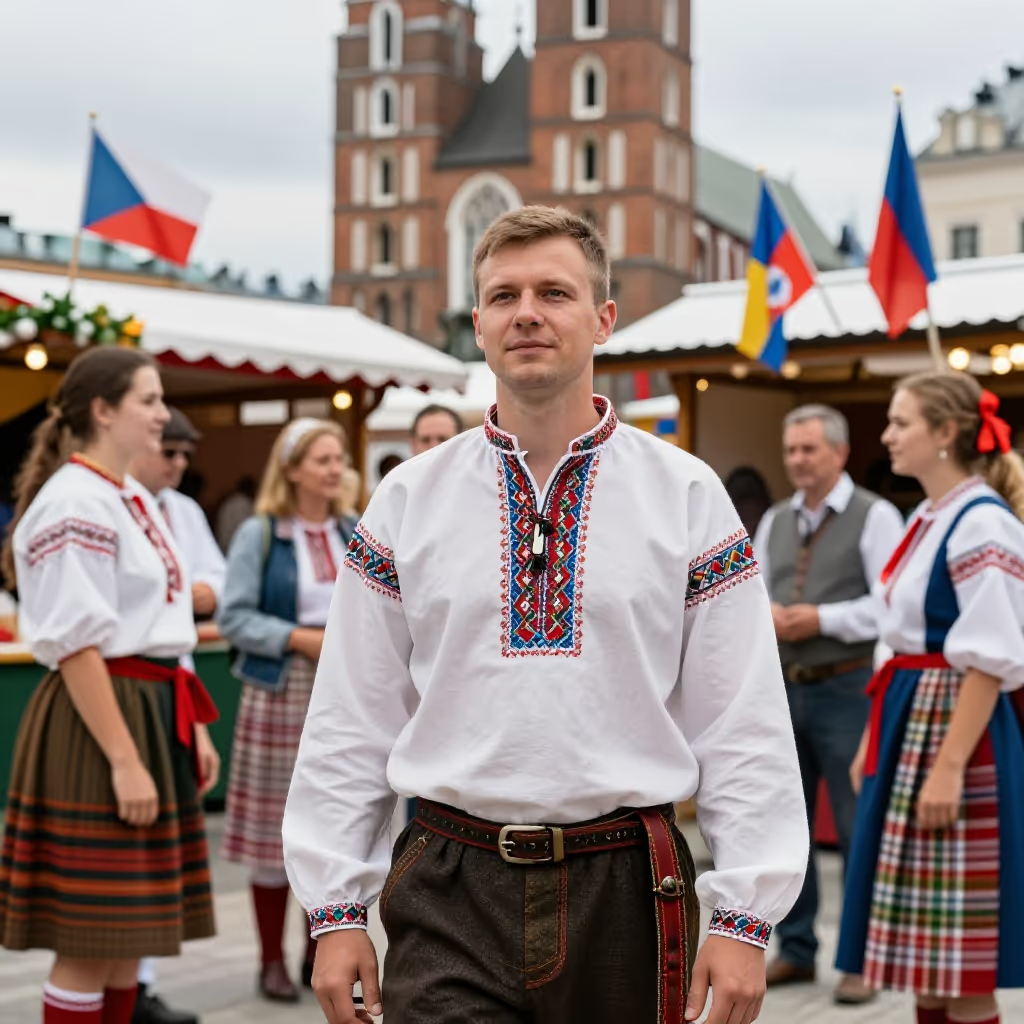
A member of one of the Slavic peoples, a large ethnolinguistic group in Eastern, Central, and Southeastern Europe, which includes, for example, Russians, Poles, Czechs, Serbs, and Croats.
example
Der polnische Papst Johannes Paul II. war der erste Slawe in diesem Amt.
The Polish pope John Paul II was the first Slav in this office.
Usage tips
N-declension
'Der Slawe' (the Slav) belongs to the N-declension. This means that the noun gets the ending '-n' in the accusative, dative, and genitive singular, as well as throughout the plural. A common mistake is to forget this ending.
EXAMPLE
Ich habe gestern einen Slawen kennengelernt.
I met a Slav yesterday.
Word family
The related adjective is 'slawisch' (Slavic). It is used to describe languages, cultures, or people's origins.
EXAMPLE
Tschechisch ist eine slawische Sprache.
Czech is a Slavic language.
Use in the plural
The word is very often used in the plural, 'die Slawen' (the Slavs). This refers to the entirety of the Slavic peoples in Europe.
EXAMPLE
Die Geschichte der Slawen ist sehr vielfältig.
The history of the Slavs is very diverse.
Compare with
confusable
Slawe vs Russe
Russian
'der Russe' and 'der Slawe' can overlap because Russians belong to the Slavic peoples. But the difference is important: 'Russe' is more specific and means a male person from Russia or of Russian origin. 'Slawe' is much more general and can also mean a Pole, Czech, Serb, Croat, and many others. Learners may confuse the words because both have to do with origin and language in Eastern Europe. If you mean the specific origin Russia, 'Russe' is correct. If you are talking about a larger ethnic or language group, 'Slawe' fits.
Slawe
In dem Vortrag erklärte der Historiker, dass nicht jeder Slawe aus Russland kommt.
In the lecture, the historian explained that not every Slav comes from Russia.
Russe
Der Russe erzählte im Kurs von seiner Heimatstadt Moskau.
The Russian man told the class about his hometown, Moscow.