

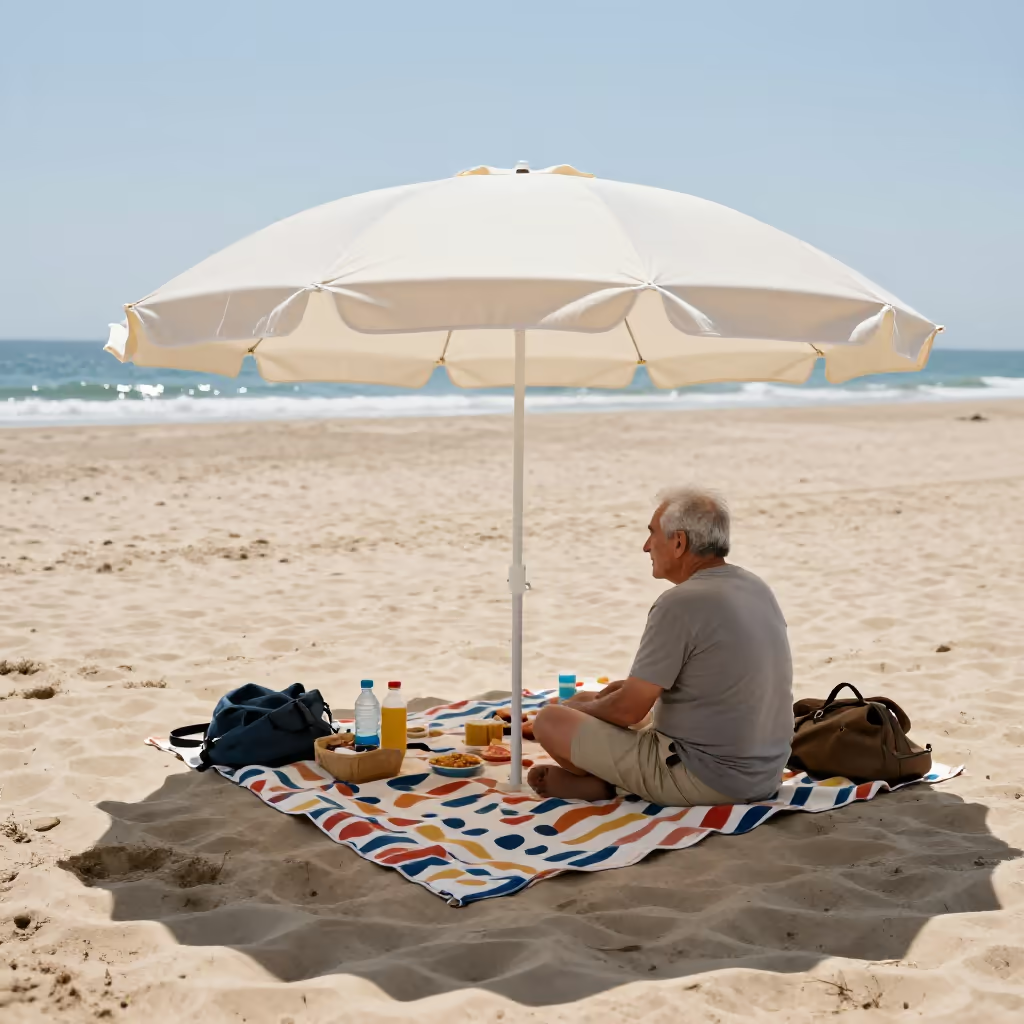
A large umbrella that can be opened and is used to provide shade and protect against direct sunlight. It is typically used in the garden, at the beach, or on terraces.
example
Wir setzten uns im Café unter einen großen Sonnenschirm, weil es so heiß war.
We sat in the café under a large parasol because it was so hot.
Usage tips
Compound word
The word is made up of 'die Sonne' (the sun) and 'der Schirm' (the umbrella/screen). So it is literally an umbrella that protects against the sun.
EXAMPLE
Am Strand brauchen wir unbedingt einen Sonnenschirm.
At the beach, we absolutely need a parasol.
Typical verbs
To open a 'Sonnenschirm' (parasol), you use the verbs 'aufspannen' or 'aufstellen'. To close it, you say 'zuklappen' or 'einklappen'.
EXAMPLE
Kannst du bitte den Sonnenschirm aufspannen? Die Sonne ist sehr stark.
Can you please open the parasol? The sun is very strong.
Correct preposition
When you are in the shade of the umbrella, you use the preposition 'unter' with the dative.
EXAMPLE
Die Kinder spielen im Sandkasten unter dem großen Sonnenschirm.
The children are playing in the sandbox under the large parasol.
Compare with
near_synonym · confusable
Sonnenschirm vs Schirm
umbrella / shade
'der Schirm' and 'der Sonnenschirm' can both mean a fold-out object used for protection. 'Sonnenschirm' is more specific: it protects from the sun and provides shade, often in the garden, on a terrace, or at the beach. 'Schirm' is more general and can also be an umbrella. Learners may confuse the words because a 'Sonnenschirm' is also a type of 'Schirm'. When it is about sun and shade, 'Sonnenschirm' is clearer. If the context is already unambiguous, 'Schirm' can also sound natural.
Sonnenschirm
Wir stellen den Sonnenschirm auf die Terrasse, damit die Kinder im Schatten spielen können.
We set up the parasol on the terrace so the children can play in the shade.
Schirm
Am Strand stellte er den Schirm neben die Tasche.
At the beach, he set up the umbrella next to the bag.