


die Spirale
spiral
A geometric shape that resembles a winding curve moving away from or toward a center.
EXAMPLE
Das Schneckenhaus hat die Form einer Spirale.
The snail shell has the shape of a spiral.
spiral
Loading your saved state.
spiral
A geometric shape that resembles a winding curve moving away from or toward a center.
Das Schneckenhaus hat die Form einer Spirale.
The snail shell has the shape of a spiral.

spiral
A figurative term for a process that reinforces itself and develops ever faster in a particular, usually negative, direction.
Die Gewaltspirale in der Region muss dringend durchbrochen werden.
The spiral of violence in the region must urgently be broken.

IUD
A colloquial term for an intrauterine device (IUD), a medical device that is inserted into the uterus for contraception.
Sie hat sich für die Hormonspirale als Verhütungsmethode entschieden.
She chose the hormonal IUD as her method of contraception.
In its figurative meaning, 'Spirale' (spiral) is often used for negative developments. Typical phrases are 'in eine Spirale geraten' (to get caught in a spiral), 'eine Spirale durchbrechen' (to break a spiral), or 'sich in einer Abwärtsspirale befinden' (to be in a downward spiral).
Das Land droht, in eine Spirale der Gewalt zu geraten.
The country is at risk of getting caught in a spiral of violence.
To specify the type of negative development, 'Spirale' (spiral) is often used as the second part of a compound noun. Common examples are 'Gewaltspirale' (spiral of violence), 'Schuldenspirale' (debt spiral), or 'Negativspirale' (negative spiral).
Die steigenden Zinsen könnten eine gefährliche Schuldenspirale auslösen.
The rising interest rates could trigger a dangerous debt spiral.
In the medical meaning, 'Spirale' (IUD) is a colloquial expression. In a formal or medical context, the technical term 'Intrauterinpessar' (intrauterine device) is used.
Meine Ärztin hat mir die Hormonspirale empfohlen.
My doctor recommended the hormonal IUD to me.
In the context of contraception, 'Spirale' (IUD) is often specified by the material or how it works. The most common types are the 'Kupferspirale' (copper IUD) and the 'Hormonspirale' (hormonal IUD).
Sie informiert sich über die Vor- und Nachteile der Kupferspirale.
She is finding out about the advantages and disadvantages of the copper IUD.
helix
Both words can refer to a screw-shaped form. „Die Spirale“ is the more general term for a winding curve, while „die Helix“ is a technical term for a three-dimensional curve around an axis with a regular pitch. Use „Spirale“ in general and „Helix“ when this three-dimensional form is specifically meant.
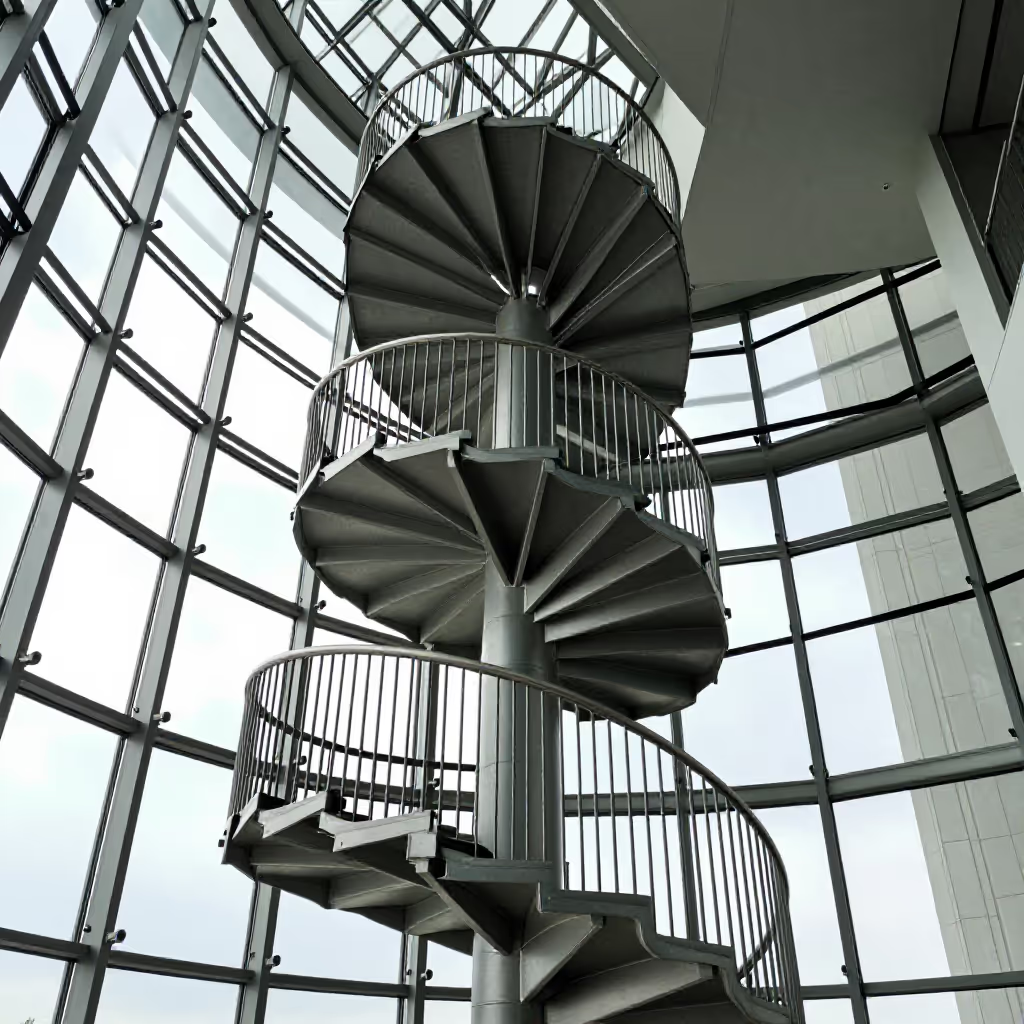
Die Kinder zeichneten eine Spirale, die sich vom Mittelpunkt nach außen windet.
The children drew a spiral that winds outward from the center.
Die Feder bildet eine Helix, die sich gleichmäßig um ihre Achse windet.
The spring forms a helix that winds evenly around its axis.