


stumpf
blunt / dull
Not sharp; without a functioning cutting edge or point. The opposite of 'scharf' (sharp).
EXAMPLE
Mit diesem stumpfen Messer kann man keine Tomaten schneiden.
You can't cut tomatoes with this dull knife.
blunt / dull
Loading your saved state.
blunt / dull
Not sharp; without a functioning cutting edge or point. The opposite of 'scharf' (sharp).
Mit diesem stumpfen Messer kann man keine Tomaten schneiden.
You can't cut tomatoes with this dull knife.

numb / apathetic
Mentally or emotionally indifferent, apathetic, and without interest or reaction.
Nach der tagelangen, monotonen Arbeit fühlte er sich völlig stumpf und leer.
After days of monotonous work, he felt completely numb and empty.

matte / dull
A surface or color that does not shine or reflect; matte.
Die Wand wurde in einem stumpfen Grauton gestrichen.
The wall was painted in a dull shade of gray.
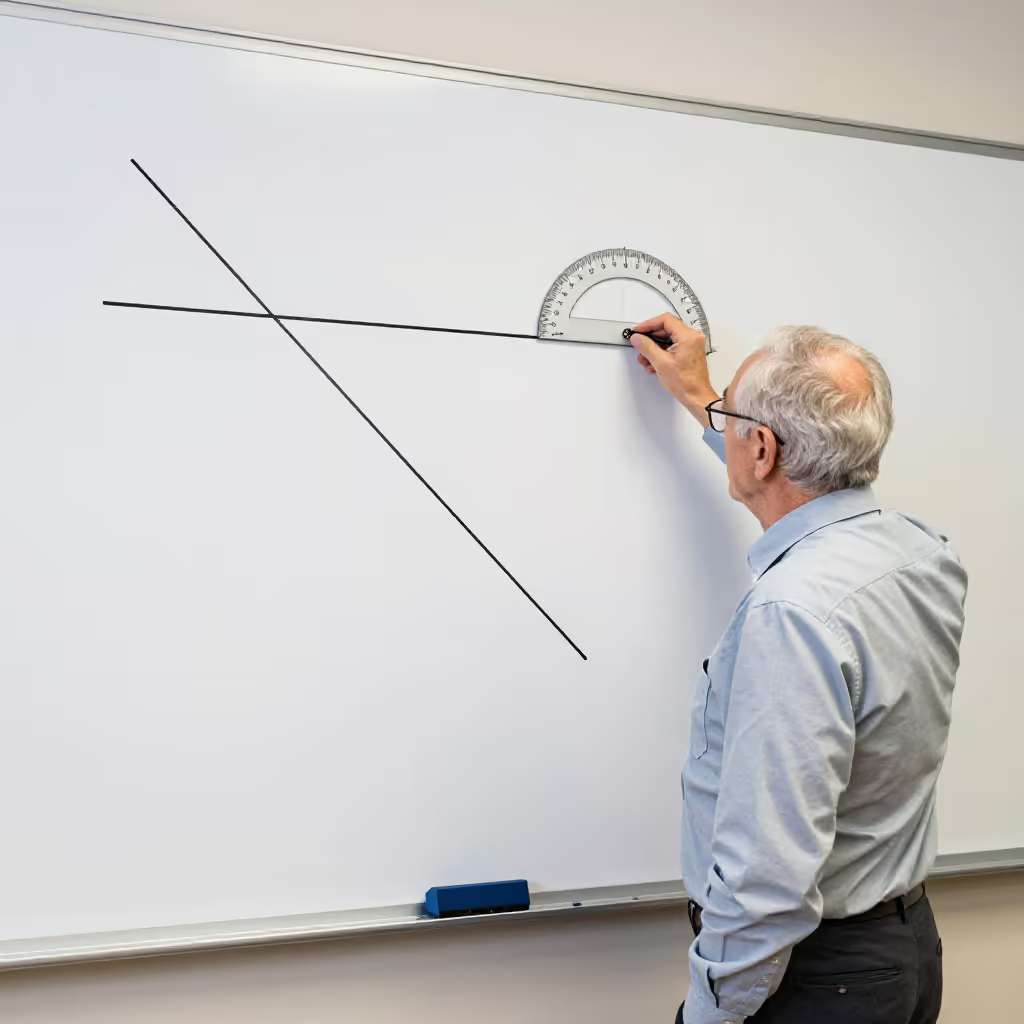
obtuse
In geometry, an angle that is greater than 90 degrees but less than 180 degrees.
Das Dreieck hat einen stumpfen Winkel und zwei spitze Winkel.
The triangle has one obtuse angle and two acute angles.

blunt
In medicine, an injury caused by an impact or blow without an open wound.
Der Patient erlitt bei dem Unfall ein stumpfes Bauchtrauma.
The patient suffered blunt abdominal trauma in the accident.
The adjective 'stumpf' (blunt/dull) belongs to a word family. The verb 'abstumpfen' means to become blunt or numb (e.g., a knife or a feeling). The noun 'der Stumpf' refers to the remaining part of something, e.g., 'ein Baumstumpf' (a tree stump).
Nach vielen Stunden monotoner Arbeit stumpft man emotional ab.
After many hours of monotonous work, you become emotionally numb.
The meaning of 'stumpf' (blunt/dull) is easy to recognize from context. With tools like knives, it means 'nicht scharf' (not sharp). With feelings or reactions, it means 'teilnahmslos' (apathetic). With colors or surfaces, it means 'matt' (matte).
Diese Schere ist zu stumpf, um Papier zu schneiden.
These scissors are too dull to cut paper.
In the meaning 'nicht scharf' (not sharp), 'stumpf' (blunt/dull) is typically combined with objects that have a cutting edge or a point. Common examples are: 'eine stumpfe Klinge' (a dull blade), 'ein stumpfes Messer' (a dull knife), or 'eine stumpfe Nadel' (a blunt needle).
Ich habe mich mit der stumpfen Kante des Papiers geschnitten.
I cut myself on the dull edge of the paper.
When a person is described as 'stumpf' (numb/apathetic), it means they are emotionally insensitive or apathetic, not that they are stupid. It describes a lack of feeling, not a lack of intelligence.
Nach dem Schock fühlte sie sich innerlich leer und stumpf.
After the shock, she felt empty and numb inside.
The meanings of 'stumpf' (obtuse/blunt) in geometry ('stumpfer Winkel' = obtuse angle) and in medicine ('stumpfes Trauma' = blunt trauma) are technical terms. They are rarely used in everyday language.
Ein Winkel über 90 Grad wird als stumpfer Winkel bezeichnet.
An angle over 90 degrees is called an obtuse angle.
weak / matte
Matt and stumpf can both describe a surface without shine or reflection. Matt is the neutral, usual term, while stumpf additionally suggests a somewhat lifeless or rough impression. Matt is usually appropriate for a desired surface finish, while stumpf can have a stronger effect when describing the overall impression.

Die alte Küchenfront wirkt stumpf und wenig lebendig, weil sie kein Licht reflektiert.
The old kitchen cabinets look dull and lifeless because they do not reflect any light.
Die neue Küchenfront hat eine matte Oberfläche und spiegelt das Licht kaum.
The new kitchen cabinets have a matte surface that barely reflects the light.