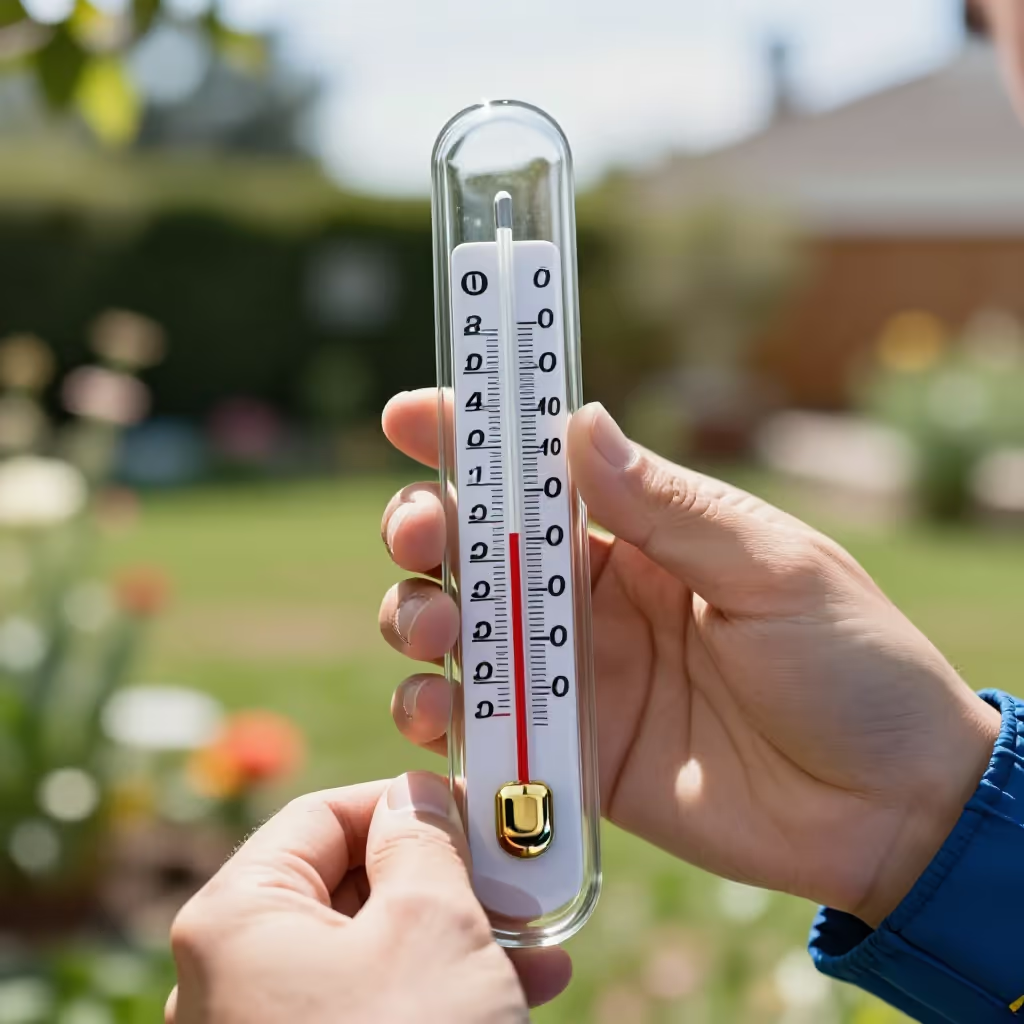
The physical measurement of the thermal state of a body or environment, usually given in degrees Celsius, Fahrenheit, or Kelvin.
example
Im Sommer kann die Temperatur hier auf über 35 Grad Celsius ansteigen.
In summer, the temperature here can rise to over 35 degrees Celsius.

Usage tips
Context clue
You can recognize the meaning of 'Temperatur' (temperature) from the context. If a number with 'Grad' (degrees) is mentioned, it is about a measurement. If people say that a person 'Temperatur hat' (has a temperature), it almost always means a fever.
EXAMPLE
Draußen hat es nur 5 Grad Temperatur.
Outside, the temperature is only 5 degrees.
Typical verbs
In a physical context, 'Temperatur' (temperature) is often combined with verbs that describe a change or measurement. Typical examples are: die Temperatur steigt (the temperature rises), sinkt (drops), fällt (falls), or wird gemessen (is measured).
EXAMPLE
Im Herbst fallen die Temperaturen deutlich.
In autumn, temperatures fall significantly.
Sentence structure with 'betragen'
To give an exact value, the fixed formulation 'die Temperatur beträgt ... Grad' (the temperature is ... degrees) or 'liegt bei ... Grad' (is at ... degrees) is often used. This is common in weather reports or scientific contexts.
EXAMPLE
Die durchschnittliche Temperatur beträgt im Januar minus zwei Grad Celsius.
The average temperature in January is minus two degrees Celsius.
Typical collocations
When talking about fever, 'Temperatur' (temperature) is often combined with adjectives such as 'hoch' (high), 'leicht' (slight), or 'erhöht' (elevated). The most common phrase is 'Temperatur haben' (to have a temperature).
EXAMPLE
Nach der Impfung hatte sie leicht erhöhte Temperatur.
After the vaccination, she had a slightly elevated temperature.
Compare with
near_synonym · confusable
Temperatur vs Hitze
heat
'die Temperatur' and 'die Hitze' both have to do with warmth. 'die Temperatur' is a measurement, for example 25 degrees or 38 degrees. It can be low, normal, or high. 'die Hitze', on the other hand, means a state of very high temperature, often in the weather, in a room, or near a fire. The words can be confused because a high temperature is often experienced as heat. If you mean a number or a measured value, 'Temperatur' fits. If you mean strong, unpleasant warmth, 'Hitze' fits.
Temperatur
Mein Nachbar misst am Wochenende die Temperatur im Kinderzimmer.
My neighbor measures the temperature in the children's room at the weekend.
Hitze
Wegen der Hitze bleiben die Schülerinnen heute in der Pause im Gebäude.
Because of the heat, the schoolgirls are staying inside the building during the break today.