

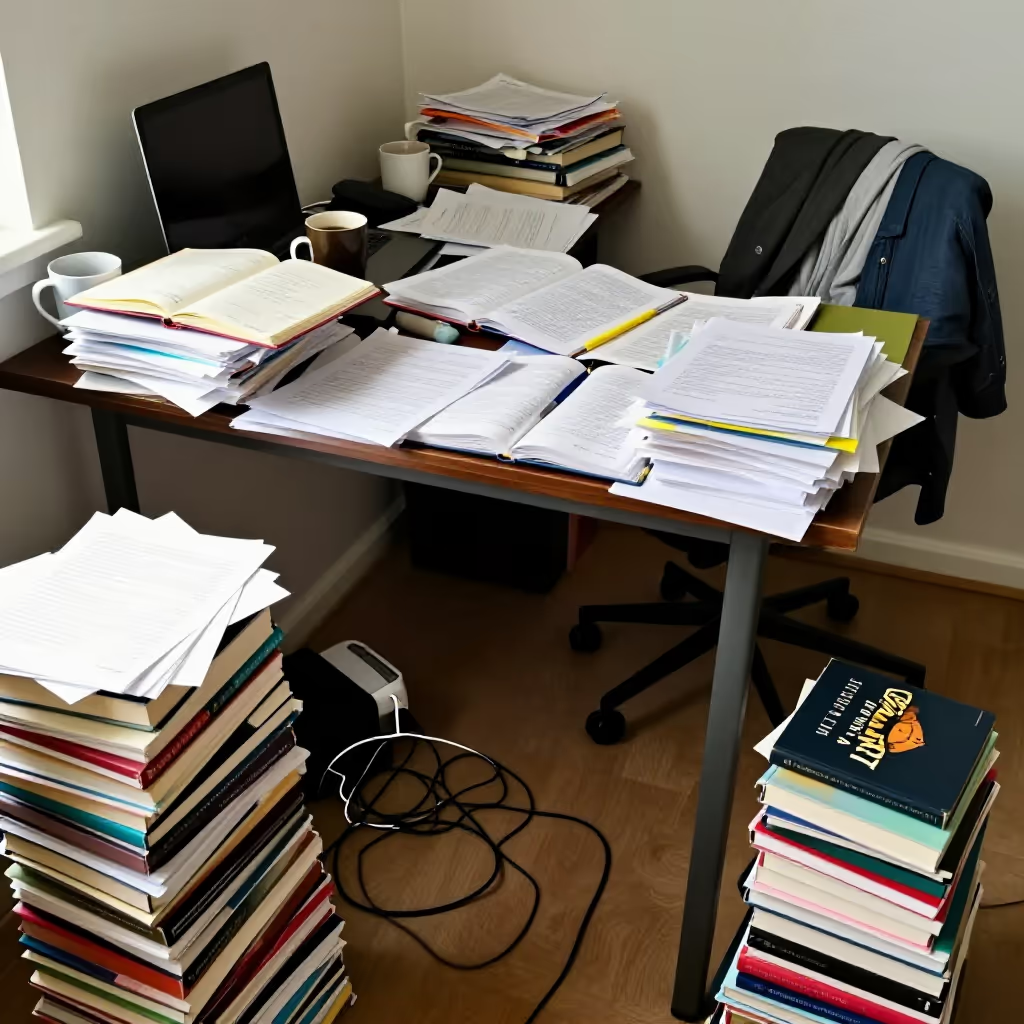
unordentlich
messy / untidy
Being in a state of disorder; not tidied up or clean. Often refers to rooms, desks, or the arrangement of things.
EXAMPLE
Sein Zimmer ist immer furchtbar unordentlich.
His room is always terribly messy.
messy / untidy
Loading your saved state.
messy / untidy
Being in a state of disorder; not tidied up or clean. Often refers to rooms, desks, or the arrangement of things.
Sein Zimmer ist immer furchtbar unordentlich.
His room is always terribly messy.

messy / untidy
A person who tends to create disorder and does not like tidying up.
Er ist ein sehr unordentlicher Mensch, seine Kleidung liegt überall herum.
He is a very messy person; his clothes are lying around everywhere.

messy / unkempt
Referring to outward appearance: not well-groomed, disheveled, or not neatly dressed.
Nach der langen Reise sah sie mit ihren unordentlichen Haaren ziemlich erschöpft aus.
After the long journey, she looked quite exhausted with her messy hair.
The word is made up of the negating prefix 'un-' and the adjective 'ordentlich' (tidy/neat). So it literally means 'not tidy' or 'not neat'.
Auf dem Schreibtisch lagen die Papiere in einem unordentlichen Haufen.
The papers were lying on the desk in a messy pile.
The noun that 'unordentlich' (messy/untidy) describes reveals the exact meaning. Does it refer to a place (room, desk), a person ('er ist unordentlich' — he is messy), or appearance (hair, clothing)?
Sein unordentlicher Schreibtisch spiegelt sein kreatives Chaos wider.
His messy desk reflects his creative chaos.
When referring to places or things, 'unordentlich' (messy/untidy) is often combined with words like 'Zimmer' (room), 'Wohnung' (apartment), 'Schreibtisch' (desk), or 'Haufen' (pile).
Ich muss dringend meine unordentliche Wohnung aufräumen.
I urgently need to tidy up my messy apartment.
Pay attention to the difference: 'Sein Zimmer ist unordentlich' (His room is messy) describes the state of a place. 'Er ist unordentlich' (He is messy) describes a trait or habit of the person.
Obwohl sie sehr unordentlich ist, ist ihr Büro immer sauber.
Although she is very messy, her office is always clean.
chaotic
Both words can describe a room that has not been tidied. „Unordentlich“ initially refers to a lack of order or cleanliness, while „chaotisch“ suggests much more extensive disorder and a lack of structure. „Unordentlich“ is often enough for things lying around, while „chaotisch“ is more suitable for complete disorder.

Nach dem Umzug ist das Wohnzimmer noch unordentlich, weil einige Bücher herumliegen.
After the move, the living room is still messy because some books are lying around.
Nach dem Umzug sieht das Wohnzimmer völlig chaotisch aus.
After the move, the living room looks completely chaotic.