


unwahrscheinlich
unlikely
Not very likely; something whose occurrence or truth one doubts; improbable.
EXAMPLE
Es ist höchst unwahrscheinlich, dass wir im Lotto gewinnen.
It is highly unlikely that we will win the lottery.
unlikely
Loading your saved state.
unlikely
Not very likely; something whose occurrence or truth one doubts; improbable.
Es ist höchst unwahrscheinlich, dass wir im Lotto gewinnen.
It is highly unlikely that we will win the lottery.

incredibly
Used colloquially as an intensifier in the sense of 'extraordinarily' or 'incredibly'.
Dieser Kuchen schmeckt unwahrscheinlich gut!
This cake tastes incredibly good!
The word is made up of 'un-' (not), 'wahr' (true), and 'scheinlich' (derived from 'scheinen'—to seem). Something that is 'unwahrscheinlich' (unlikely) therefore 'seems' 'not true' or not plausible.
Ein Sieg unserer Mannschaft scheint nach der ersten Halbzeit unwahrscheinlich.
A victory for our team seems unlikely after the first half.
The meaning depends strongly on the context. In neutral or formal sentences, it means 'unlikely'. In colloquial speech, especially before a positive adjective, it is used as an intensifier in the sense of 'unglaublich' (incredibly) or 'extrem' (extremely).
Ein Lottogewinn ist statistisch sehr unwahrscheinlich.
A lottery win is statistically very unlikely.
To express low probability, the structure 'Es ist unwahrscheinlich, dass ...' (It is unlikely that ...) is often used. The subordinate clause with 'dass' then describes the event that is unlikely.
Es ist unwahrscheinlich, dass er pünktlich kommt.
It is unlikely that he will arrive on time.
In spoken language, 'unwahrscheinlich' (incredibly) often functions as an intensifier for positive qualities. This use is informal and expresses great amazement or enthusiasm.
Ich habe gestern einen unwahrscheinlich lustigen Film gesehen.
Yesterday I saw an incredibly funny film.
incredible
When describing an extraordinary coincidence, both unglaublich and unwahrscheinlich can work. Unglaublich mainly expresses amazement about it, while unwahrscheinlich emphasizes the low probability or doubts about whether it is true.
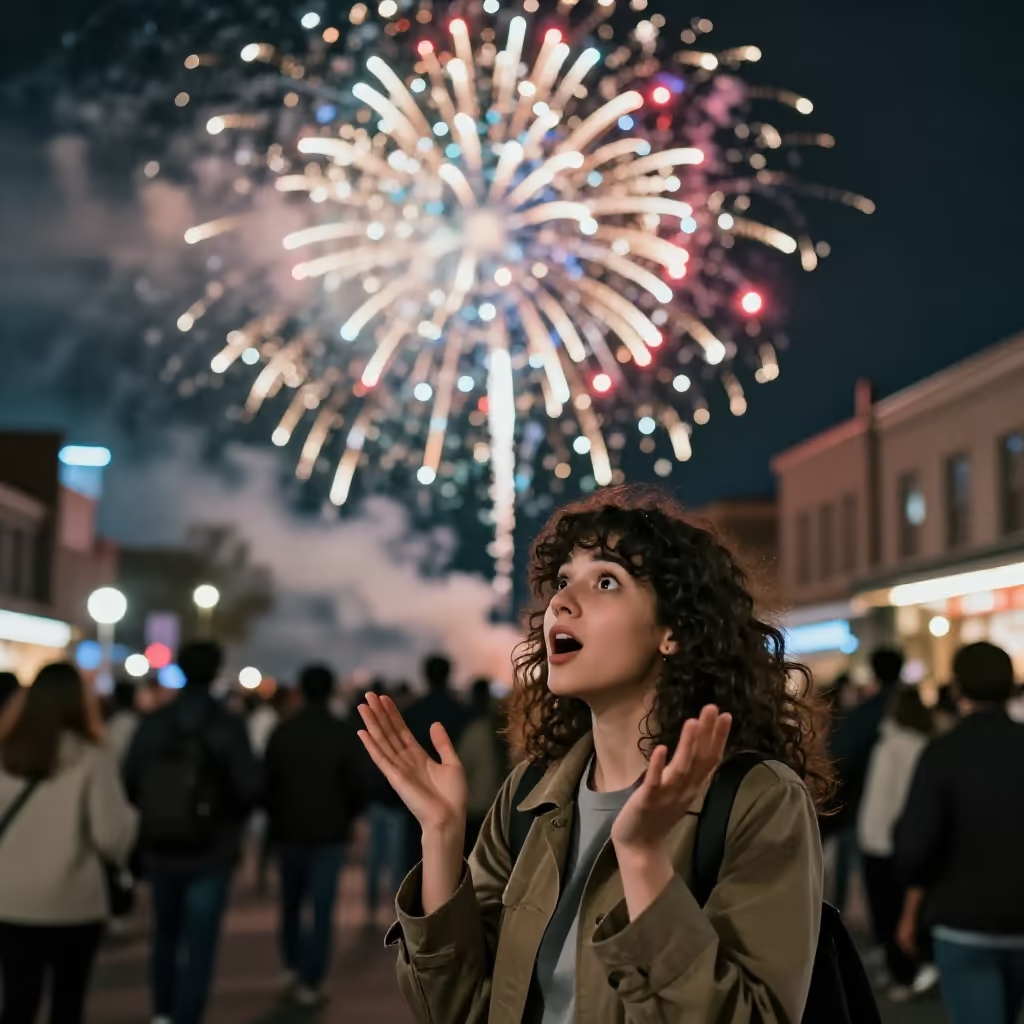
Es ist unwahrscheinlich, dass wir uns nach zwanzig Jahren zufällig wieder treffen.
It is unlikely that we will happen to meet again after twenty years.
Es ist unglaublich, dass wir uns nach zwanzig Jahren zufällig wiedergetroffen haben.
It is incredible that we happened to meet again after twenty years.