

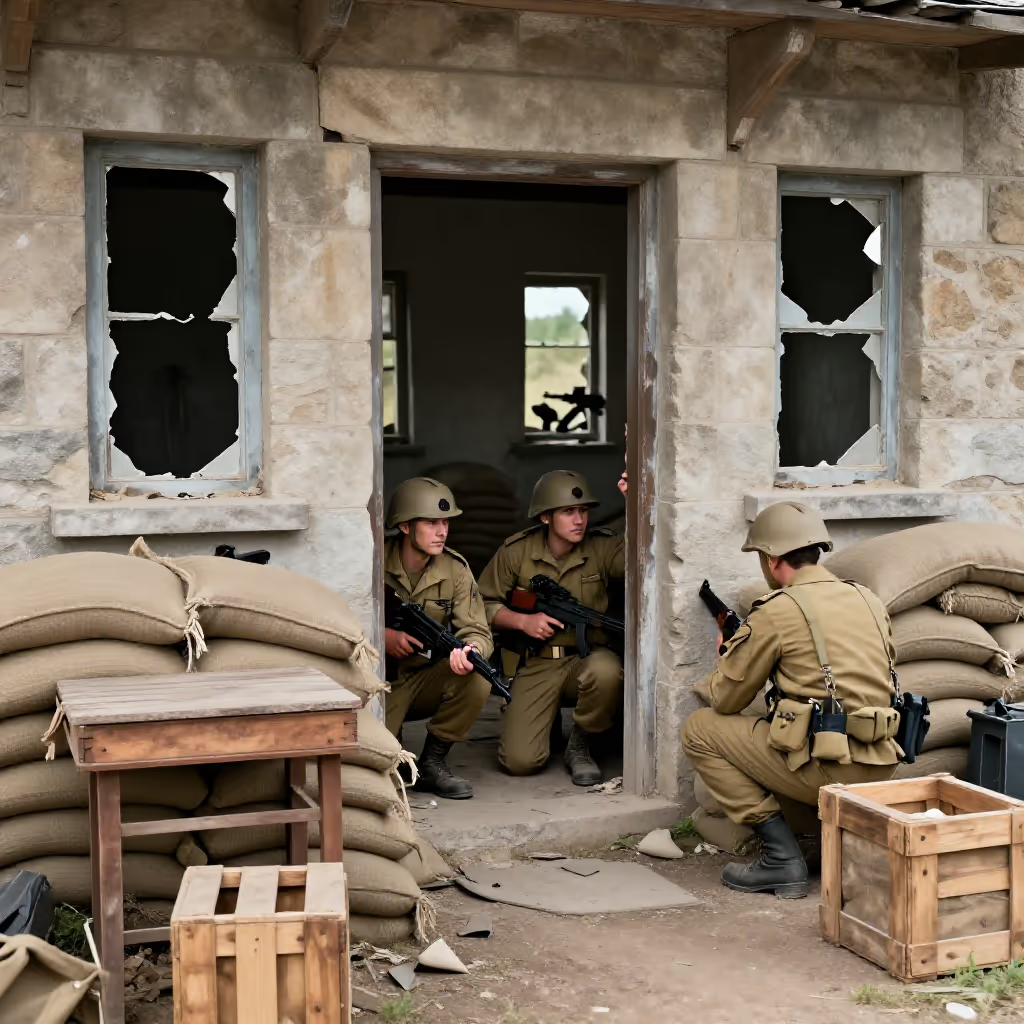
To protect oneself in a place with barricades or other obstacles in order to defend against an attack. You make a position difficult to capture.
example
Die Soldaten verschanzten sich hinter Sandsäcken.
The soldiers barricaded themselves behind sandbags.

Usage tips
Always reflexive
The verb 'verschanzen' (to barricade oneself) is always used reflexively with 'sich'. It describes that a person or group protects or isolates themselves, not that they barricade something else.
EXAMPLE
Die Demonstranten verschanzten sich im besetzten Gebäude.
The demonstrators barricaded themselves in the occupied building.
Inseparable verb
The prefix 'ver-' is inseparable and remains firmly attached to the verb stem in all sentence forms. The stress is always on the stem: ver-SCHAN-zen.
EXAMPLE
Er hat sich in seinem Büro verschanzt und geht nicht ans Telefon.
He has barricaded himself in his office and isn't answering the phone.
Preposition 'hinter'
Most often, 'sich verschanzen' (to barricade oneself / hide behind) is used with the preposition 'hinter' and the dative. This describes what serves as protection or a barricade.
EXAMPLE
Der Verdächtige verschanzte sich hinter einem umgekippten Tisch.
The suspect barricaded himself behind an overturned table.
Context clue
Whether the literal or figurative meaning is intended can be recognized from the object after the preposition. Physical objects like 'Möbel' (furniture) or 'Mauern' (walls) point to the literal meaning, while abstract terms like 'Regeln' (rules) or 'Ironie' (irony) point to the figurative meaning.
EXAMPLE
Die Einbrecher verschanzten sich hinter den Möbeln.
The burglars barricaded themselves behind the furniture.
Compare with
near_synonym · confusable
verschanzen vs ausweichen
to dodge / avoid
'ausweichen' and 'sich verschanzen' can both describe someone not openly facing a confrontation or responsibility. 'ausweichen' is more general and often just a single reaction, for example to a question. 'sich verschanzen' sounds stronger: someone withdraws, makes themselves inaccessible, and figuratively protects themselves behind excuses, rules, or silence. The words can be confused because both express avoidance. If someone simply does not answer directly, 'ausweichen' fits. If someone really shuts themselves off, 'sich verschanzen' fits better.
verschanzen
Vor dem Wochenende verschanzt sich mein Kollege hinter seinen E-Mails und spricht mit niemandem.
Before the weekend, my colleague hides behind his emails and speaks to no one.
ausweichen
Mina wich der Frage nach dem Fehler aus und sprach lieber über die neue Technik.
Mina avoided the question about the mistake and preferred to talk about the new technology.