


vorüber
over
Describes that something has passed in time, ended, or been completed.
EXAMPLE
Der Sturm ist endlich vorüber und die Sonne scheint wieder.
The storm is finally over, and the sun is shining again.
over / past
Loading your saved state.
over
Describes that something has passed in time, ended, or been completed.
Der Sturm ist endlich vorüber und die Sonne scheint wieder.
The storm is finally over, and the sun is shining again.
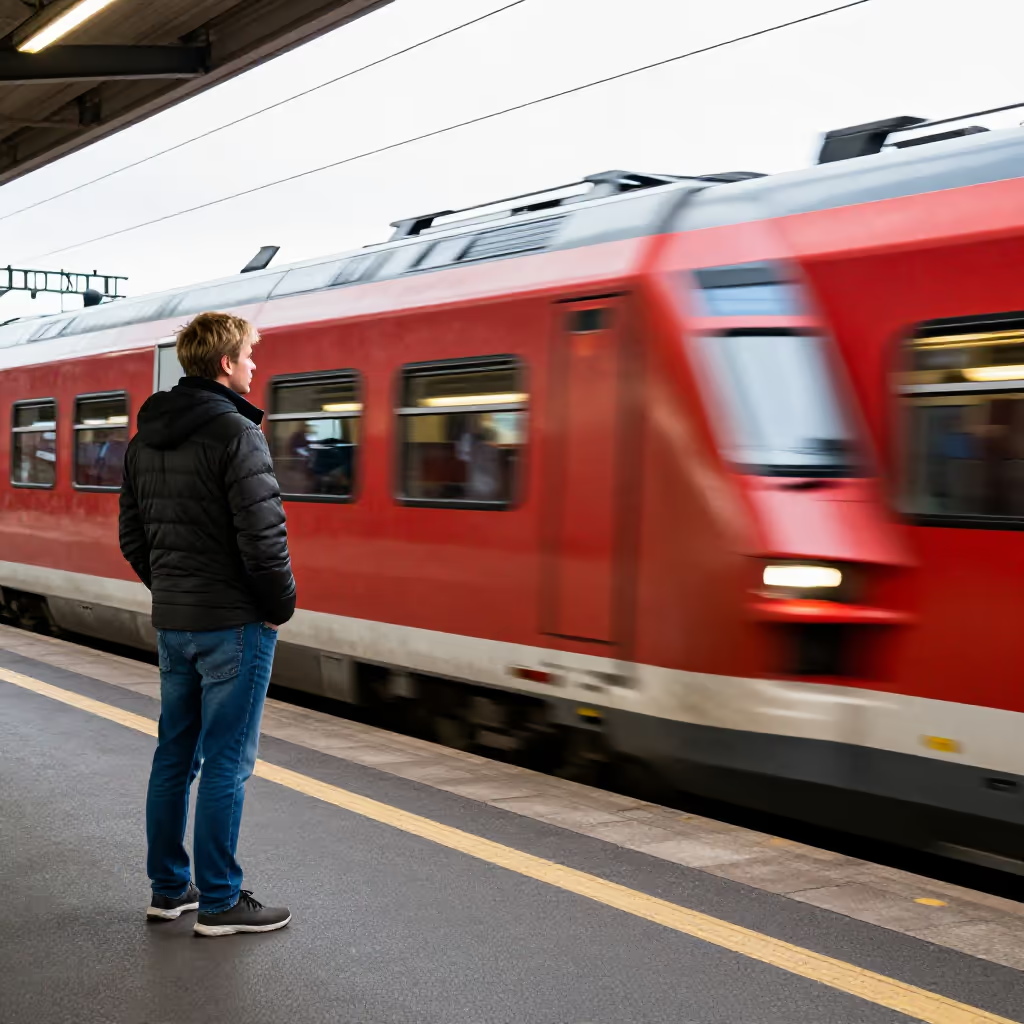
past
Describes a movement in which someone or something goes, drives, or flies past a place or person. It is often used as part of a separable verb, but can also stand alone.
Ich sah ihn am Fenster vorüber eilen.
I saw him hurry past the window.
'Vorüber' (over/past) is very often the prefix of separable verbs such as 'vorübergehen' (to pass by / to be over) or 'vorüberfahren' (to drive past). In main clauses, the prefix stands at the end of the sentence; in subordinate clauses and in the infinitive, it remains attached to the verb.
Ein Gewitter zieht gerade vorüber.
A thunderstorm is passing by right now.
In the temporal meaning, 'vorüber' (over) is almost always used with the verb 'sein' (to be). The structure is: [something] ist / war vorüber ([something] is / was over).
Die schlimmste Zeit ist jetzt vorüber.
The worst time is now over.
In the spatial meaning, 'vorüber' (past) is often combined with the preposition 'an' + dative. This expresses which place or person someone goes or drives past.
Er ist an mir vorübergegangen, ohne mich zu grüßen.
He walked past me without greeting me.
over / past
Vorbei and vorüber can both express that a period of time, an event, or a state has ended. In standard German, vorbei is the neutral everyday choice. In this temporal use, vorüber often sounds more elevated and can place greater emphasis on the passage of time.

Die schwere Zeit ist vorüber, schrieb Nina in ihrem Brief.
The difficult time has passed, Nina wrote in her letter.
Die schwere Zeit ist vorbei, sagte Nina im Gespräch.
The difficult time is over, Nina said in conversation.