

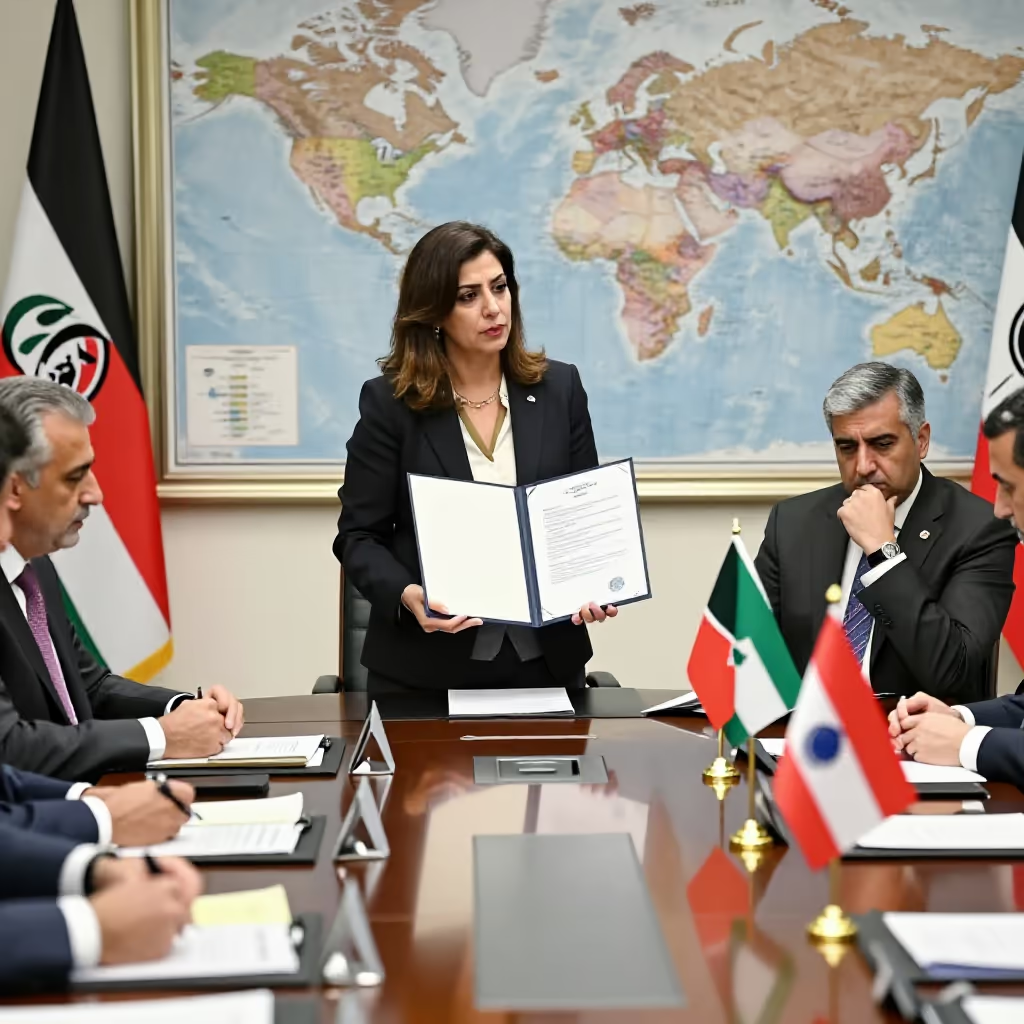
An institution that manages capital from member countries in order to secure the stability of the international monetary system and grant loans to countries in economic difficulty. It usually refers to the International Monetary Fund (IMF).
example
Der Internationale Währungsfonds hat dem Land einen Notkredit zur Stabilisierung seiner Wirtschaft gewährt.
The International Monetary Fund granted the country an emergency loan to stabilize its economy.
Usage tips
Word composition
The word consists of 'Währung' (currency) and 'Fonds' (fund). A 'Fonds' is a collection of money for a specific purpose. So literally, it is a pool of money that deals with currency issues.
EXAMPLE
Der Währungsfonds wurde gegründet, um die globale Finanzstabilität zu sichern.
The monetary fund was established to secure global financial stability.
Context clue
When 'der Währungsfonds' (the monetary fund) is used without further additions, it almost always means the International Monetary Fund (IMF). The context is usually international economic and financial policy.
EXAMPLE
In den Nachrichten wurde über eine neue Prognose des Währungsfonds berichtet.
The news reported on a new forecast by the monetary fund.
Typical collocations
Typical verbs associated with the monetary fund are 'einen Kredit gewähren' (to grant a loan), 'Hilfe beantragen' (to apply for assistance), or 'Auflagen erfüllen' (to meet conditions). These describe its function as a global lender.
EXAMPLE
Das Land muss die strengen Auflagen des Währungsfonds erfüllen, um weitere Kredite zu erhalten.
The country must meet the monetary fund's strict conditions in order to receive further loans.
Compare with
confusable
Währungsfonds vs Zentralbank
central bank
'Zentralbank' and 'Währungsfonds' both belong to the area of money, currencies, and the economy. Even so, they refer to different institutions. A 'Zentralbank' is responsible for the monetary policy of a country or currency area, for example interest rates and the money supply. 'Währungsfonds' usually refers to the International Monetary Fund. It helps countries in economic difficulty with loans and is meant to keep the international monetary system stable. The words can be confused because both have to do with currencies. Remember: the central bank controls its own currency policy, while the monetary fund works internationally with many countries.
Währungsfonds
Der Währungsfonds hat dem Land einen neuen Kredit zugesagt.
The monetary fund has promised the country a new loan.
Zentralbank
Nach der Krise senkte die Zentralbank die Zinsen.
After the crisis, the central bank lowered interest rates.