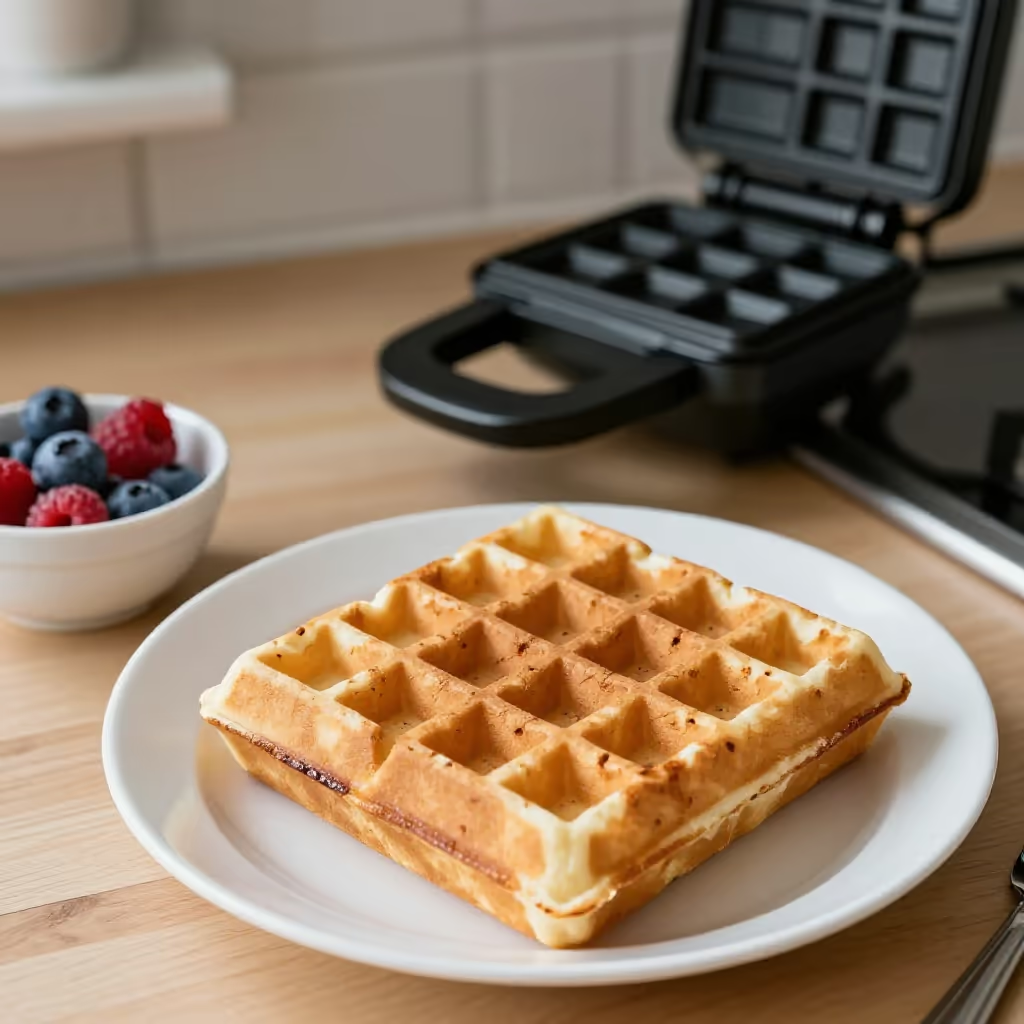
A flat, crispy pastry made from batter, baked in a special waffle iron with a characteristic pattern.
example
Auf dem Weihnachtsmarkt esse ich am liebsten eine frische Waffel mit Puderzucker.
At the Christmas market, my favorite thing to eat is a fresh waffle with powdered sugar.

Usage tips
Context clue
You can easily recognize the meaning of 'Waffel' (waffle) from the context. If it's about food, baking, or cafés, it means the pastry. In colloquial sentences about people, it is usually about the idiomatic meanings.
EXAMPLE
Ich hätte gern eine Waffel mit Sahne.
I'd like a waffle with whipped cream.
Fixed expression
The idiom 'einen an der Waffel haben' (to be nuts) is a fixed structure. The person being described as crazy is always the subject of the verb 'haben' (to have). This expression is very colloquial.
EXAMPLE
Du glaubst das wirklich? Ich glaube, du hast einen an der Waffel.
You really believe that? I think you're nuts.
Dative construction
The expression 'jemandem eine Waffel geben' (to slap someone) means to give someone a slap. The person receiving the slap is always in the dative. This expression is also colloquial.
EXAMPLE
Der Vater hat seinem unartigen Sohn eine Waffel gegeben.
The father slapped his naughty son.
Typical collocations
In a culinary context, 'Waffel' (waffle) is often combined with certain verbs and toppings. Typical phrases are 'eine Waffel backen' (to bake/make a waffle) or 'eine Waffel essen mit' (to eat a waffle with) powdered sugar, hot cherries, or whipped cream.
EXAMPLE
Am Sonntag backen wir oft frische Waffeln.
On Sundays we often make fresh waffles.
Compare with
near_synonym
Waffel vs verrückt
crazy
'verrückt' and 'die Waffel' are connected only in a specific idiom. 'verrückt' can directly describe a person, an idea, or behavior as strange or unreasonable. 'die Waffel' normally means a waffle, but in the expression 'einen an der Waffel haben' (to be nuts), it colloquially means that someone is crazy or odd. This expression is rather mocking and not especially polite. Therefore, 'verrückt' is more flexible, while 'Waffel' in this meaning fits almost only in the fixed idiom.
Waffel
Wenn er wirklich barfuß durch den Schnee läuft, hat er doch einen an der Waffel.
If he really walks barefoot through the snow, he must be totally nuts.
verrückt
Nach der Arbeit fand Frau Yilmaz die ganze Situation ziemlich verrückt.
After work, Ms. Yilmaz found the whole situation pretty crazy.