


wie
how
Asks about the manner in which something happens or how something is done.
EXAMPLE
Wie hast du dieses Problem gelöst?
How did you solve this problem?
how / as
Loading your saved state.
how
Asks about the manner in which something happens or how something is done.
Wie hast du dieses Problem gelöst?
How did you solve this problem?

how much / how long
Asks about the degree, extent, or amount of something.
Wie lange müssen wir noch warten?
How much longer do we have to wait?

as
Introduces a comparison and means “in the same way or manner as.”
Sie singt wie ihre Mutter.
She sings like her mother.

just as
Connects two details that are equal or similar in a particular respect.
Mach es so, wie ich es dir gezeigt habe.
Do it just as I showed you.

how
Expresses a particularly high or strong degree in an exclamation.
Wie schön dieser Ausblick ist!
How beautiful this view is!

however
Expresses that a particular manner, circumstance, or decision does not play a decisive role.
Wie auch immer du dich entscheidest, ich unterstütze dich.
However you decide, I will support you.
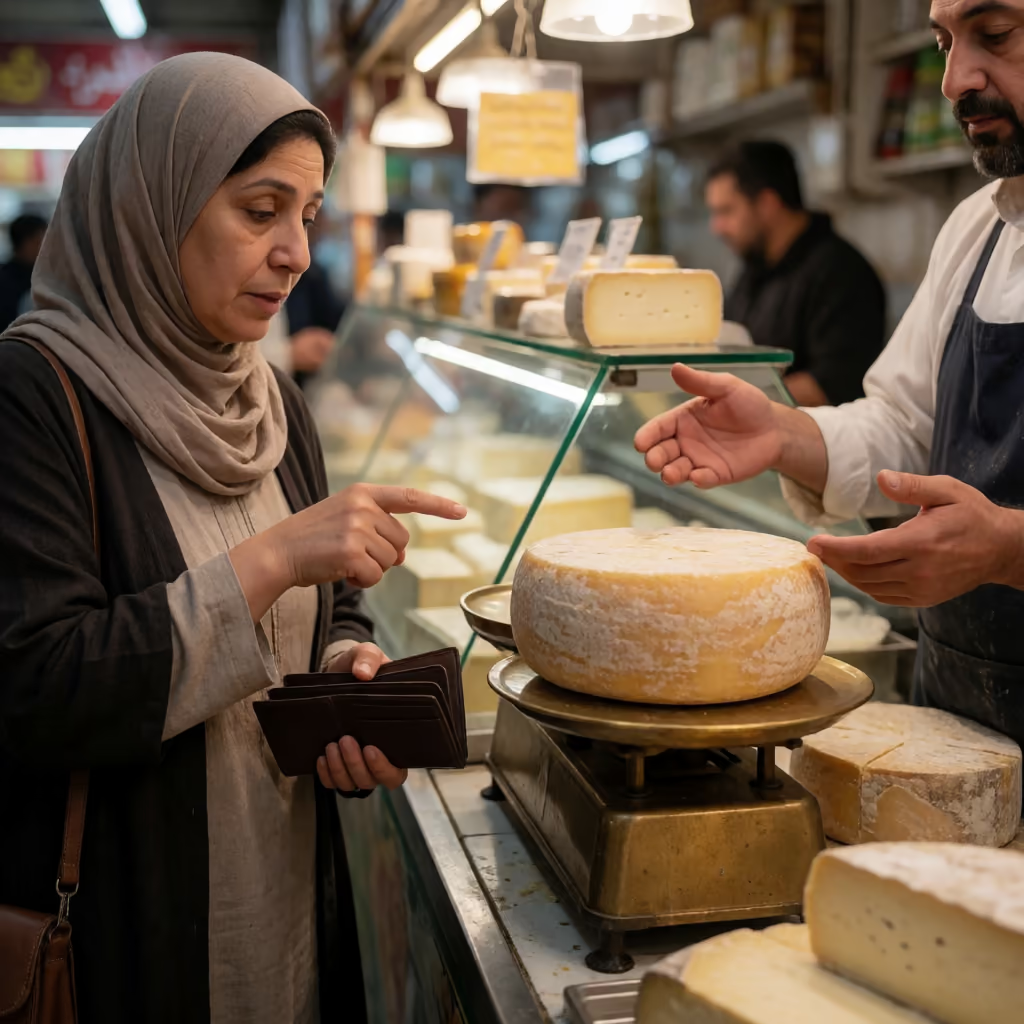
how much
Asks about the amount or price of something that is not counted, but considered in terms of measure or extent.
Wie viel Wasser soll ich in den Topf geben?
How much water should I put in the pot?

how many
Asks about the number of people or things.
Wie viele Gäste kommen zu deiner Feier?
How many guests are coming to your party?
At the beginning of a sentence, “wie” (how) often introduces a question or an exclamation. When it appears between two people, things, or actions, it usually indicates a comparison.
Wie funktioniert dieser Drucker?
How does this printer work?
In a direct question, the conjugated verb comes immediately after the part of the sentence being asked about. When the question is embedded in another sentence, the conjugated verb comes at the end of the subordinate clause.
Wie öffnet man diese Datei?
How does one open this file?
In questions about degree or extent, “wie” (how) usually comes directly before an adjective or adverb. Common combinations include “wie lange” (how long), “wie oft” (how often), “wie weit” (how far), “wie schnell” (how fast), and “wie groß” (how big).
Wie weit ist es noch bis zum Bahnhof?
How much farther is it to the train station?
After “wie” (as/like), the case of the comparison group depends on its function in the sentence. That is why the same comparison group can be in the nominative, accusative, or dative, depending on the sentence.
Paul arbeitet wie sein Bruder.
Paul works like his brother.
In the structure “so, wie” (just as), a subordinate clause often follows “wie”; a comma comes before it, and the conjugated verb goes at the end. The word “so” (so) in the main clause can refer to the manner being described.
Der Tisch soll so stehen, wie wir es gestern besprochen haben.
The table should stand just as we discussed yesterday.
In exclamations, “wie” (how) comes directly before the emphasized adjective or adverb. The conjugated verb often comes at the end of the sentence, and “wie” is strongly stressed in speech.
Wie schnell die Zeit vergangen ist!
How quickly time has passed!
In “wie auch immer” (however), “auch” (also) and “immer” (ever/always) always follow “wie” (how). If a subordinate clause follows, its conjugated verb goes at the end; a following main clause is usually separated by a comma.
Wie auch immer das Gespräch endet, wir bleiben höflich.
However the conversation ends, we will remain polite.
“Wie viel” (how much) is often used with substances, amounts of money, time, and abstract quantities. Typical combinations include “wie viel Geld” (how much money), “wie viel Zeit” (how much time), “wie viel Platz” (how much space), and “wie viel Erfahrung” (how much experience).
Wie viel Zeit brauchst du für die Aufgabe?
How much time do you need for the task?
“Wie viele” (how many) is normally followed by a countable plural noun. When this phrase is the subject, the verb is also in the plural.
Wie viele Seiten fehlen noch?
How many pages are still missing?
than / when / as
„Als“ follows a comparative and compares different degrees. „Wie“ expresses equality or similarity, often together with „so“ or „genauso“. Therefore, use größer als (bigger than), but genauso groß wie (just as big as).

Der blaue Bus ist genauso schnell wie der rote Bus.
The blue bus is just as fast as the red bus.
Der blaue Bus ist schneller als der rote Bus.
The blue bus is faster than the red bus.