


würgen
to gag
To have the physical reflex of vomiting without actually throwing up; to feel the urge to vomit.
EXAMPLE
Der schreckliche Geruch ließ ihn würgen.
The terrible smell made him gag.
to gag / choke
Loading your saved state.
to gag
To have the physical reflex of vomiting without actually throwing up; to feel the urge to vomit.
Der schreckliche Geruch ließ ihn würgen.
The terrible smell made him gag.

to choke
To violently squeeze someone's throat in order to hinder or stop their breathing.
Der Täter versuchte, sein Opfer zu würgen.
The perpetrator tried to choke his victim.

to force down
To swallow something, usually food, only with great difficulty and effort.
Er war so satt, dass er den letzten Bissen kaum noch hinunterwürgen konnte.
He was so full that he could barely force down the last bite.
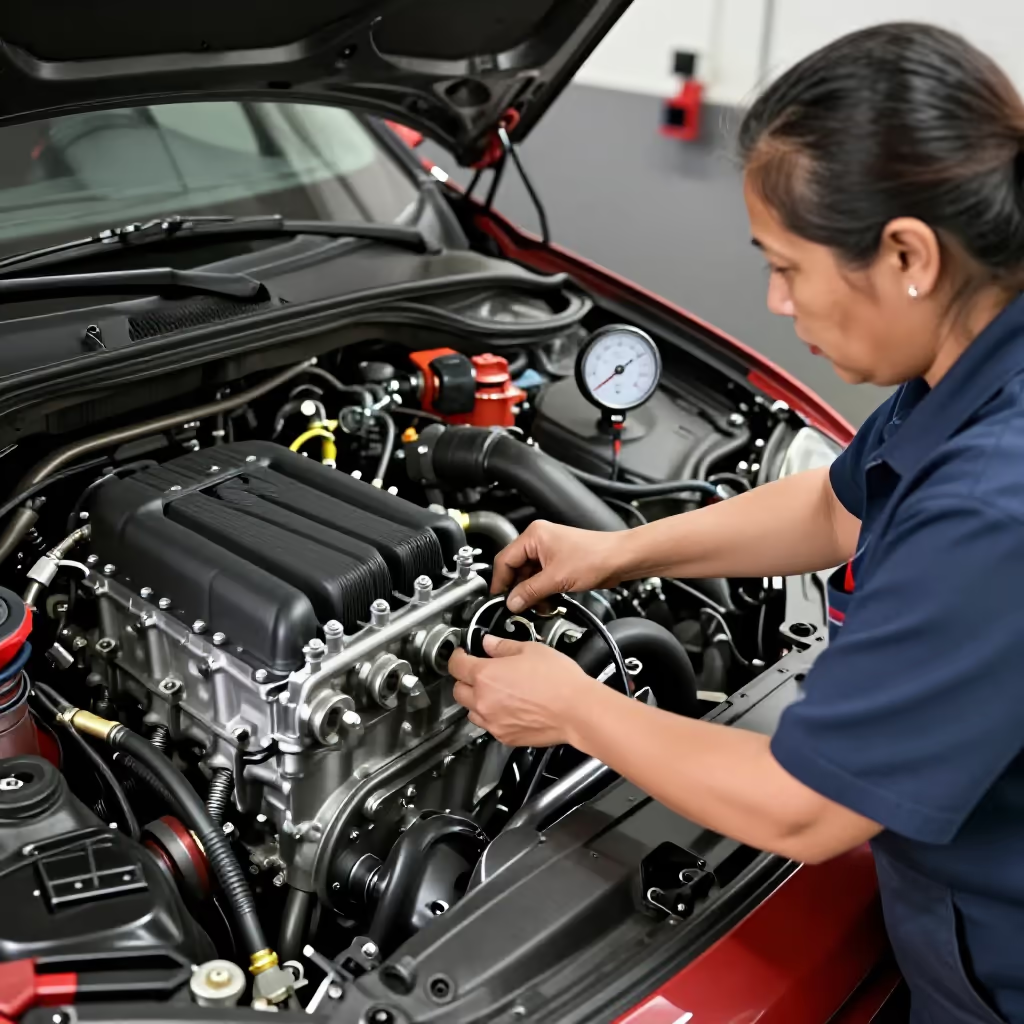
to choke / sputter
In technology, to throttle or severely restrict the flow of something, for example in an engine.
Der Motor würgte kurz, bevor er ansprang.
The engine sputtered briefly before it started.
The meaning of 'würgen' (to gag/choke) depends heavily on the sentence structure. Without an object, it usually means to gag or feel the urge to vomit. With an accusative object (a person), it means to violently grab someone by the throat.
Er musste plötzlich würgen.
He suddenly had to gag.
The meaning 'jemanden erwürgen' (to strangle someone) is very strong and is used mainly in the context of violence and crime, for example in crime novels or police reports.
Die Polizei ermittelt, weil der Täter sein Opfer gewürgt hat.
The police are investigating because the perpetrator choked his victim.
In the meaning 'etwas mit Mühe schlucken' (to swallow something with difficulty), 'würgen' (to gag/choke) is often combined with the separable prefix 'hinunter-' (down). In a main clause, 'hinunter' goes at the end.
Das trockene Brot konnte ich kaum hinunterwürgen.
I could barely force down the dry bread.
When the subject is an engine or a machine, 'würgen' (to choke/sputter) has a technical meaning. It describes the engine faltering or threatening to stall.
Wenn man die Kupplung zu schnell loslässt, würgt der Motor ab.
If you release the clutch too quickly, the engine stalls.
to reduce / to throttle
When someone forcibly squeezes another person's throat, both würgen and drosseln can be used. Würgen generally describes obstructing someone's breathing in this way; in this context, drosseln refers specifically to cutting off the air supply by applying pressure to the throat. The meanings therefore overlap considerably.

Der Angreifer würgte den Mann und behinderte dadurch seine Atmung.
The attacker choked the man, thereby obstructing his breathing.
Der Angreifer drosselte den Mann, indem er ihm fest den Hals zudrückte.
The attacker strangled the man by squeezing his throat tightly.