


das Zitat
quote
A passage taken word for word from a text or a speech by another person.
EXAMPLE
Am Anfang seines Aufsatzes verwendete er ein berühmtes Zitat von Goethe.
At the beginning of his essay, he used a famous quote by Goethe.
quote
Loading your saved state.
quote
A passage taken word for word from a text or a speech by another person.
Am Anfang seines Aufsatzes verwendete er ein berühmtes Zitat von Goethe.
At the beginning of his essay, he used a famous quote by Goethe.

quote
In finance, the official determination or listing of a price or rate, for example for a stock on the stock exchange.
Das letzte Zitat für diese Aktie lag bei 150 Euro.
The last quote for this stock was 150 euros.
'Das Zitat' (the quote) belongs to the word family of the verb 'zitieren' (to quote). A quote is the result of the action: when you quote someone, you produce a quote.
Der Professor zitiert oft aus klassischen Werken.
The professor often quotes from classic works.
The two meanings can easily be distinguished by context. If it is about authors, books, or speeches, a word-for-word quotation is meant. If it is about stocks, the stock exchange, or prices, a financial quote is meant.
Dieses Zitat von Einstein ist weltberühmt.
This quote by Einstein is world-famous.
To indicate the source of a quote, German uses the prepositions 'von' (by/from) for the person and 'aus' (from) for the work (book, film, speech).
Ich suche ein passendes Zitat von Mark Twain.
I'm looking for a suitable quote by Mark Twain.
saying / pronouncement
A Zitat is the exact reproduction of someone else’s words. An Ausspruch, by contrast, is the noteworthy statement itself, which may be well known or often quoted. An exact reproduction of a sentence is called a Zitat, while a well-known sentence by a person is an Ausspruch.
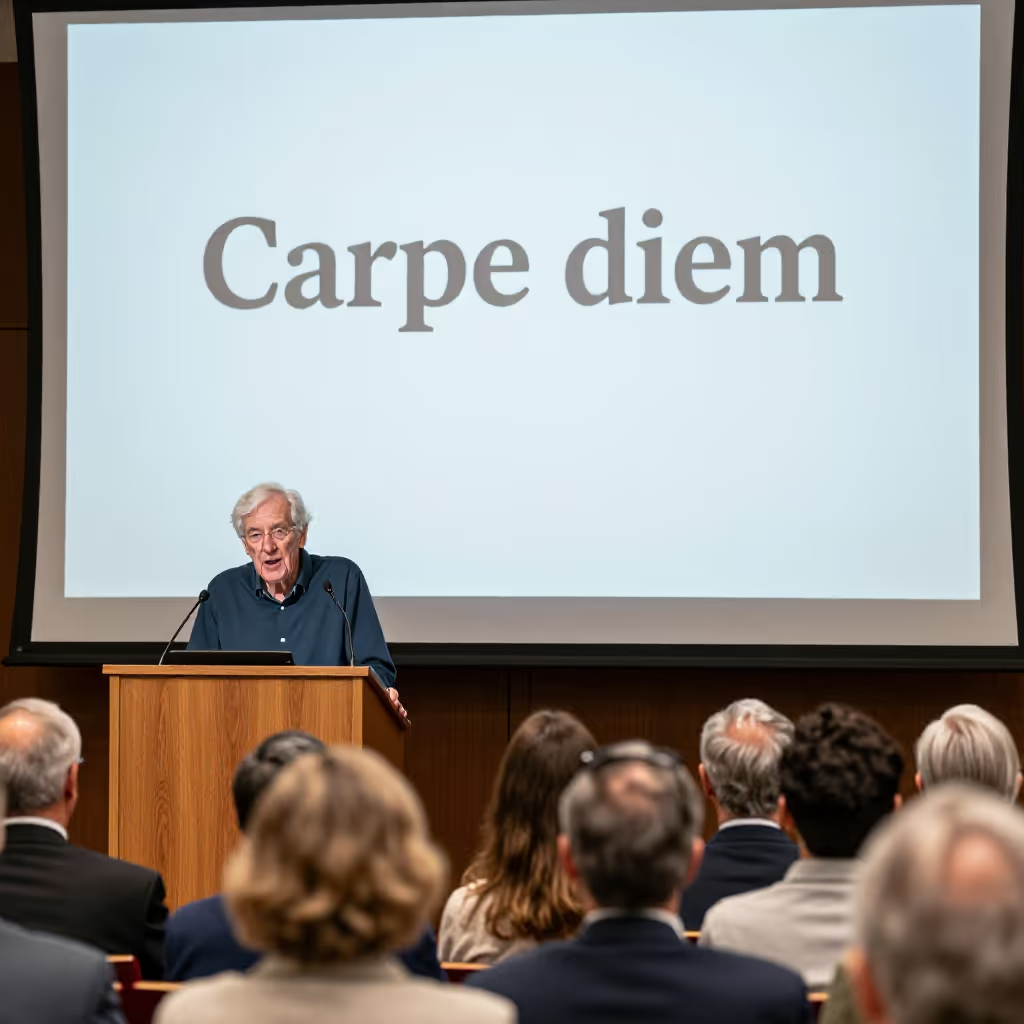
Die Zeitung gibt die Worte der Autorin unverändert als Zitat wieder.
The newspaper reproduces the author’s words unchanged as a quote.
Die Zeitung erinnert an einen bekannten Ausspruch der Autorin.
The newspaper recalls a well-known saying by the author.