


sich etwas zulegen
to get for oneself
To buy or acquire something new for oneself, usually a larger or more significant item.
EXAMPLE
Wir wollen uns nächstes Jahr ein neues Auto zulegen.
We want to get ourselves a new car next year.
to acquire / to gain
Loading your saved state.
to get for oneself
To buy or acquire something new for oneself, usually a larger or more significant item.
Wir wollen uns nächstes Jahr ein neues Auto zulegen.
We want to get ourselves a new car next year.

to gain
To increase in amount, weight, size, or speed; to become more or faster.
Im Urlaub habe ich leider zwei Kilo zugelegt.
Unfortunately, I gained two kilos while on vacation.

to add
To add something in order to strengthen or supplement something. Often refers to adding fuel to a stove or fireplace.
Kannst du bitte noch ein paar Scheite Holz in den Kamin zulegen?
Could you please add a few more logs to the fireplace?

to speed up
Colloquial for working faster or making more effort; to increase the pace.
Wir müssen zulegen, wenn wir heute noch fertig werden wollen.
We need to speed up if we still want to finish today.
'Zulegen' (to acquire / to gain) is a separable verb. The prefix 'zu' comes at the end in a main clause, but stays attached to the verb in a subordinate clause. With 'zu' + infinitive, 'zu' comes between the prefix and the verb.
Er legt sich ein neues Handy zu.
He is getting himself a new phone.
The verb consists of the prefix 'zu-' and the verb 'legen' (to lay/put). The prefix 'zu-' often expresses adding or increasing something, which can be seen in all meanings.
Sie hat im letzten Jahr an Erfahrung deutlich zugelegt.
She has gained significantly in experience over the past year.
In the meaning 'sich etwas anschaffen' (to acquire something for oneself), the verb is used reflexively with the dative and an accusative object: someone (nominative) gets themselves (dative) something (accusative).
Ich habe mir endlich einen neuen Laptop zugelegt.
I finally got myself a new laptop.
When it is about an increase, 'zulegen' (to gain/increase) is often used with the preposition 'an' + dative, for example 'an Gewicht zulegen' (to gain weight) or 'an Tempo zulegen' (to pick up speed).
Der Läufer hat auf der letzten Runde an Geschwindigkeit zugelegt.
The runner picked up speed on the final lap.
In the meaning 'schneller werden' (to get faster), 'zulegen' is often used as a command or statement and can stand without an object.
Leg mal zu, sonst verpassen wir den Bus!
Speed up, or we'll miss the bus!
to gain weight / increase
Both zunehmen and zulegen can mean that someone gains body weight. Zunehmen is the neutral, general choice, while zulegen sounds more colloquial in this use. Zunehmen is usually appropriate in an objective text, while zulegen is also natural in casual conversation.
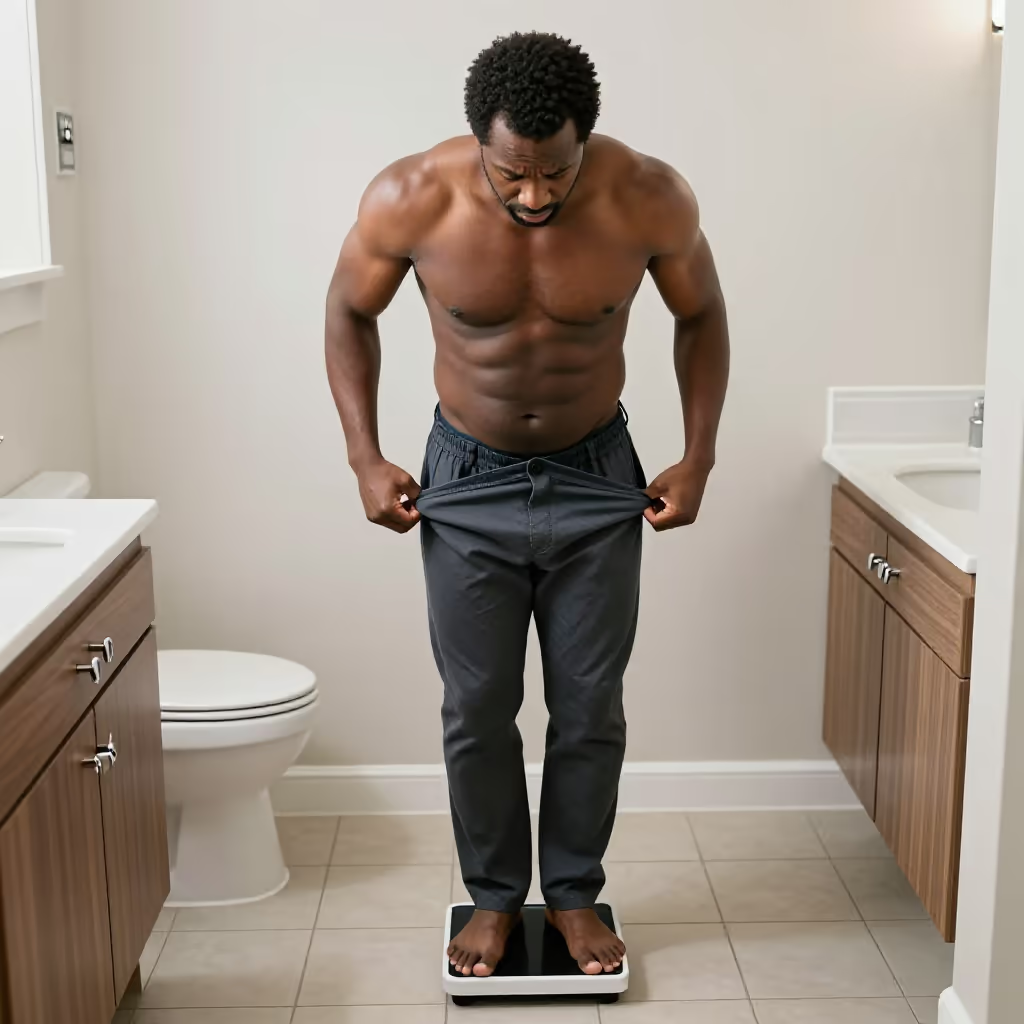
Seit den Feiertagen hat Paul ein paar Kilogramm zugelegt.
Paul has put on a few kilograms since the holidays.
Seit den Feiertagen hat Paul drei Kilogramm zugenommen.
Paul has gained three kilograms since the holidays.