To move someone or something back to an earlier place or starting position using force or pressure.
example
Die Polizei musste die neugierige Menschenmenge vom Unfallort zurückdrängen.
The police had to push back the curious crowd from the scene of the accident.

Usage tips
Separable verb
'Zurückdrängen' (to push back/curb) is a separable verb. The prefix 'zurück-' comes at the end in a main clause. In the infinitive with 'zu', 'zu' comes between the prefix and the verb.
EXAMPLE
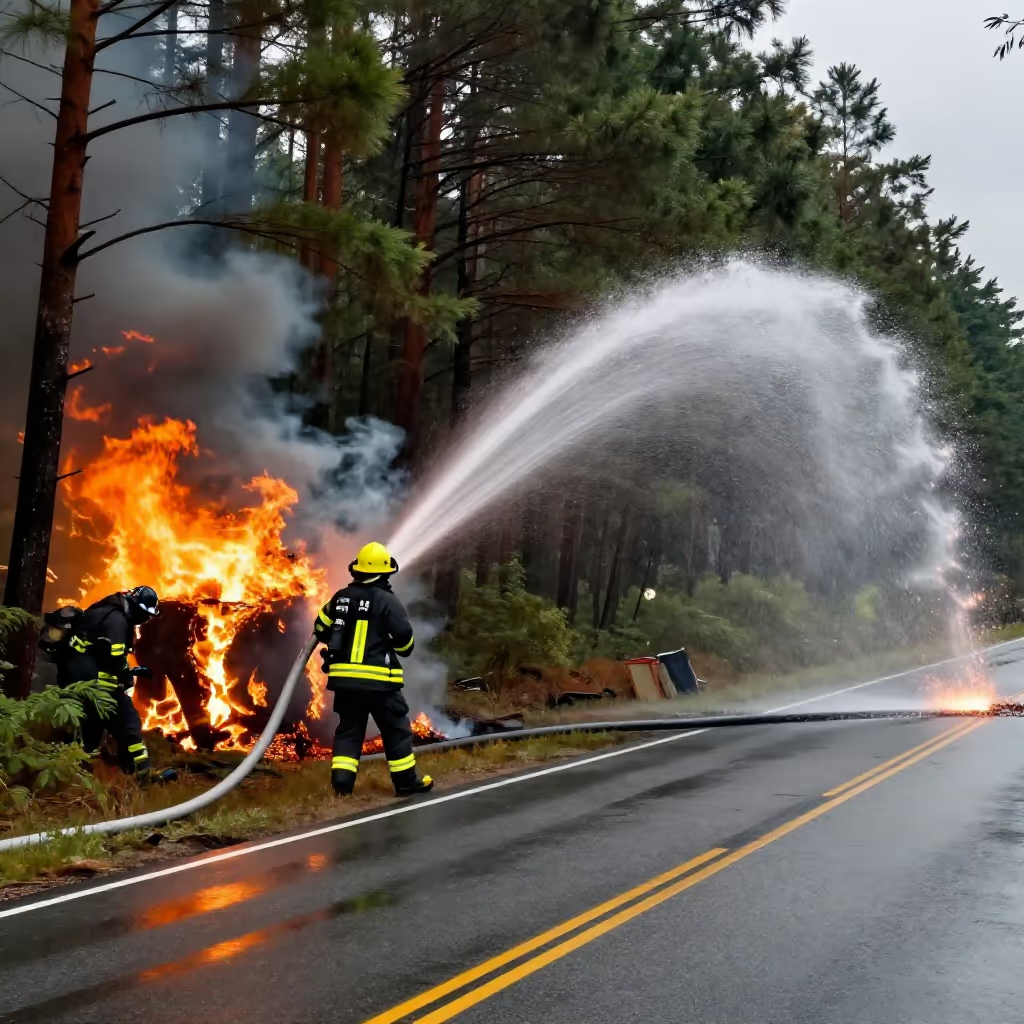
Die Feuerwehr drängte das Feuer erfolgreich zurück.
The fire department successfully pushed the fire back.
Word structure
The verb is made up of 'zurück' (back) and 'drängen' (to push, to press). Its meaning is therefore often literal: to push something or someone backward.
EXAMPLE
Die Wellen drängten das kleine Boot an die Küste zurück.
The waves pushed the small boat back toward the coast.
Context clue
The meaning depends on the object. If it is about physical things or people, such as 'Menschenmenge' (crowd) or 'Gegner' (opponent), the literal meaning is intended. With abstract concepts, such as 'Einfluss' (influence) or 'Krankheit' (disease), the figurative meaning is intended.
EXAMPLE
Die Sicherheitskräfte drängten die Fans zurück.
The security forces pushed the fans back.
Typical collocations
In the figurative meaning, 'zurückdrängen' (to curb) is often used with negative, abstract nouns. Typical examples are: 'den Einfluss zurückdrängen' (to curb influence), 'die Kriminalität zurückdrängen' (to curb crime), or 'Gefühle zurückdrängen' (to suppress feelings).
EXAMPLE
Er versuchte, seine Enttäuschung zurückzudrängen.
He tried to suppress his disappointment.
Compare with
near_synonym
zurückdrängen vs Flucht
escape / alignment
'die Flucht' and 'zurückdrängen' can both have to do with running away, retreating, or driving someone off. With 'in die Flucht schlagen' (to put to flight), you force someone to run away. 'zurückdrängen' means more specifically to move someone or something backward with force or pressure. So the difference is: with 'Flucht', the focus is on running away; with 'zurückdrängen', the focus is on force or pressure from outside. 'zurückdrängen' also fits when someone only moves back and does not fully flee.
zurückdrängen
Die Polizei drängte die Menge langsam hinter die Absperrung zurück.
The police slowly pushed the crowd back behind the barrier.
Flucht
Die lauten Hunde schlugen den Fuchs in die Flucht.