

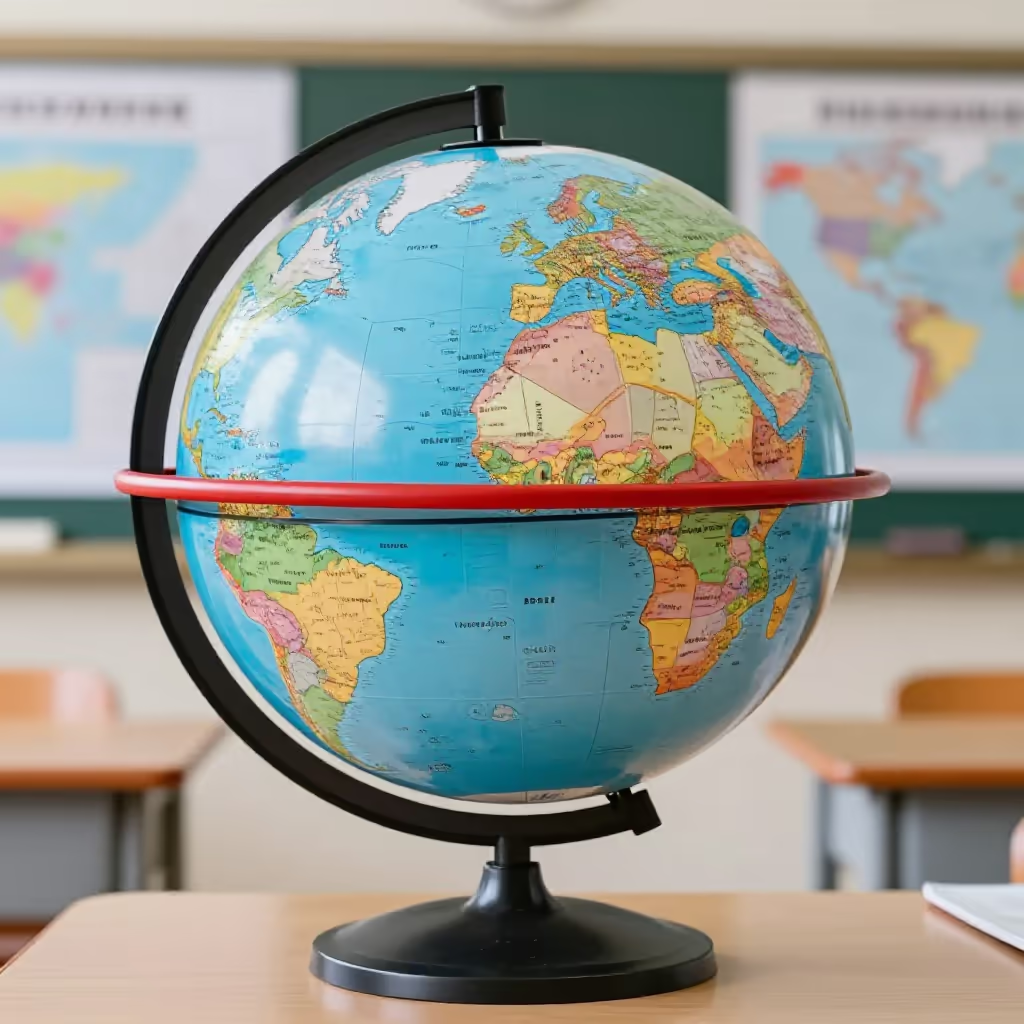
der Äquator
equator
The imaginary, longest line of latitude that divides the Earth into a northern and a southern hemisphere.
Länder, die am Äquator liegen, haben ein tropisches Klima.
Countries that lie on the equator have a tropical climate.
equator
der Äquator, die Äquatoren
Loading your saved state.

equator
The imaginary, longest line of latitude that divides the Earth into a northern and a southern hemisphere.
Länder, die am Äquator liegen, haben ein tropisches Klima.
Countries that lie on the equator have a tropical climate.
| gender | masculine der |
|---|---|
| plural | die Äquatoren |
| genitive | des Äquators |
| singular | plural | |
|---|---|---|
| nominative | der Äquator | die Äquatoren |
| accusative | den Äquator | die Äquatoren |
| dative | dem Äquator | den Äquatoren |
| genitive | des Äquators | der Äquatoren |
The article changes with the case; it is shown in colour.
To indicate a position, you use 'am Äquator' (on/at the equator). When crossing the line, you say 'den Äquator überqueren' (to cross the equator, with the accusative).
Die Stadt Quito liegt fast direkt am Äquator.
The city of Quito lies almost directly on the equator.
Location is often described relative to the equator. For this, constructions such as 'nördlich des Äquators' (north of the equator) or 'südlich vom Äquator' (south of the equator) are used.
Deutschland liegt auf der Nordhalbkugel, also nördlich des Äquators.
Germany is in the Northern Hemisphere, so north of the equator.
The adjective 'äquatorial' (equatorial) is derived from the noun 'der Äquator' (the equator). It is used to describe things that are typical of this region.
In der äquatorialen Zone gibt es oft Regenwälder.
There are often rainforests in the equatorial zone.