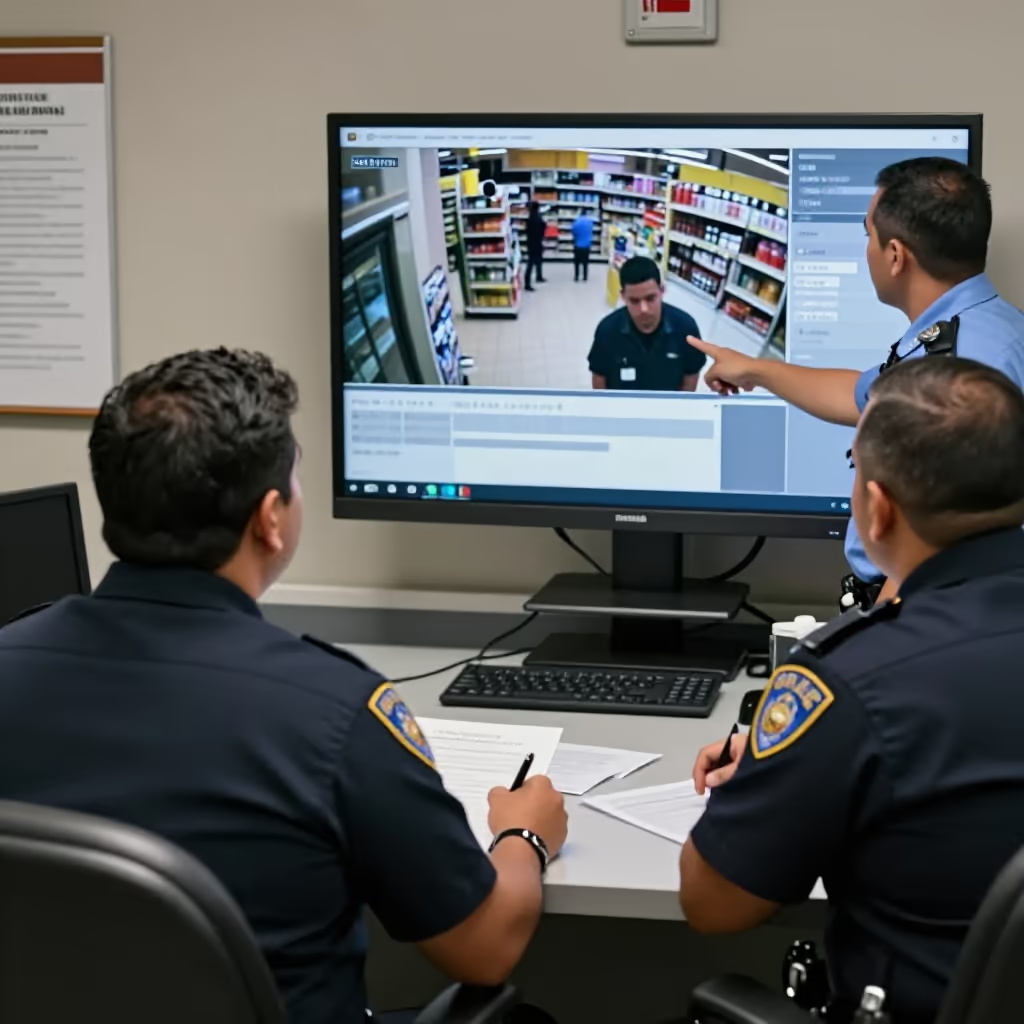
In the legal sense, proof that a person suspected of a crime was in another place at the time of the offense and therefore cannot be considered the perpetrator.
example
Der Verdächtige hatte für die Tatzeit ein wasserdichtes Alibi, das von mehreren Zeugen bestätigt wurde.
The suspect had an airtight alibi for the time of the crime, which was confirmed by several witnesses.

Usage tips
Typical verbs
The word 'Alibi' (alibi) is very often combined with the verb 'haben' (to have). Other typical phrases are 'jemandem ein Alibi geben' (to give someone an alibi / to vouch for someone) or 'sich ein Alibi verschaffen' (to get oneself an alibi / to arrange proof or a pretext).
EXAMPLE
Der Angeklagte hatte für den Tatzeitpunkt ein Alibi.
The defendant had an alibi for the time of the crime.
Context clue
You can recognize the legal meaning from contexts involving crime, police, or court. The colloquial meaning as 'Ausrede' (excuse) is used in everyday situations to justify why someone did not do something.
EXAMPLE
Die Polizei konnte sein Alibi für die Tatnacht widerlegen.
The police were able to disprove his alibi for the night of the crime.
Strong collocation
In a legal context, the adjective 'wasserdicht' (airtight) is often used to describe a complete and unchallengeable alibi. A 'wasserdichtes Alibi' (airtight alibi) is the best possible proof of absence.
EXAMPLE
Dank zweier unabhängiger Zeugen hatte sie ein wasserdichtes Alibi.
Thanks to two independent witnesses, she had an airtight alibi.
Register: Colloquial
The figurative meaning of 'Alibi' (alibi) as an excuse or pretext is typical of colloquial language. It describes a justification that is often not entirely honest.
EXAMPLE
Er nannte die Fortbildung als Grund, aber eigentlich war es nur ein Alibi für einen Kurzurlaub.
He cited the training course as the reason, but actually it was just an excuse for a short vacation.
Compare with
near_synonym · confusable
Alibi vs Beweis
proof / evidence
'der Beweis' and 'das Alibi' can both show that a statement is true. But a 'Beweis' is general: it can show that something is true in many areas, for example in court, in science, or in mathematics. An 'Alibi' is more specific. It shows that a suspect was somewhere else at the time of the crime. For that reason, an alibi is a particular type of proof. Colloquially, 'Alibi' can also mean an excuse. In that case, it is precisely not real proof, but only a reason someone gives. Learners may confuse the words because both occur in crime stories and in court. In practice: 'Beweis' is general, while 'Alibi' is especially suitable when the question is where someone was at a particular time.
Alibi
Max hatte ein Alibi, weil er zur Tatzeit im Krankenhaus war.
Max had an alibi because he was in the hospital at the time of the crime.
Beweis
Die Kameraaufnahme ist ein wichtiger Beweis für die Polizei.
The camera footage is an important piece of evidence for the police.