To act overly important, show off, or behave as if you had more authority than others. It has a negative connotation.
example
Seit seiner Beförderung spielt er sich ständig als der große Chef auf.
Since his promotion, he has constantly been putting on airs as the big boss.
Usage tips
Separable verb
'Aufspielen' is a separable verb. In a main clause, the prefix 'auf' goes at the end. In subordinate clauses and in the infinitive with 'zu', the verb stays together.
EXAMPLE
Er spielt sich immer im Büro auf.
He always puts on airs in the office.
Context clues
The three meanings can be distinguished easily: The first meaning is always reflexive ('sich aufspielen'). The second has a technical object ('Software', 'Update'). The third has to do with music ('die Band', 'zum Tanz').
EXAMPLE
Er spielt sich als Experte auf.
He puts on airs as an expert.
Reflexive use
In the meaning of 'angeben' (to show off) or 'sich wichtig machen' (to act important), the verb is always reflexive. You must use the appropriate reflexive pronoun (mich, dich, sich, uns, euch, sich).
EXAMPLE
Spiel dich nicht so auf, du bist nicht der Chef!
Don't put on airs like that; you're not the boss!
Construction with 'als'
'Sich aufspielen' (to put on airs) is very often combined with the preposition 'als' (as) and a noun. This expresses which role a person is unjustifiably claiming for themselves.
EXAMPLE
Er ist erst seit einer Woche hier und spielt sich schon als der große Kenner auf.
He has only been here for a week and is already putting on airs as the great expert.
Context: IT and technology
This meaning is typical in the field of computer technology. You install software, updates, data, or new operating systems onto a device.
EXAMPLE
Der Techniker hat die neueste Software auf alle Firmencomputer aufgespielt.
The technician installed the latest software on all company computers.
Context: music
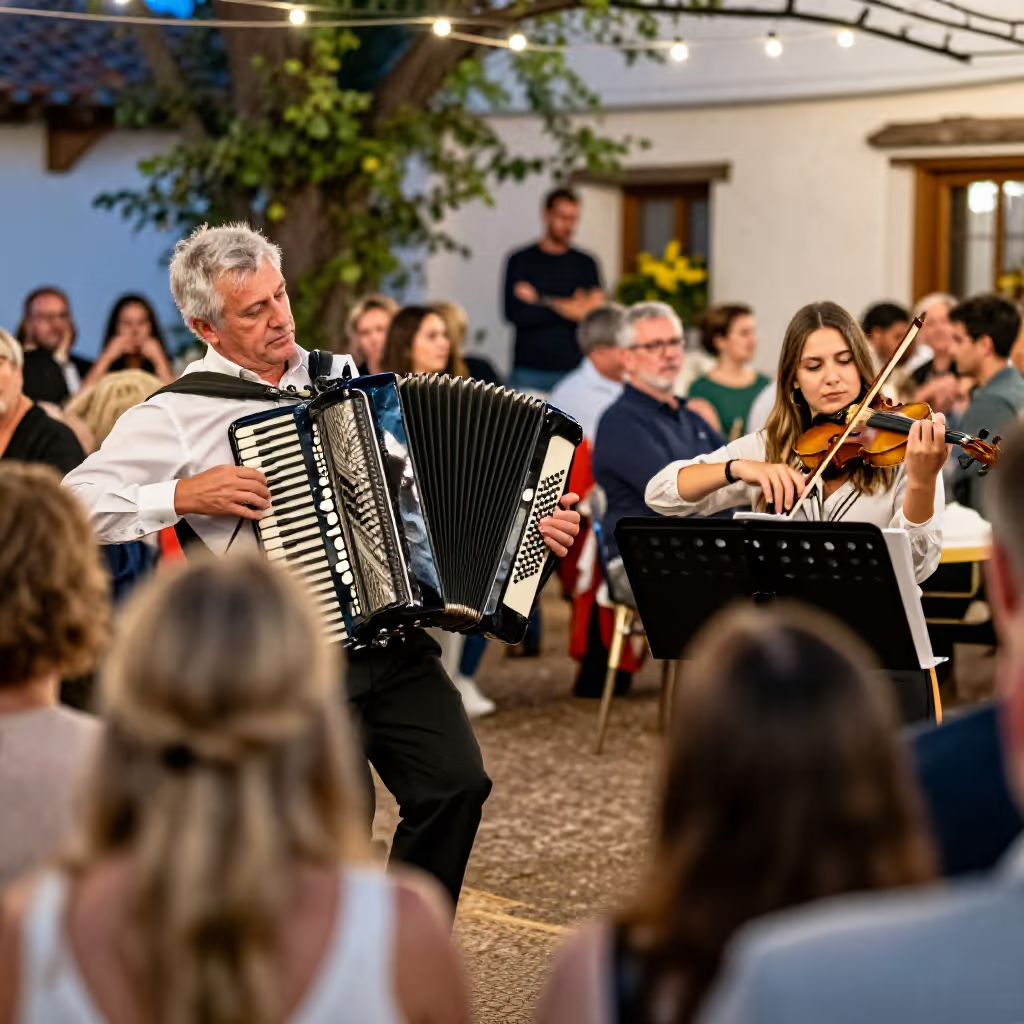
In this meaning, the subject is usually a band, an orchestra, or a musician. A very typical phrase is 'zum Tanz aufspielen' (to play for dancing), which means that the music for the dancing guests begins.
EXAMPLE
Auf dem Stadtfest spielte eine lokale Band auf.
A local band played at the town festival.
Compare with
near_synonym · confusable
aufspielen vs spielen
to play
'spielen' and 'aufspielen' can both mean that music is being made. 'spielen' is general: you play an instrument or a song. 'aufspielen' is used more when musicians start playing music at a celebration or in front of an audience. It often suggests dance music or entertainment. The words can be confused because both have to do with music. As a practical rule: a person 'spielt Geige' (plays the violin), but a band 'spielt auf' (starts playing for an audience).
aufspielen
Nach dem Essen spielte die Kapelle zum Tanz auf.
After the meal, the band played for dancing.
spielen
Im Musikzimmer spielt Mehmet ein ruhiges Lied auf dem Klavier.
In the music room, Mehmet is playing a quiet song on the piano.